Episode Transcript
[00:00:00] Speaker A: As someone who's pastored churches over the last 21 years of my adult life, I can tell you that the leadership challenges today are harder than any that I've ever experienced. In this conversation, we're going to unpack the five biggest challenges that we see facing leaders in the church today and talk about what you can do about them. Let's do this.
You're listening to the reach. Right? Podcast, the show dedicated to helping your church reach more people and grow.
Well, hey, guys, I'm Thomas.
[00:00:32] Speaker B: And I'm Ian.
[00:00:33] Speaker A: And today we are talking about how we can better navigate leadership challenges in our churches here in the 21st century. Should be a good conversation for us. I have pastored for decades of my adult life. At this point, it's kind of strange to say that in my mid forties here, but it's true. And the challenges, there's always been challenges, and I will say that they are different to today. I have only pastored in the 21st century, I guess, but they are different today than they were, I guess, even 20 years ago. So I think it should be a good conversation for us to dive into on this, Ian, and kind of talk through some of the issues we're seeing.
[00:01:11] Speaker B: Yeah, agreed. And you're right. Not only have, and I've pastored as well, not as long as you, but we've worked with churches for, my goodness, you and I both, you know, coming up close to almost two decades, I guess, definitely over 15 years. And, you know, when we first started working with churches. Yeah. We've seen these challenges change over the years, and things in the culture change just approaches that. Churches take that. Again, unique challenges. So it is good to stay fresh on these. I think that some church leaders and pastors can, you know, who've been pastoring even longer than you, Thomas, can get, maybe just become unaware or just, you know, of these modern day challenges. So maybe we'll point out some things that some pastors have not intentionally overlooked, but just overlooked, because it's just easy to kind of get into a way of doing church right. We've seen this with churches for years. They can get in the way of how they've been doing it for years and sometimes really miss the mark on addressing certain challenges.
[00:02:16] Speaker A: There used to be this, this commercial, I think it was a Febreze commercial where they talked about how it was this whole term that they coined, I believe, about becoming nose blind, where, like, you just get so used to smells that, like, you don't even notice them anymore. And then when a visitor comes over to your house or like, you know, walks through your laundry room or something like that, they're just like someone who's new to it. They are totally blown away by it. And I see this happening so much in churches is that maybe it's not nose blind, but it's, you know, church blind, where we are so used to doing things. After you've pastored somewhere for five years, even, but even more so if you've done it for 25 years or 30 years, you become church blind to the things that are maybe different or not working or some of the challenges that you're facing. So having some fresh eyes is always important. I'm, I guess, what, four or five months into my newest assignment at a church as an executive pastor at a church that I've been at for five years, but I'm an executive pastor and I'm kind of new there, and it's been great to, you know, I find myself having lots of conversations where some fresh eyes that I have have helped other people within our church. And it's been a really fun process for us, I'd say so. Anyway, hopefully this is a good conversation. Hopefully it breaks. It pulls the scales off your church blindness, I guess, maybe that you may have in some areas and should be fun to kind of talk through some of this, but. And one more point of connection, Ian, you started doing this for churches in 2006.
[00:03:47] Speaker B: Yeah.
[00:03:47] Speaker A: That's getting close here.
You're like 18 years, to be exact. You said almost.
[00:03:54] Speaker B: I said 15. I'm always rounding down to make myself nearly 20 years.
[00:04:00] Speaker A: It's time to round up on that, I think that is.
[00:04:02] Speaker B: I guess so. You're right. Nearly 20 years. It sounds good, too. It sounds better each.
[00:04:07] Speaker A: Yeah. Very, uh, very authoritative. I think you're. So.
[00:04:11] Speaker B: We've learned a lot.
[00:04:12] Speaker A: Anyway, let me start with the first challenge. It is declining attendance, and there's no way around this. The fact is that across the board, attendance at church is declining. It is more within certain kinds of churches and denominations. Obviously, we know that mainline denominations have seen the biggest decline overall. Evangelical churches have seen decline. The slowest decline has probably been in the spirit filled realm, but there still is some evidence of decline in those areas.
And it's something that I just think we have to navigate. There's lots of reasons for this, and a lot of times we're tempted just to kind of explain away the decline in numbers and say that it's for other reasons and we can't really put our fingers on it, but that's not actually helpful. And I think it's just a reality, though, that people are going to church less. I think, you know, we just go back. I shared this story, I think, on the podcast before. A few years back, my daughter had a soccer tournament and the final game was at 10:00 a.m. on Easter Sunday in the soccer.
[00:05:19] Speaker B: Oh, gosh.
[00:05:20] Speaker A: So we just like, had to like, say, you know, unfortunately, my daughter, who was an important player and a team captain and stuff, she couldn't go to that game because we had priorities. And this is such reality. I know you're living in the middle of, of sports, youth sports stuff. Right? So, but like, I've heard people say that good attendance now is, is twice a month. That's kind of like good attendance at church. And, yeah, you know, where it used to be, you know, 50 Sundays a year.
[00:05:47] Speaker B: Oh, yeah.
[00:05:47] Speaker A: Maybe something more like 25 Sundays a year is what a fully committed person is doing at your church now. Do I like this as a pastor? Absolutely not. Do I think there's growth to be had for people if they come more often than every other week? Absolutely there is. But that's just kind of the reality that we're living in here. So something you have to navigate. I don't know. Maybe you can kind of take the lead on some ideas or if you have anything else to add on the problem. But any ideas on how to navigate declining membership? Ian?
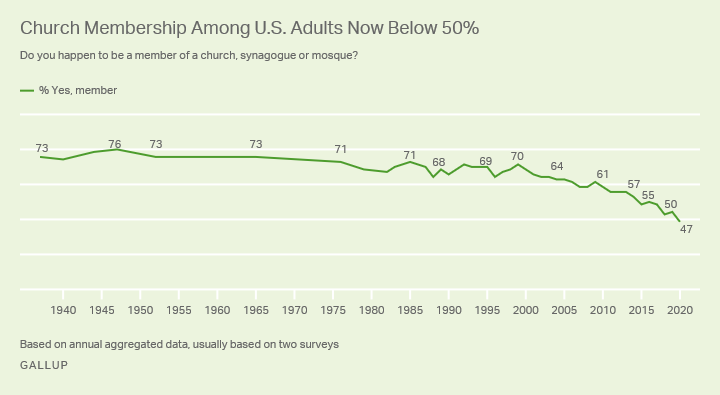
[00:06:14] Speaker B: Well, first of all, I think I still hear this to this day in communicating with so many pastors day in and day out that I do on the front lines here at reach Wright, everything still goes back to Covid. And as much as I hate to mention that this was a factor, as a matter of fact, one of the stats here in this post that people can see is, according to Gallup, church membership is below 50% as of 2020.
And it's already been, it was already been on the decline. But I still come across so many churches that, you know, have not recovered from COVID And I still, even in 2024, what is it, August 2024? Right now, even I still find myself asking, when I'm asking about church attendance and involvement, what was attendance pre Covid? It still is a relevant question. But now some churches have seen the encouraging thing, a ton of growth. And most churches, we're at a point now where everyone has returned back to in person church when I say that everyone, everyone is able. There are still some people that, since COVID only watch online, and that has been, that has been one of the things that I hear all the time is that oh, since COVID we just have so many people, they can watch so many pastors online now. They have not come back to church. That one pastor said the other day, people have just gotten lazy since then and they can just go online. But to answer that question you had, Thomas, I would say let's not make that as an excuse because one of the other things that came to mind when you were sharing that, that people are faithful if they go to, or considered faithful, or involved if they go two times a month now, is we've been measuring engagement for the last years and this is an important thing. Engagement used to just be butts and seats, right? And that is still important.
We would prefer that. Like we said, you and I are old school, I guess, but also you look at the involvement.
Is someone actively giving? Are they in a small group? Are they in a small. And we're going to jump to some of these things here in a bit. But are they in a small group? How else are they engaged other than Sunday? So begin to open your eyes and look more than just attendance on Sunday. Yes, that's important still, but there's other ways to get people engaged and involved. So there's the encouragement.
[00:08:41] Speaker A: Yeah. So I think to me, the primary way that we overcome this challenge of declining attendance, and I think for most churches it's a front door problem, just that we don't see enough visitors walking through our doors. So being really intentional about that, primarily, I think personal evangelism and teaching your people and putting the responsibility on the people of your church to invite people and win people to Jesus and those things is so important. And then there's all the methods that we help churches with here at retry of just nailing your first impressions, like websites, taking advantage of the low hanging fruit when it comes to having people see your church and encounter you that way, like that.
Be visible online, the Google grant, or people finding you when they type in churches near me, those kinds of things. We see other podcast episodes for full breakdowns on some of those ideas. But yeah, it's a problem. It's a challenge. It's something we have to address.
We can't just resign ourselves to it.
We have to remember at the same time that Jesus promises that he will be the one that builds the church.
[00:09:46] Speaker B: That's right.
[00:09:47] Speaker A: It's not necessarily all on our shoulders, right. Not even. Not necessarily. It's completely not on our shoulders.
[00:09:53] Speaker B: Yeah, that's right.
[00:09:53] Speaker A: That he invites us to partner with him, but he's the one that builds the church.
[00:09:57] Speaker B: Amen. And this next one I'm glad that I'm talking about, because I have an example of just connecting with the church, struggling with this issue that I spoke with earlier today. That's generational gaps are more of an issue in today's day and age than ever before. And I think that is because now those that have been running churches have been boomers, that generation, they are getting much older now, and some of them are, of course, passing on and. But yet still there are so many churches where that generation, or slightly younger, are you the ones making decisions? They're within boards of the church or committees that are influential. And often I'm seeing a lot of younger pastors that have come on now that struggle to get certain growth strategies past because of this big gap. And I think the gap is not only. It's not just decisions in the technology and the marketing efforts you just mentioned previously, Thomas, and pastors being able to move forward, but that gap is wider now than it was. Like we were saying when you and I first started helping churches almost two decades ago, that gap has widened now.
And I'm seeing so many churches that have been these traditionally older churches that did not address this generational gap and make efforts to reach the next generation that are all but dead. I spoke to an anglican church today. Four people left, including the pastor, and they just cannot reach anyone. But they missed. They never. He told, you know, one of the things we got onto the subject was, was they've never had a website, they never got involved in social media, they never got online. And now he feels like it's just too late. And so. So, yeah, it is a real issue. And I just touched on a couple of topics within this interracial. This generational gap issue.
[00:11:59] Speaker A: Yeah, yeah, I think that this is such a big thing for churches. Cause I know I've been in ministry long enough to know that it's so hard to break these generational gaps when you have them in your church. So my church that I'm at, it's predominantly thirties and up. So a lot of thirties and forties families, a lot of what we call them here in Hawaii is kupuna, which is senior citizens, I guess you'd say. So we have a lot of that. It's a function of where we live. It's a very. It's not a very affordable area. So if you're at 20 something, it's hard to get a young family started in the part of the country that we live in here on East Honolulu, where my church is. But it is something that is so hard to break because you watch this, a 21 year old that walks into our church. Yeah, there's ten other people in their twenties or something like that, maybe 20 of them. But it's not kind of the, it's not the primary thrust of the people. You don't look around and see that everybody looks like you if you're at that age. And I hear this so often with churches struggling to reach young families where they have an older congregation and they don't really have enough kids to make a vibrant kids program.
[00:13:17] Speaker B: Right.
[00:13:18] Speaker A: And so when a family comes in with kids that they would love to embrace and bring in, it's just something hard to appeal to them. So there are a lot of these kinds of generational gaps that, that we do see kind of coming up there. I guess the advice on this is that intentionality, like you just have to be really intentional. You were talking about how it's hard. And they kind of had never, this church had never done social media or websites. It reminds me kind of like we get to this certain place in our lives. I found that where we want to say, you know, I learned this stuff from before, I'm not going to learn this new stuff. I think like the generation before us, some of them did that with computers, just kind of resign themselves like, nah, this whole computer thing isn't for me. Maybe some of us are like that with phones.
I know that my grandparents were that way with VCR's and that's why it was flashing twelve and they never knew how to, never figure out how to set those kinds of things. I know my generation was like that with cars that, you know, two generations ago, like everybody could fix their own car and now, you know, I am and I think you probably, I could speak for you too. We're not great at it, you know, no things that we ever picked up. So. Yeah, it's just something where you have to be intentional in churches about not just saying that, you know, oh, well, I'm not going to learn this new thing or I'm not going to embrace, you know, I'm seeing it so much with TikTok, right? Like we had like the older generation just dismissed it. Like, ah, you know, our church wants nothing to do with these dance videos I keep seeing out there, but we almost, we, you know, if you're getting on it now, you're kind of getting on it after the big opportunity has kind of, it's at the end of its time here basically. So. Yeah, the, the point is though, never, if you ever hear yourself saying that, like, we missed the boat on this or I don't have the time to learn these new things. That's a sign that kind of. That generational complacency. Yeah. Has crept in and it's going to lead to these generational gaps you have in your church there.
[00:15:08] Speaker B: Yeah. It's going to lead to churches dying, too. Yeah, unfortunately. So. But.
[00:15:12] Speaker A: All right, next challenge is social justice issues. My goodness. This is one that I'm even, like, nervous to talk about it on this podcast where nobody will judge us for what we say. I don't think maybe you will. So if you judge us, please let me know down in the comments your judgment. That would be great.
I've taken a few approaches on this. I have pastored in Madison, Wisconsin, which is a blue circle in the middle of a red ish state. I pastored in suburbs of Austin, Texas. So a red area where you live in a red area in a red state right next to a big blue city. Now, I pastor in Honolulu, Hawaii. So a. I'd say it's a blue state, but it's still culturally pretty conservative in a lot of ways here. So, you know, I've been in places where social justice justice issues really are advantageous to talk about them, and I've been in places where they're disadvantageous talk.
[00:16:11] Speaker B: Right.
[00:16:12] Speaker A: I've tried approaches where you just ignore them, and that didn't work very well. And I've tried approaches where you talk about them and then it gets you into trouble. So, you know, the answer to this, I think, is that if I could give you any advice, as someone who's, I think, navigated some of these things pretty well. I lived in Madison when, you know, riots had windows. Right. Like windows directly beside our church were being broken during some of the riots and racial things that were happening a few summers ago. So I've lived through a lot of these things. And so I think giving people context in your churches on how to navigate these conversations is what's important. And letting people take that context and allowing the Holy Spirit and his conviction to rise up in them and speak to what does the action I'm to take actually look like as a result of this? So I do not think it's probably healthy in most cases. And maybe you could make a case that I'm in a super liberal area or a super conservative area. So I want to preach that. I don't really, I don't go that way, but, you know, maybe you could make a case for that. But I think kind of remaining neutral as a church, but giving people biblical context to handle their social justice challenges that they're facing, I think, is really important. Our church is about to go through a series. We're going to talk about LGBTQ issues and abortion issues and gender identity issues and these kinds of things. And so we're right in the middle of planning this and going headlong into this conversation, and we're prayerfully doing that. But I think it's something that you cannot avoid. But the solution is giving context, I think, for it. So what do you think, Ian?
[00:18:01] Speaker B: I completely agree. I think that that's what makes it easier to deal with is just steering everything towards what God's word says and towards an issue. You know, instead of making it about how you, as the pastor, feel across the pulpit or just even, like you said, if you're in a red area or you're a blue area, you make it all about that. Well, then you. You know, you're. You're going to leave out certain people and what they value and at least giving them the opportunity to know what God would say about certain social justice issues, according to his word. So, nothing much to add. I think that's when my church does this effectively. That's exactly what we do. It's not something that we always address, but it happens during key times and things that we see in the news. And as a part of a large church, which we. I'm a part of a very large, mega sized church that is also a different dynamic. And I don't think this is. This is still the same issue for a small, medium, and large sized church. But when you have a certain amount of people and a certain amount of tension, it can be easier to. Trickier to navigate through, but it's always easier when you steer it towards the gospel, and that's what I've seen my church do well. So. Agreed. Next one. Mental health awareness. Another big one these days, because of just modern day science, technology and everything and just the culture we're in today, it's been brought to the surface how many more people?
I think everyone has always struggled with things like anxiety and depression and. And there's. Mental disorders have been around, but they're being more brought to the surface and identified in this day and age. And I think because the day and age we live in and the things that we deal with, social justice issues and everything else that we've been talking about, this has become more of an issue. And it is something that in the past, a lot of churches probably have not addressed head on. And again, just like we said, for social justice issues, I think context and what God has to say about depression and anxiety, because those things are outlined in the Bible as well. That's always important, but we need to be moved past the just. The problem is you don't have the joy of the Lord in your life. You know, we have to identify and really care for folks going through this, because it is keeping some people paralyzed, keeping them from not only attending church, but being involved in church.
Yeah. And if we can find a way to address this issue and help these folks, that's gonna be a big success.
[00:20:39] Speaker A: Now, I don't have the stat in front of me, but I remember thinking, this is off the charts. The number of people that have a diagnosed mental health condition in our country, it's really something that.
It's mind boggling how high it is. I think it's actually an enormous evangelism opportunity for us because it's so top of mind aware for so many people right now. They're thinking about this, or everybody has someone in their life that has someone with a mental, that knows someone that has a mental health condition of some kind, whether it be they're going through depression, or they lost someone to suicide, or someone that has adhd or anxiety, whatever it would be. If it's not them themselves, they have people in their lives going through it. So they're looking for resources, tools, support groups, these kinds of opportunities to process some of this, whether they are the ones suffering from mental health conditions or family members or loved ones are. It's something that touches everybody. And I think your church speaking to it and giving context again, and what scripture would teach on these things, and giving a support network, I think, really goes a long way. So, yeah, huge opportunity, I think, for churches. Last one is balancing tradition and innovation.
This is one that I think has been a constant of all of these. This has been something that has been a challenge throughout our entire time in ministry. I'd say, ian, back when we first started helping churches, like we said at the beginning of the episode, back in 2006, for you, doing some of this kind of work, 2007, for me, that was a conversation. Every church was happening. They were doing traditional worship. They had a movement that wanted to do contemporary worship. A lot of them arrived at some kind of a blended worship thing. So.
And I imagine we hear that less. I don't talk as much to people in that stage of the process as much as you do, Ian. Like you hear that less than you did 15 years ago. Or 18 years ago, I guess. Is that true?
[00:22:33] Speaker B: Most certainly. I hear it less, but I still hear it pretty often. It still is a challenge, still something that a lot of pastors are dealing with and, and, you know, the older folks who hold the purse strings, so to speak, wanting to have it their way and doing it their way, and a lot of pastors afraid to deviate from that and do fresh, innovative things. But, yeah, you reminded me when I first started working with churches and websites were a brand new thing. You know, there were churches that have just done things traditionally that thought that the www dot was the mark of the beast. And so mindsets, mindsets like that, you know, and I'm not saying anyone who's into, we're talking about tradition and innovation. If you like traditional worship, that doesn't mean you think that the Internet is the mark of the beast, but there was a time when that was something we would hear pretty regularly.
[00:23:29] Speaker A: So, yeah, so I think the one we have to navigate right now is, is AI. And. Yeah, yep, yep. And then I. There's probably some tradition and innovation questions around giving and finances, I think specifically with cryptocurrencies and some of those kinds of things. I think that that's kind of a hallmark of that debate of innovation versus tradition. Do we pass the plate at church or do we allow people to give online? That's one we kind of wrestled with. But now we're kind of getting into some of those cryptocurrency conversations, and there's just so many of these that are happening. And so with AI, I think the big challenge here is that there is a resistance, and I feel it, too, a resistance towards AI. There's so many unknowns about these kinds of things, but if you kind of resign yourself right now and say, like, I'm just not going to be an AI guy, I'll let the young kids kind of deal with that, I think that's going to be a hallmark. We'll look back on ten years from now, if not even much sooner, and say, man, we really missed the boat. And it's hard for us to catch up in these kinds of areas here. So that's kind of a tradition, and I. Tradition versus modern, uh, kind of dilemma that we're facing there. I mentioned the cryptocurrency one as well, too. I think that a lot of pastors and church leaders are resistant towards that. And I'm not here to campaign about you, you know, putting bitcoin on your church's balance sheet or anything like that, but you should probably be processing that. You know, about 20% of Americans, the statistics show, own some kind of cryptocurrency, and for a lot of them, that has appreciated in value quite a bit over the last few years. And so you're missing a big opportunity if you're not allowing people to be able to give in that kind of way at your church there. So another one of those things that I think is a kind of tradition versus innovation dilemma that churches are struggling with. So I would say in general, as much as you can and anything short of sin, pursue the innovation, because I think you'll be blessed for it. In most cases, sometimes it won't pan out, it'll be a flash in the pan. But I think some of these things, like the ones we just mentioned, I think are probably here to stay and something you probably need to wrestle with.
[00:25:37] Speaker B: At your church there agreed. Be all things to all men that you may win some.
That's it speaks of being innovator.
[00:25:44] Speaker A: Anything else to add as we wrap up? Ian?
[00:25:46] Speaker B: No, you could do this, we hope. We uncovered maybe some things church leaders and pastors weren't thinking about, maybe giving you some help and some context on how to address them. And we're always here to help in any way we can.
[00:25:58] Speaker A: Good stuff. If this has been helpful to you, it would mean a lot to me if you would hit the subscribe button down below, or you would subscribe to the podcast as a whole. If that's something that you listen to us on an audio device there. I would say this too, if you want to drop us a comment. We love responding to these kinds of comments. We promise to respond to every comment that's left at this season in our things. We probably get about 50 or so a week, and we're still able to respond to all of them. And we've kind of started actually doing some video responses, too. So this is something that we do to help give us new podcast episode ideas. So if you're running into a challenge in church leadership that you're seeing, we'd probably love to hear what you're dealing with, and maybe we could turn it into another episode. So thanks, guys, for being a part of the Reachwrite family, and we'll see you next time.
[00:26:45] Speaker B: See ya.