Expanding Reach with Church Podcasting: A Comprehensive Guide

February 22, 2024 00:23:56
Expanding Reach with Church Podcasting: A Comprehensive Guide
REACHRIGHT Podcast
Expanding Reach with Church Podcasting: A Comprehensive Guide

Feb 22 2024 | 00:23:56

/

Show Notes

In today’s digital age, connecting with our church community goes beyond traditional methods. There’s livestreaming, social media, and now a new popular form of media: podcasts. Church podcasting offers a powerful new way for your church to connect with your audience.

Through simple audio episodes shared online (just like this one!), churches can extend their message, teachings, and sense of community far beyond the physical walls of the church building. It’s an opportunity to bring sermons, discussions, and reflections directly into people’s homes, cars, and daily lives.

This guide aims to simplify the process of starting a church podcast, offering practical steps, insights, and strategies for expanding reach and fostering meaningful connections. Whether you’re tech-savvy or just starting out, the potential impact of church podcasting is vast, offering a platform for spreading messages of faith, hope, and community in an increasingly interconnected world.

Let’s jump in.

Estimated reading time: 11 minutes

What is a Church Podcast?

What is a Church Podcast?

Church podcasting involves sharing audio recordings of religious content, discussions, and sermons online for people to listen to at their convenience.

By embracing podcasting, your church can adapt to the changing landscape of communication, meeting people where they are. Whether they’re commuting, exercising, or relaxing at home, they can be listening to a podcast.

Sermon Podcast Episodes

One common type of church podcast is the sermon podcast. This involves recording sermons delivered during church services and making them available for download or streaming.

Sermon podcasts allow people who may not be able to attend in person to still benefit from the teachings and messages shared by the church community. Sermon podcasts have been around in various forms for many years, and they’ve proven to be invaluable assets for people who are busy but want to grow deeper in their relationship with God.

Other Podcast Episodes

Sermons don’t have to be the only episodes you release as podcasts. You can podcast about anything related to church and church culture! There are Christian podcasts diving deep into books of the Bible, discussing controversial questions, or answering fan questions using a Biblical foundation.

Really anything you can talk about, you can record as a church podcast episode. We at Reachright aren’t a church, but we do a podcast every week to help churches with all kinds of ministry-related stuff. Maybe you can do something similar!

Expanded Reach with Podcasts

Church podcasting opens up new opportunities for engagement, outreach, and community building, allowing churches to connect with individuals who may not have otherwise been able to participate in their services or events. It’s a modern way to share timeless teachings and foster spiritual growth in an increasingly digital world.

According to Edison Research, podcast listening has skyrocketed in the past few years. In 2023, 42% of Americans listen to podcasts each month.
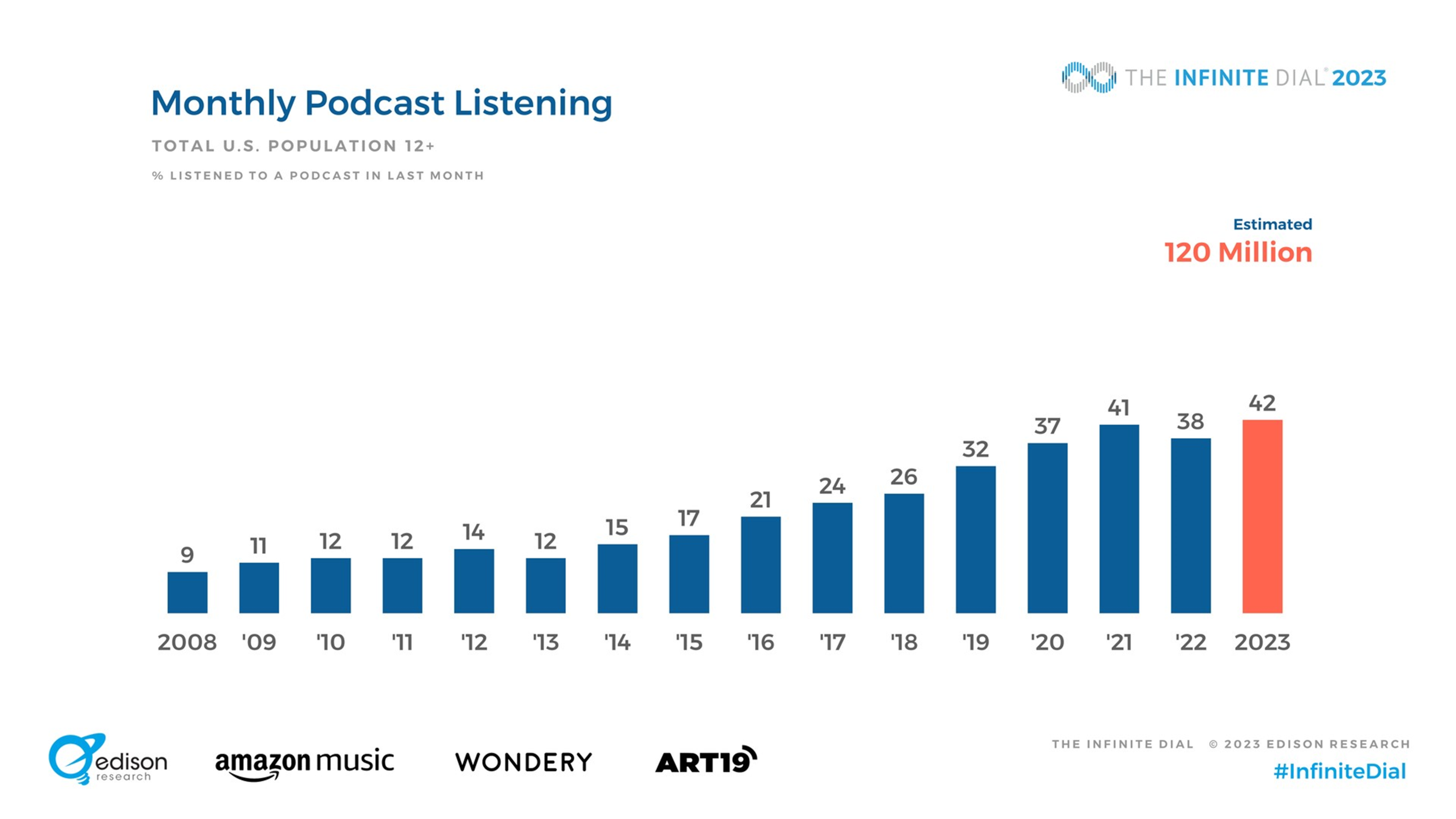
Edison Research

That’s a crazy amount of people! There is no doubt that a podcast is a great way to connect with people these days. So why not jump in on the fun?

Let’s dive into how you can get started podcasting.

Getting Started

Getting Started

Getting started with podcasting for your church is an exciting journey that can help you connect with your congregation and beyond. Here are some key steps to kick-start your church podcast:

Finding a Podcast Hosting Service

To make a church podcast accessible to a wider audience, it needs to be hosted on a podcast hosting service. These services store the audio files and provide a platform for distributing them to various podcast directories and apps, such as Apple Podcasts, Spotify, and Google Podcasts.

Podcast hosting services also offer features like analytics to track listener engagement and the ability to schedule and publish episodes.

Specifically, sermon podcast hosting platforms cater to the needs of churches and religious organizations. They often provide tools for organizing and categorizing sermons, creating podcast artwork, and customizing podcast feeds. Sermon podcast hosting platforms make it easier for churches to manage their podcast content and make it accessible to listeners across different devices and platforms.

Some popular and affordable podcast hosting services are Podbean, Acast, and Spotify for Podcasters.

Plan Your Content and Format

Decide on the type of content you want to share on your podcast. Like we mentioned in the section above, it could include sermons, Bible studies, interviews with church members, or discussions on relevant topics. Consider the format of your episodes—will they be solo recordings, interviews, or group discussions? Will there be one set host with different weekly guests, the same group of people each week, or something else?

Collaborate with your church members to brainstorm ideas and create a content calendar to stay organized. Remember to keep your episodes engaging, informative, and relevant to your audience’s interests and needs.

Integrate with Your Church Website

Once you’ve recorded and uploaded your episodes to your podcast hosting platform, integrate your podcast with your church website. Create a dedicated page or section where visitors can listen to episodes, subscribe to your podcast, and access additional resources.

Encourage your church members to subscribe, share, and leave reviews to help promote your podcast and expand its reach. Build community by inviting members to contribute ideas, share their stories, and participate in podcast episodes.

By following these steps and harnessing the power of podcasting, your church can create meaningful connections, share inspiring messages, and reach a wider audience with the love and teachings of your faith.

Building Your Podcasting Workflow

Building Your Podcasting Workflow

Building an efficient podcasting workflow is essential for creating and delivering high-quality episodes to your audience. Here are some tips on how to streamline your podcasting process.

Recording and Editing Episodes

Start by recording your podcast episodes using recording equipment such as microphones and audio interfaces. Choose a quiet and controlled environment to ensure good audio quality. If your church already has a tech/audio team (which you probably do if you have worship services), feel free to use their equipment and help.

Once recorded, edit your episodes to remove any mistakes, add music or sound effects, and improve overall clarity. Editing software like Audacity or Adobe Audition can help you refine your audio files and make them ready for publishing.

Uploading Your Podcast

After editing, upload your finished episodes to your chosen podcast host, as we described in a section earlier on. Make sure you have an account on your preferred podcast hosting service and follow their instructions to upload your episodes.

Once uploaded, your host will generate an RSS feed—a special file that contains information about your podcast and its episodes. This RSS feed is what podcast platforms use to display and distribute your episodes to listeners.

Promoting and Engaging with Your Audience

Once your episodes are live on podcast platforms like Apple Podcasts, Spotify, and Google Podcasts, it’s time to promote your podcast and engage with your audience. Share your episodes on social media, your church website, and through email newsletters to reach potential listeners.

Encourage your existing audience to subscribe, rate, and review your podcast to boost its visibility and credibility. Stay connected with your podcast listeners by responding to feedback, addressing questions, and incorporating listener suggestions into future episodes.

By establishing a clear and organized workflow, you can consistently deliver compelling podcast content to your audience and cultivate a loyal following for your church’s podcast.

6 Content Creation Strategies

6 Content Creation Strategies

Creating compelling podcast content is essential for engaging your audience and building a loyal following. Here are 6 simple yet effective strategies to help you craft engaging podcast episodes:

1. Discuss Relevant Topics and Themes

Before recording your podcast episodes, take the time to identify topics and themes that are relevant and meaningful to your audience. Consider the interests, concerns, and questions of your listeners, as well as the overarching mission and values of your church.

You can draw inspiration from current events, Bible passages, community issues, or personal experiences. By focusing on topics that resonate with your audience, you can capture their attention and keep them coming back for more. Don’t forget to include catchy episode titles that will get people excited to listen!

2. Diversify Your Content Formats

Keep your podcast content fresh and engaging by diversifying your content formats. Instead of solely delivering sermons or monologues, consider incorporating a variety of formats such as interviews, panel discussions, storytelling, and Q&A sessions.

Invite guest speakers, church members, and community leaders to share their insights and perspectives on different topics. Mixing up your content formats not only adds variety to your podcast but also caters to different learning styles and preferences among your audience.

3. Plan Engaging Episode Structures

Structure your podcast episodes in a way that keeps listeners engaged from start to finish. Begin with a captivating introduction that sets the tone and context for the episode. Clearly outline the main points or themes you’ll be discussing and maintain a logical flow throughout the episode.

Break up longer segments with transitions, anecdotes, or soundbites to maintain momentum and prevent listener fatigue. Consider ending each episode with a compelling call-to-action or reflection to encourage listener engagement and feedback.

This also includes keeping an eye on your episode length. If your podcasting hosting platform shows data that people are dropping off at a certain point in your episodes, it might mean they’re too long. Consider adapting to the analytics and adjust your episode lengths accordingly.

4. Tell Compelling Stories and Anecdotes

Tell Compelling Stories and Anecdotes

Stories have a powerful way of capturing the imagination and resonating with listeners on a personal level. Incorporate real-life stories, testimonials, and anecdotes into your podcast episodes to illustrate key points and evoke emotions.

Share personal experiences, testimonies of faith, and stories of transformation within your church community. By weaving compelling narratives into your podcast content, you can create a deeper connection with your audience and inspire them to reflect on their own lives and faith journeys.

5. Address Listener Questions and Feedback

People love to feel like they are a part of something. Create a sense of community and interactivity by addressing listener questions and feedback in your podcast episodes. Encourage listeners to submit their questions, comments, and prayer requests through email, social media, or voicemail.

Dedicate segments or entire episodes to answering listener questions, addressing common concerns, and providing practical guidance and support. When you actively engage with your audience and address their needs, you demonstrate that their voices are heard and valued.

6. Maintain Consistency and Authenticity

Consistency is key to building a loyal audience for your podcast. Establish a regular publishing schedule and stick to it to keep your listeners engaged and coming back for more. Whether you release new episodes weekly, bi-weekly, or monthly, maintain a consistent cadence that aligns with the expectations of your audience.

Additionally, stay true to your church’s values, beliefs, and personality throughout your podcast content. Be authentic, genuine, and transparent in your communication, and strive to build trust and credibility with your audience over time.

By implementing these content creation strategies, you can create podcast episodes that inspire, educate, and uplift your audience while strengthening the community within your church.

Guide to Church Podcasting

Guide to Church Podcasting

Creating engaging podcast content for your church is about connecting with your audience in meaningful ways. By identifying relevant topics, diversifying content formats, and maintaining authenticity, you can build a loyal following among your listeners.

Remember to listen to your audience, address their questions and feedback, and consistently deliver content that resonates with their interests and values. With dedication and creativity, your church podcast has the potential to really impact people. And isn’t that what it’s all about?

We wish you luck in your podcasting and God bless!

Further Resources on Church Podcasts

View Full Transcript

Episode Transcript

[00:00:00] Speaker A: Have you ever thought about doing a podcast for your church? And I'm not just talking about your sermons and delivering them the same way you would a podcast, but actually a dedicated podcast for your church, its members, and people in your community there. Well, in this episode, we're going to break down some of the tips and tricks that we've learned recording over 185 podcast episodes. Let's do this. You're listening the reach, right? Podcast. The show dedicated to helping your church reach more people and grow. Hey, guys, I'm Thomas. [00:00:34] Speaker B: And I'm Ian. [00:00:35] Speaker A: And today we are talking about church podcasting, whether churches should do it, and if you decide to take the leap, we have six tips that we want to share with you. Having done 180 some od episodes of this podcast now, I think we could say that we've become. I guess, I don't know. I don't know if I'd use the word experts on it just yet, but we definitely have some experience in doing podcasting, and both of us have experience in churches. And while we haven't done a church centric podcast, we do a podcast for pastors and church leaders. And it's a little bit of a different audience, but we want to share some of the things we've picked up with you over the three years now, over three years that we've been doing this here. So it's flown by, hasn't it, Ian. [00:01:20] Speaker B: Has flown by 180 seems crazy. Yeah, it's a blur. But it's good. If we look back at some of our first podcasts compared to now, we have got some experience, and there's a better difference. [00:01:35] Speaker A: Yeah, we've learned quite a bit on the road here with this. But let's start off by talking a little bit about what we're talking about. When we talk about a church podcast, what do we mean by that? When we first started doing podcasts, I think for a lot of churches, when you think about a podcast, you think about just a way of putting out your church's sermon, which there's nothing wrong with that. I think that's a good avenue to do that. You can use really, what podcasting is. I think people have these ideas when they think about it, but it really is just the method of delivering content to people in a way that automatically goes on to their devices there. Podcasting was an apple specific term originally, and it's become much more broad than that. But it doesn't mean necessarily that you do interviews or you do some kind of format. There's all kinds of formats. There's all kinds of podcasts out there. There's nothing wrong with a sermon podcast where you would take your church's weekly sermon and put it on there. There's a few things you can do to make that more engaging, I would think. But in this conversation, we want to talk a little bit more about churches that want to consider taking a step beyond that, just repurposing your sermons. Again, good to do. But this is if you want to take the next step on that and actually create a new form of content for your church, a new piece of content every week. So before we get any further into it, I want to warn you that it's not for the faint of heart. The average podcast is like, quit after four or five episodes, right? So typically people, I mean, I can't tell you how many times I've heard people say, oh, I'm going to start a podcast. They do a podcast, they record it a few times, and then they give up. And we knew that was something that we would have to watch out for when we started this, Ian, and so we said, we're going to do this for the long haul. We're going to try it for at least we decided, we said when we started, yeah, we were going to do it every single week, and we'll talk more about this as we get going. But it is something that you need to count the cost before you do it. So if you're in this place right now and you're watching this video or listening to this podcast episode, because you're kind of testing the waters to see if you want to do a church podcast, well, my caution to you is to truly count the cost and commit to doing it for the long haul on a consistent interval. And if you're willing to do that, then it might make sense for you to do something like that. But it does take time and resources and energy to execute it well. So something you need to be thinking about, right? [00:04:06] Speaker B: Yeah, that is good to mention first, Thomas, because, yeah, it is something that, and again, we'll dig into more of it, but it is something that requires a lot of work and consistency. That's the first step, is deciding you're going to be in it for the long haul, not just testing the waters, because that's just a waste of time, I guess, when it all comes down to it. But, yeah, why don't we dig in and I'll kind of go over the first thing here. And this is probably a good first point to discuss because it's how to start thinking outside the box other than just repurposing your sermons or messages. When you start a church podcast, it's discuss relevant topics and themes. What does that mean when you're planning discuss relevant topics for your church, themes that make sense for your church. Every church is different. Their culture is different. They have different ministries. Their demographics of their members are different, or the demographics of the communities that they're called to reach are different. So start to brainstorm, sit down, and think about what are some relevant topics that make sense for your church. And these could, of course, vary, but they could be biblical passages or topics, or they could be community issues or just personal experiences within the church and members. So there's a lot of things to start sitting down at the table with maybe other leadership and say, hey, what are relevant topics for our church? What makes sense for us to think through? [00:05:36] Speaker A: Yeah, I think this is probably the thing that derails more podcasts than anything else. It's not the recording part, the talking about things, really. I think you and I probably find that's the easy part, is like, we get this together, and once we've kind of written out the content of what we want to say and everything, but it's generating new ideas all the time of things that would be interesting, engaging, relevant to our audience. And so here we are, 180 some episodes deep, and we feel like, in some ways, we feel like at some point, after, like 30 episodes, I think he probably said, well, we've basically talked about everything, right? We've talked about everything that we could talk about, but then you find that after a while that, well, there's new angles for everything. And then now 180 episodes deep, I think we feel like we've only just kind of scratched the surface of things that we could do deeper on so many different topics. And with the comments and as our audience has grown, I feel like we hear more and more from people of things they'd like to hear us talk about and different things to cover. So I will warn people that's probably the most challenging part of this, is coming up with new and fresh ideas and new angles. But I think if you take the time to really dig in and ask people from within your church kind of what are they wanting? What are they looking for? And then find new, interesting ways to engage with some of those kinds of things, I think you can cover most of that and you'll never run out of topics to talk about. Absolutely. That's good. All right, next one is diversify your content formats. So that's something that we have found something here at reachwrite that works for us. And so usually we go through some kind of a hack or something to help teach pastors how to better do some specific act of ministry or something to help them grow their church is kind of the common denominator on things. But we found kind of a content style that works well for us is just kind of this back and forth that you and I do, but it took a lot of time to get there. We played a lot with different lengths, different formats, different ways that we talk about things. But for churches, I think you have so many more broad opportunities. I think for churches, bringing people in from outside or from inside your church, but outside of just the pastor talking into a camera or into a microphone, I think that really goes a long way. It helps you with some of these other things we're going to talk about, but just getting new perspectives of different people that are authorities in their specific area and why they do what they do, and getting to the heart of some of those kinds of things, I think that really goes a long way. But, yeah, as you're starting out, especially, I think play with it. Remember, one of the good things is when you first start a podcast is nobody's really listening, and so it might feel like it's a struggle, but really that's good because you have lots of time to work out, hey, what is working, what feels right, what gets the most engagement on things, what's impacting the most lives, what's reaching the most people with the gospel. You could answer some of those kinds of questions, and that really helps you get over that hump there, I would say so, yeah, play around with a lot of formats. I don't know anything to add on that. Ian. [00:08:43] Speaker B: Yeah, as a matter of fact, you may remember a little while back, I was involved in a podcast that was being done at my church, and this specifically was a podcast that was more small groups related. So part of a large church with many groups. So we had a lot of different kinds of groups, and I had led a very, I guess, if this is the way to put it, successful small group, meaning we were seeing people commit and find Jesus and get deeper, and we had a successful thing going. So the head of our small groups ministry at our church wanted me in on the podcast to talk about how we started, and it was a struggle at first, and then how we got to the end and are thriving as a healthy small group. And so there's one of many ideas, but it was exactly what you just said, bringing someone else in, and maybe not even just someone who's a part of your church. Of course, that example I gave was me being a member of the church there. But yeah, so reminded me of that time. It was good to contribute and it felt fulfilling for me just doing ministry, to be able to share that. To share. Hey, here's what God did in our small group. Here's how we struggled at the beginning, and here's where we're at now. So, good thing. Yeah, good segue to the next one. Planning, engaging episode structures. So what do we mean by this? So we do this here again, people that watch follow our podcast, listen to our podcast. We have intros, we have ways to break up things within the podcast or episodes. Now, this takes a little bit of editing and some talent, I guess, or just some work would maybe be the way to put it in attention. But yeah, rather than just start recording and there's things that you can do at like an intro segues and then of course, watching things. Another part of this is keeping an eye on episode length. Something you and I always chuckle about, as I'm always telling you. Hey, Thomas, let's shorten this. We're going too far too long. No, but it is important in certain podcast themes or episodes. Maybe some can go a little longer than others, but maybe. Obviously, as a general rule, we try to err on the side of keeping it shorter for attention spans. [00:11:07] Speaker A: Right? Yeah, we've played with everything from 35 to 40 minutes down to eight or nine minutes. We've tried some of those style. I think we've kind of landed on these 20 minutes. Typical length is kind of our average right now. But it's not like we're not looking at a clock right now. At least I'm not. Maybe you are, Ian, you're kind of keeping an eye on how long Thomas is going with stuff here. But here's my advice to churches on this, is that you are not Joe Rogan. That's the thing you need to hear is that I think a lot of people, you know, Joe Rogan goes for like three or 4 hours. Some of his best. He his guests and what he does. And he's a very unique interviewer. And he has an enormous audience already. And there's lots of things that he has going for celebrity. [00:11:53] Speaker B: Come on, someone might listen for 2 hours perhaps. [00:11:56] Speaker A: Yeah, that's right. Should you land Rick Warren or Tim tebow, steven Furtick to come up, tim tebow to come on your show, go a little longer with that episode, right? Sure. But yeah, I think in general, I would err on the side of brevity. So I think 30 minutes is kind of a good. Under 30 minutes would be a good target for a church. Kind of like a sermon podcast. Yeah, think about that. So we've done episodes about sermon length before, and so this falls into that same camp. So, yeah, be thinking about that. But, yeah, I think people would be interested to know the structural parts that we do. So after you and I finish recording, I'll usually come back and do, like, an intro, and I'll kind of try to really nail two or three sentences that grab someone's attention. So if you're listening to this podcast, you probably already heard that at the start of this. That's something I record afterwards, and that's a piece of advice. And then you and I. Funny other anecdote is that because we turn a lot of this into reels and TikToks and YouTube shorts, is that before every episode, we record, like, eight or ten hooks for those. So, like, three second little intros to tease someone with a piece of content from this video. So there's lots of episode kind of structure, things that we do that you may not know if you're watching this or listening from the outside, but that's all stuff you need to be thinking about as you're recording your podcast there for your church. That's good, good stuff. All right, next one is to tell compelling stories and anecdotes. That's something that you and I have always talked about. I know that was something that, as pastors, that probably comes naturally to a lot of our audience, right, telling these kind of stories. But remember, if you're bringing on people that you're going to interview or guests, that may not become natural for them. I remember when you and I first started, Ian, that was even sometimes a challenge for you, is know, just kind of remembering the. You can say the point. And if our podcast was just reading off these six points that we have here today, it would be uninteresting. It would be very short. So it'd be something you'd love for that reason, at least, but it'd be short and not something that anybody would really pay attention to. So really, people are coming for the stories, for the way that we tell these kinds of things, the way that we explain that, the way that we get into it, why it makes sense, a story about how it happened to me in the past. So don't ever forget that that's the primary thing that you're doing. You may be communicating gospel truth or Bible lessons or something like that. But in the end, people come for the story, for what they're getting from it, for the entertainment in a lot of ways is the reason why they do it. So something just to keep in mind as we think about it. Yeah. [00:14:37] Speaker B: One other thing I'll add to that is if you are having a guest, or maybe it's just a church member or someone, then you want them to tell a story. Like you said, for a lot of pastors, ministry leaders, that comes natural to us. But for them it may not. So give them some guidance, maybe give them. I know that the funny thing that came to mind is sometimes when you ask someone to share a testimony, that can turn into an hour, 2 hours. So it's, instead of, hey, let's just talk about where you were before, what God did and where you're at now, and give them some structure. So one little idea, that's just one idea about a mini, but give whoever is coming on, it may not be as natural to so give them a little format or guidance on that. So next one is address Listener questions and Feedback. So once you get your podcast going, like you jokingly said, but it was true, Thomas. Like the first good chunk that we did, we didn't hear from anyone, and sometimes we still don't, but we hear from a lot more people now. And definitely you always want to address those questions, respond, and that does a lot of good things. So, first of all, we've done some of our episodes just based on feedback that we've had from our audience. Or maybe it was something that you mentioned in a podcast that prompted something you didn't think about and someone, they contributed another thought that was in addition to what your content on your podcast was. And so making sure you're always addressing those things, the listeners, the feedback, all of that. [00:16:13] Speaker A: Yeah, that's good. I'd say about 25% of feedback, for us at least, should be just categorically ignored. Right? Because you're always going to get some feedback. That's just people telling you that you're helping the devil or whatever it is, and so you're going to get some of that. If it's on the Internet, that's going to happen. We may dedicate a whole episode to reading ridiculous comments. [00:16:35] Speaker B: I'd love that. [00:16:36] Speaker A: We've got now that one we can. [00:16:37] Speaker B: Go long with, that one we can go longer with. [00:16:40] Speaker A: We do 180 of them. We don't get it that much, but at least every a couple of times a month, we'll get someone that says something that is insanely inappropriate or in offensive or funny things. And funny. [00:16:54] Speaker B: Funny, but not funny. [00:16:55] Speaker A: Yes, but I would say that this is something that one piece of advice with this is you need to solicit this. Right? So ask people, and you'll notice that we do that on every episode, that ask people to comment, ask them to respond. Ask them questions that make people want to give you feedback. Say things. Sometimes it's okay to say things that you may frame them in a way that are intentionally kind of baiting someone to respond. So I know that David, our video editor, he just finished a video that he did talking about how kids should have phones in youth group and at youth camp and those things. And we knew that while he agreed with what he was saying, don't lie about these things. But he knew that that would be something, be very controversial, that a lot of pastors and youth leaders don't think kids should have phones at anything church related. And so he knew that going in. And it's kind of like engaging. It kind of builds conversation. So don't be afraid to do some of those things. Don't be afraid to ask people to respond in certain ways. Don't make it just about clickbait, obviously, or comment bait, I guess you'd call it. But yeah, it is something you need to solicit. So, good stuff. Yeah, that's good. All right, good. Last one. And again, I'd say this is the most important. We save the best for last. Consistency and authenticity. But specifically the consistency part. That is the key. You will not succeed. And like I said in the beginning, that most podcasts, that people start them with the best intentions, they realize how much work it takes, and it stops after a few episodes, because just being consistent with this is hard to do. So count the cost. And if you get anything from this episode, here's what I would encourage you to do, is choose a schedule and commit before the Lord to sticking with that schedule for a period of no less than one year. And I don't even care what that schedule is. It doesn't really matter that much. I think that we chose weekly. I think that doing more than weekly would probably be more than what most churches could handle. But hey, if you have the capacity and you want to really push on this, I think you could do more, but I would say no less than monthly. Even monthly is not. That's really light. So if it's monthly, change what I said from committing to doing it for one year. Change it to like three years, because you need to get a consistent schedule of a few dozen episodes under your belt, I think before you're going to start to see any kind of real progress with this here. So choose it. And here's kind of just to tell you how the cheese is made. There's sometimes where that's hard to stick with the consistency. Last week, we're filming this episode three days late because I threw up my back last week and it was tempting to just say, you know what, we'll just skip a week. No big deal. But here we had to record it three days later and you were accommodating a different day. Work with that. Yeah, we changed everything around because staying with our schedule now, we're not releasing it late. We record early. This will go live on the same day that it normally goes live on things. But this is the kind of thing I'm talking about, that things are going to come up. There's going to be times where you don't want to, don't feel like can't physically record your podcast, but you need to have that level of commitment that you're going to do it, really, no matter the cost now, obviously. So there's things that can come up that take precedence over recording your church podcast. Yes. But as far as you are in control of it, make it a commitment before the Lord, like I said, that you will stay consistent with whatever schedule you commit to. I would err on the side of not doing too much. So don't say I'm going to do a daily podcast for our church. That's a lot to commit to until you've done a few dozen to know what you're getting into with that there. So that's kind of my thoughts on that. But you didn't need to add on that, Ian. [00:20:58] Speaker B: No, not much, other than just to give someone also some encouragement and an idea of how to maintain consistency is we, at first, when we started ours, we would record one a week. So every week we would sit down and do one of these. And then we started finding, hey, if we do two or three, sometimes three, most of the time we do two in one week. We don't have to record one the next week. So just kind of giving away a tip that kind of keeps us consistent. We usually will record a couple at once and post them later. So that's just one idea. If someone's thinking, hey, I do want to do it weekly, but I don't know if I can sit down every week or do it. [00:21:39] Speaker A: If your theme at your church, your podcast, is tied to this week's, message or something like that, or different, some kind of current events thing. You talk about those things, that'll be harder. But yeah, I think there's a lot have a spreadsheet. So right now, just kind of so people know to help us with consistency. Most of the year we have topics at least kind of like placeholder topics out there for most of the year. So my writing team and I, that we work together on creating kind of the flow of some of the content. So every episode we do has a whole blog post that goes with it, and our writing team and I, we do that together. And so we have all of that drawn out. So we have a plan on all of that. And we have recording dates and publishing dates. And we generally record at least one week before we actually publish the episode. Because with topics like ours, there's nothing that's really that pressing that is hot off the presses. We have to talk about it by tomorrow. And I think for most churches, that will be the same. He's the same yesterday, today, and forever. So there's not really necessarily anything that has to be, that's brand new from scripture that you're going to uncover that needs to get out today. So I would recommend probably having at least a little bit of a buffer, record four or five episodes before you launch your first one. Good. And then start churning it out there. So, yeah, that's some good advice on that. Well, good. I hope this is something that's helpful. I talk to a lot of churches that do want to have a podcast. I think they kind of wrestle with what's involved with that and what goes into it. I think for the right church, it's not for every church. I just want to put that out there. Not every church should do this. I think every church probably should deliver their sermons through podcasting methods. But to record an extra kind of a piece of content every week, it's not for everybody, and so count the cost. And if it is for you, I really hope this has been helpful to you. If it isn't for you, I hope this has been helpful also because it'll affirm that you probably shouldn't be doing this anyway. Yeah, hopefully this has been helpful. If you have any questions, like we said before, or comments or things you want to let us know, or if you're doing a church podcast that is working well, I'd love to hear about that in the comments section. Thanks, guys, for being a part of the Reachwrite family, and we'll see you next week. See ya.

Other Episodes

Episode 0

July 25, 2024 00:19:20
Episode Cover

5 Game-Changing Church Email Automation Techniques

Let’s face it: we are living in the digital age. We can communicate and connect with each other like never before. And effective communication...

Listen

Episode

July 31, 2025 00:32:05
Episode Cover

9 Things That Kill Church Growth (And What to Do Instead)

Every church wants to see more people come to know Jesus Christ. We long for fuller pews, deeper connections, and stronger impact in our...

Listen

Episode 0

March 30, 2024 00:23:27
Episode Cover

Mother’s Day Worship Service Ideas To Bless Moms

Mothers Day Service Ideas to Bless Moms Hopefully, you’re ready to celebrate one of the biggest holidays of the year for churches – Mother’s...

Listen