Episode Transcript
[00:00:00] Speaker A: TikTok is hands down one of the best opportunities for churches right now. And in this conversation, we're going to unpack seven tips that we have mined that'll help your church get the best results from TikTok. Let's do this.
You're listening to the reach, right? Podcast, the show dedicated to helping your church reach more people and grow.
Hey, guys, I'm Thomas.
[00:00:25] Speaker B: And I'm Ian.
[00:00:26] Speaker A: And today we are talking about TikTok for churches. Some strategies. We actually have seven of them that will help your TikToks reach more people.
TikTok is a platform that I think has a reputation that is in know. It's pretty accurate, but I think that it depends on who you ask. But people have different perspectives on TikTok. But I think no matter what you think of it, it is a platform where there are a lot of people to be reached by churches there. So I think it's something that every church should at least consider taking a look at. It should be a good conversation.
[00:01:02] Speaker B: I think so, because I think I talk to, of course, a ton of churches day in and day out, and a lot of them are not using it yet. And they kind of have it in mind that it's only for the younger generation. And while the younger generation is definitely most active on it, that's just not the case. You can reach many adults. And of course, churches do want to reach the next generation.
[00:01:30] Speaker A: Good thing.
I think that's a lot of people's understanding of it. It's the reputation that it has is that I've heard it, that there's different platforms for different generations. So you and I are gen Xers. We're both young gen Xers. Young tail end. I mean, you're kind of more mid Gen X. I'm more kind of like the young Gen X side, but there you go. But, yeah, so you and I are in that vein. And so our generation generally is start. We had myspace pages, but we really adopted Facebook. And some of us are pretty diehard in it.
I think, for millennials, if you had to take a guess, you'd kind of identify them with Instagram, and that's their platform that they use. And for Gen Z, you generally think that they are the ones that are on TikTok.
I've seen that. While that's the reputation that a lot of them have, I've seen lots of breaking of those rules. I don't know. Let's do it.
If you took a look at your phone and look at your screen time on each one of those apps, which one would you say you're on? The. Which, not of those, but of any.
[00:02:44] Speaker B: Social media apps, it would be probably now. Well, if we call YouTube social media, it would be YouTube, and then Facebook would be.
[00:02:55] Speaker A: So for me, it's probably YouTube and Twitter. Those are the two that I spend most time.
How? I don't know. I think YouTube is kind of. I've heard that Gen Alpha, or whatever you put after Gen Z, theirs is becoming YouTube. And I think that's partly because they grew up watching Cocoa Melon and these kinds of things on YouTube, and that platform was catered to them from a very young age, and they're the generation that's coming up there. So interesting to see how that goes going forward. But all of those rules are, I think they're good, and they kind of give you a little bit of a place on where platforms are right now. But I think that they're also very much overstated. I know my wife is on TikTok more than any other platform now.
I don't know. I think it's different. I know my son, who is my older son, who's Gen Z, and my younger son, who's Gen Alpha. They're both on YouTube more than any other platform. And so it really can go out the window with that stuff. I think my daughter is on TikTok and Instagram. And so it's all over the place. But all that to say, we actually ran into. I'll let you share it, but we ran into a stat here about the prevalence of TikTok. Why don't you hit that? Yeah.
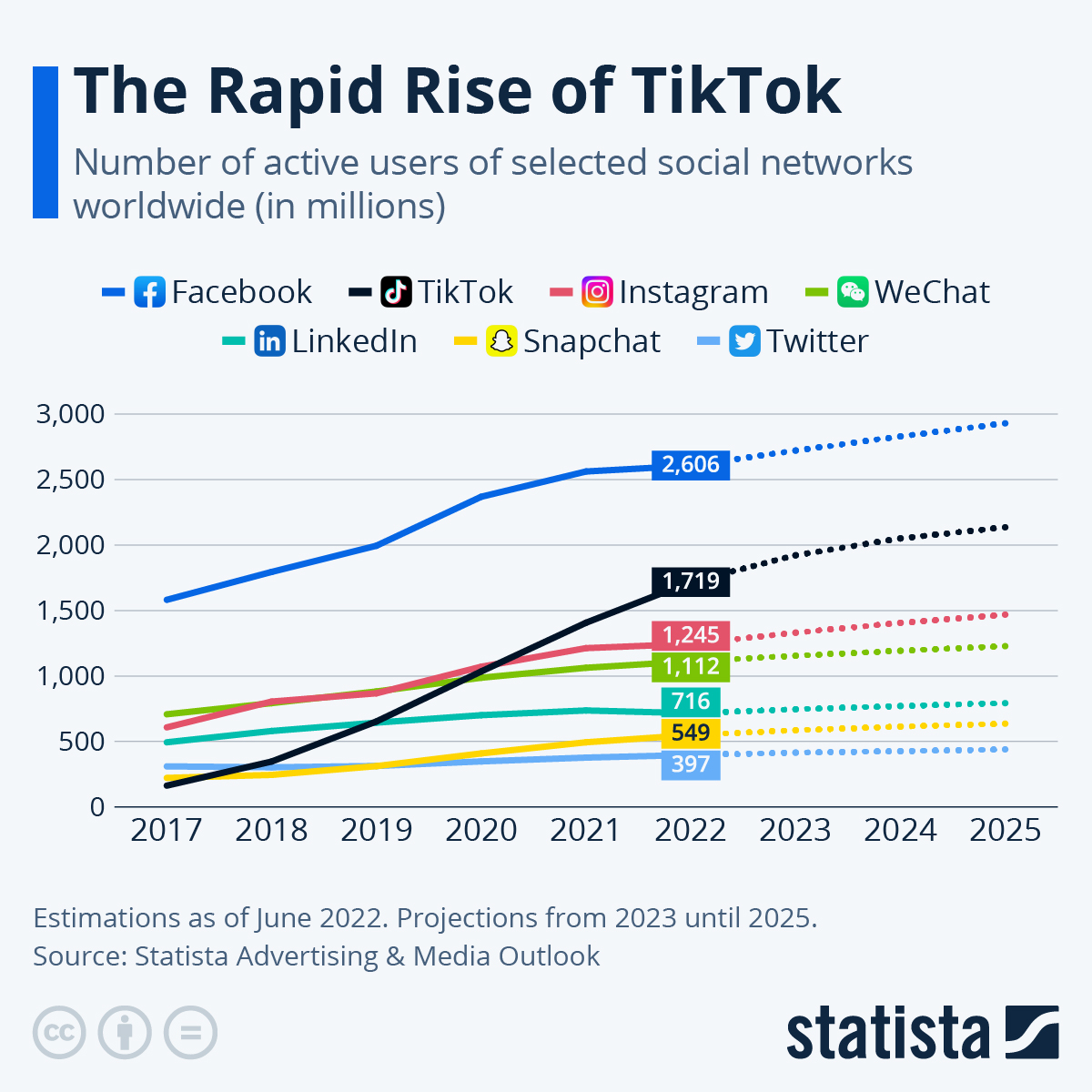
[00:04:10] Speaker B: This is from Statista advertising and media Outlook.
It was shocking to me in a big way, obviously. So as far as usage and active users, I should say Facebook still leads the charge since 2017.
But right behind that is TikTok. So Facebook has.
Well, let's see. Active. How was this done?
[00:04:39] Speaker A: Active daily users, I think, is what it was.
[00:04:41] Speaker B: Daily users is what it was. Yeah. Thank you, Thomas. So, daily users, Facebook is 26. Six. So 2606. And then we have TikTok in second with 1719. So 1719.
[00:04:58] Speaker A: I think that's billion.
[00:05:00] Speaker B: Billion. Yes.
[00:05:01] Speaker A: Goodness.
[00:05:02] Speaker B: Brain farts galore here.
[00:05:03] Speaker A: It's okay.
[00:05:04] Speaker B: All right.
[00:05:04] Speaker A: So they have 2000 users every day on Facebook. It's amazing. No, it's billions, not 2600.
[00:05:13] Speaker B: They'd be struggling. Yeah, that'd be a bad day.
[00:05:15] Speaker A: So a couple of things about that, I think that it's surprising to me. So TikTok has moved ahead of Instagram. It's ahead of Snapchat. It's ahead of Twitter. It's ahead of all the other platforms except for Facebook. Facebook has a lot more ecosystem stuff, like from groups to Facebook marketplace and all that stuff. I do think some of that data, my guess is it's skewed a little bit about what China does, because China allows TikTok but not any of the other platforms that you have on here.
[00:05:43] Speaker B: Correct.
[00:05:44] Speaker A: So they probably skew those average daily users a little bit higher for TikTok. But all that to say, it is a platform that is widely used in the United States, where we are all over the western world, really, everywhere in the world, people are using TikTok. I think that if your church is not using it, you are missing out on an enormous opportunity. And chances are, if you're using, it's not going to be that much work. I think that's the thing that people get afraid of, is that I can't do TikTok. I can't do one more thing.
If you're already doing reels or you're already doing YouTube shorts or Facebook reels or any of those things, you're doing 95% of the work, at least, of posting TikToks, because these platforms are totally fine with you cross promoting, putting the same video on all four of these platforms. So again, the big four are TikTok, Instagram reels, Facebook reels, two different platforms. You could do them at the same time, but they're two different platforms. And then YouTube shorts, really, it's the exact same kind of content. Now, you can't say that if one piece does really well on one, it'll do really well on the other, because we've seen this not be the case at all in all of our testing here. But it is something that you probably can do if you already are getting in, if you're already creating some of these kinds of short form video content pieces. Anyway, should be a good conversation for us to kind of.
[00:07:15] Speaker B: Yeah, absolutely.
[00:07:16] Speaker A: Today.
[00:07:17] Speaker B: Yeah. So we got seven of these. You want to dig in?
[00:07:19] Speaker A: I do, yeah. So the first one is that you need to make sure that your content is interactive. This is something we've seen to get better results when we make our content on their interactive. So what do we mean by this is in your content? Ask a question. So the most common thing that churches are going to do for TikTok is they're going to do repurposed sermons. They'll take that highlight moment from your sermon. Really a great strategy. It seems to work very well still. And they will put it out there. Now, the problem with that is that typically, our sermons don't have a natural call to action at that exact moment in our sermons there. So if it's kind of like that high point of your sermon when you choose it, because it's really an engaging part, you may have some kind of a next step people do in their heart or a commitment they make personally. But you're not always asking like, hey, what can you do now? And so when I say call to action, a lot of times what you're going to do is you're going to impose this on the video and just write text. Like, how will you respond? Or does this matter to you? Or asking a question that people are likely to do a comment on or hit like, or something like that to make it more interactive and build conversation. Beyond that, you want to make sure you respond like, hands down to every single comment that comes out on TikTok, especially in the beginning. So even if someone just flash, like, a couple of fire emojis or something on one of your things, do another emoji back. Respond in kind to them. So ask someone younger which emojis to use, because I don't really, I know to stay away from fruit. I know in general, you want to stay away from any kind of fruit emoji. You'll get into trouble with that. But as long as you're not sending over fruit, you're probably going to be okay.
[00:09:14] Speaker B: Fire is usually a good thing. Of course it's always good.
[00:09:17] Speaker A: I know that fire is good. Yeah, I think fire is a good thing. I'm sure you could think of bad reasons. That's good fire. But anyway, that's neither here nor there.
[00:09:26] Speaker B: Well, good.
[00:09:27] Speaker A: That's my thought.
[00:09:28] Speaker B: Well, next one is understand your audience. We already kind of said this at the beginning when talking about users on it. TikTok, the majority is a younger audience. So if that is who you're targeting, you want to tailor your content towards them. So make sure that you do that. Now, again, you'll engage millennials, some gen xers there as well. And of course, you need to know who you're targeting. Of course, we hope that every church, first, is thinking of someone who's not a member. So first of all, when we talk about targeting, try to target people that have not yet visited your church. And so that is a good strategy to have. But definitely consider topics that matter to which audience you're trying to reach. Their age, their makeup, not just age, but just their makeup, the demographics, all of that come into play. Good to think through some of those things, for sure.
[00:10:26] Speaker A: So here's the thing, too, is I think that the mistake a lot of churches make is they think their audience are church members. And in reality, your audience is going to be on at least your good ones that your good TikToks you put out there. They're going to go to a wider audience than just your church members or people that are following you. Because the algorithm and the way it works is it's taking data from who's watching this and how long they're watching it and when they're commenting and who's liking, and then it shows that to more people that they think are going to like it. So you have to remember that your audience is not church members. So TikTok is a bad platform for you to talk about announcements at your church and things that are happening.
You shouldn't be using it for that. You should be using it instead for telling stories and knowing your audience are people that are probably less familiar with your church than you think that they are. But it's a great place for you to be just sharing this kind of just general content that is approachable to everybody. So remember that and make sure that it's a better platform for internal or external discussions than internal. You don't want to make TikTok videos of your business meetings and that kind of stuff about, here's what our finances were this weekend, whatever. That's not the kind of stuff you want to cover there. And you just want to just be more aware of the fact that most people don't know that. Now, one cool thing about TikTok is it definitely has a local bent with the audience as well. So it's something that it's going to be targeting people that are right there in your community. For the most part, it'll go outside of that, but it'll give favor to people that are near your church, and that's something you can really take advantage of. So know those things about your audience as well.
[00:12:11] Speaker B: That's good. And I think that's a good segue to the next one you're going to get, because now that we're knowing our audience, what's something powerful to communicate to them?
[00:12:20] Speaker A: All right, the next one is to use the power of stories on TikTok.
It's so true that, like, a story is the best way to engage people. So if you are able to tell good stories and be able to talk about people, and I think one of the best ways for churches to do this is testimonies like getting those in there about who someone was and what God did and who they are. Now, these kinds of stories, they are naturally going to be very engaging for people and some of the best kind of content. So one piece of advice and around kind of telling stories is you really have to focus on the first 2 seconds of your TikTok. That's really where it's kind of the make or break. This is called the hook. It's what gets people to stick around on things. And if you start off your hook, like, you start off your TikToks with a story of something that's kind of engaging, like, we've done some testing on this, and we joke about this sometimes when we're recording these. But one of the best ways to start a TikTok is by saying, a guy told me recently, or I heard from this guy. And so what we do here at Reachwright, when we do this podcast, we know that we repurpose some of our podcast episodes into TikToks and reels and those things. And so right when we start every episode, we go through and we work on the hooks specifically, and we probably ought to do some outtakes of these sometime, Ian. The ridiculous things, we try to come up with that, but we try to find interesting ways to introduce things. But really, the common denominator between all of these is it's about story. It's about kind of turning something that would be otherwise kind of plain, whether it's just a stat or one of these tips, and turning it into a story about why and telling the reason behind some of these things here. So, yeah, story is one of the foundational principles of getting your TikToks to blow up.
[00:14:13] Speaker B: Well, yeah, and it's biblical, too. Right? It makes me think of testimonies.
[00:14:17] Speaker A: Right?
[00:14:17] Speaker B: Think of it that way. And when I say tell a story, I'm not saying just do testimonials on TikTok, even though you can.
It's a very powerful thing. Just like when a pastor is giving an illustration within a message and everything, it's just getting creative, and stories are engaging, and they're also, again, a common thing that's being carried out on TikTok all the time. So now that's good.
Next one is follow trends and challenges. So this is funny. I know that when TikTok first came onto the know, and it was funny, my kids, like yours, started using it more than I did Thomas. And the challenges were the things that we would hear about at first. That's what at least kind of engaged me to start thinking of TikTok and what I started hearing, the first one that comes to mind was the bucket of ice water on the head or something. Everyone was.
Yeah. And that was like one of the first ones. Right.
But trends and challenges are important. And I mean, even though we're in ministry and this is church specific, that doesn't mean you can't have fun and follow some of these trends out there and let people know you're relevant so they don't have to be sinful, negative trends or anything like that. Of course, we don't recommend that. But having good trends out there and challenges, making sure you're aware of those, that's going to really help.
[00:15:42] Speaker A: Yeah. So you'll notice there's a few things I'd mention here. So one on TikTok, there's trending sounds. So you'll see sometimes this series of videos that you notice, oh, that's all the same sound as one that I've already heard there. So that's a good one to jump on if it makes sense. You cannot really wedge the gospel into every sound, I guess, that you would see on the trending sounds. In fact, the vast majority don't make sense for churches to do. I know we try to use some of them just to build engagement on some memes and things that we put out there. We'll use some of the trending sounds to try and make that happen. So that's one idea.
I think that there's also something to be said for these formats that people do. So one that comes to mind right now, and this will kind of date this video, but I saw one, this is maybe a month ago, there was this trend where people would, two people would get together and be going for a walk or just hanging out. And they'll start out with saying, like, the one I saw was about dinks or double income, no kids. So couples that don't have kids for whatever reason, and they're talking about their lives, so they'll say, oh, we're dinks. And then they'll say, we don't have to worry about finding a babysitter to go out on a date, or we're dinks. And they'll do this format where they go back and forth and each say something about that. I could see that working great for a church where you do like, we're pastors, of course, we only work just on Sunday mornings or something. That's not true or funny in that way. Right. It's just kind of an interesting format that people will already be familiar with. And what that will do is it'll drive more engagement, more traffic and more views because people are familiar with the format and it's something, a new spin on a proven kind of strategy is what that looks like. So, yeah, I really like that idea there. So, yeah, I think the challenges and challenges and trends are a good thing to at least keep your eye on and maybe, if it makes sense, kind of run for them.
[00:17:41] Speaker B: That's good.
[00:17:42] Speaker A: Awesome. All right, number five. If you get nothing out of this episode, this is the one thing. If you get nothing else, the number five is be consistent and frequent.
Emphasis on the consistent because frequent can mean all kinds of things.
[00:17:57] Speaker B: Right.
[00:17:57] Speaker A: If I'm just getting started on TikTok and I'm a church, I probably try to make one a week. If you can just get one a week, that's probably like the floor, but commit to doing one a week. But here's the thing is, it is all always about consistency.
If you try this and say, we're going to do one a week and we're going to try it for three weeks in a row, you can expect you might get some decent results, because I've noticed that your first few TikToks, they actually kind of boost you a little bit and kind of try to get you incentivized to make more of them, right. But pretty quickly, reality sets in and you're going to get eleven views or 14 views or these kinds of things.
But if you commit to consistently putting out TikToks, putting out content on TikTok and making these posts, you will have many TikToks that you put out there that don't do much, but you will occasionally have ones that are absolute bangers, as the kids call them. Right? So you'll have ones that just absolutely blow up and do well. We had one and it was a meme that we made.
It was a joke about sound people getting attention when things go wrong on Sunday morning.
And our average TikToks, we get, I think we look at about 3000 views on an average TikTok here at reach, right? This one does like a million views on it, right? So that is what happens. It may not be a million for a church, it may be different in your circles, but you're going to do posts. When you start out, you're going to get 40 or 50 people watching each TikTok and then maybe you'll have one that does 75 or 80 and you'll have a little bit of a bounce. But if you do it consistently, and you do it for months and months at a time, one a week, you're eventually going to have one of these bangers, and it might be one that does 15,000 views or something like that, and that's where all of the gains are made. So we had a Facebook one that went off just the other day, and it did very well, and it added 50% to our number of Facebook followers in one day just because the algorithm picked it up and it just went for it. It really is incredible to see the kind of power that these things have there. But the secret sauce is being consistent.
If you cannot commit to doing this for a minimum of six months and doing it at least once a week, it's probably not something you want to venture into. But, yeah, if you're willing to be consistent, you'll get results.
[00:20:28] Speaker B: Yeah, that's good. And like many things, that's the case. So, yeah, that well said that if there was only one thing you can do, it's that consistency.
That's really the case with any social media that you do in anything, but especially with this and the nature of it. So next one, this one could be overlooked here, I think, easily with just building collaborations with TikToks, with TikTok and partnerships. So that means kind of connecting with other like minded organizations following them, and that could be other organizations that are consistent with your mission, with your values, that type of thing that make sense for your church to connect with. But these things will bring fresh perspectives, partnerships, and also send traffic back to you, right?
[00:21:21] Speaker A: Yes, absolutely.
I think that anytime you can be connecting with other people on any social platform, but specifically on TikTok, what you do is you leverage their audience with yours whenever you can do that. So there's two primary ones I could think of. So it would be other organizations in your community that'd be an obvious way to kind of partner with someone else. So if you have maybe a homeless mission that you partner with there in your community, and they happen to have a TikTok channel, if you guys make content together and do collabs, and kind of what you do is you basically double your audience if you have the same size audience there, and it introduces your audience to theirs and it introduces their audience to yours. So it's something that I think is a really big opportunity there. And then also you probably have someone in your church that is active on TikTok or makes TikToks. And so that's the person that you want to be talking to about these strategies. And chances are if they really love your church, that they would love to find ways to leverage their audience and their ticket.
[00:22:28] Speaker B: Finding a champion, as we call it. Right?
[00:22:30] Speaker A: Yeah, you find someone that knows their stuff and can help you with it, but also if they'd love to kind of share what God's doing in their lives with their audience, and your church will be the beneficiary of those kinds of things. So, yeah, encourage them to be able to talk about ways you can partner together on these kinds of things, tag them, and kind of build goodwill in that way. So pretty cool strategy.
[00:22:54] Speaker B: Absolutely. And last but not least.
[00:22:56] Speaker A: Yeah, let me hit it. It's make data driven adjustments, emphasis on the data driven. One of the great things about all these social platforms is you got lots and lots of information at your fingertips that you can use it however you see fit and make adjustments with it. So the primary thing that you're going to measure is you're going to take a look at what works on TikTok, and you're going to try to feed it more of that kind of content if you want to reach more people. So assuming the content was valuable to you and it maybe brought you more followers or got more engagement, you want to be producing more of that kind of content. So you're going to find pretty quickly that if you're doing what most churches do, you're repurposing sermon content that some content does better than others. Controversial content will always do better on TikTok.
So if you do a message on, I don't know, LGBTQ issues or even tithing or things that people have questions about or maybe have passionate opinions about, and you put out that repurposed content on there that will say, always you want to measure this and see how it does for you. But chances are it'll do well. You'll see that in the data, and you're going to figure out that, yeah, if we do more of this kind of content, we can get more views. Now, you need to weigh whether you want more controversial content out there or not, if that makes sense for your church or not. But there's going to be certain things. You're going to notice that certain parts of the sermon, when we get more into the illustration part, it does better than when we just get into the theology part or the scripture reading or those things. So you're going to want to play with these things, see what works, and try to give TikTok more of what it works. If that is moving your church forward in its goals of reaching more people with the gospel. So that's the way I think about that.
[00:24:50] Speaker B: No, that's good stuff. That's good stuff for sure. Cool.
[00:24:53] Speaker A: Anything to add as we wrap up, Ian?
[00:24:55] Speaker B: No, I mean, it's worth, like I said at the beginning of this, I come across so many churches that are just not on board with TikTok yet. And I think it's just, this is a tremendous opportunity for you to, because every church I talk to wants to engage the next generation, right? So this is your opportunity to do that. It's your opportunity to broaden your reach. And it's not so bad if you carry out these things here. And obviously your mission is to lead people to Jesus as a pastor and a ministry leader. And we feel like these are excellent strategies to take to do that and really just hope that this encouraged someone to maybe take that step. Find that champion is what I would say. Find that person within your church that can do that or get professional help with it, for sure.
[00:25:42] Speaker A: Yeah, that's good stuff. Well, that's good. I hope it's been helpful to you. If you're looking for content idea, I'm going to leave a link to a video right up here. Now you're going to see that. It's going to pop up in just a second. That is some ideas on how to make content for TikTok, some different trend ideas there. Check that out. Hit that like and subscribe button. Leave us a comment if you have any things that's working for you on TikTok. Thanks for being a part of the Reachwright family and we'll see you next time. See ya.