Boosting Sermon Engagement: 7 Innovative Techniques for Pastors

August 22, 2024 00:20:18
Boosting Sermon Engagement: 7 Innovative Techniques for Pastors
REACHRIGHT Podcast
Boosting Sermon Engagement: 7 Innovative Techniques for Pastors

Aug 22 2024 | 00:20:18

/

Show Notes

Engaging your congregation during a sermon can be a challenge for pastors, but it’s crucial for delivering a powerful message. A sermon is more than just speaking from the pulpit; it’s an opportunity to connect, inspire, and transform lives.

We all know how hard it can be to give an engaging sermon. You have to meet a certain time limit but not go too far over, you want to have the church’s attention but not be gimmick-y, you want it to be meaningful and impactful without losing the focus of your church, and so much more.

There is no tried-and-true way to give an awesome sermon that grabs and keeps everyone’s attention. In this podcast, however, we cover everything you need to know about making engaging sermons, including 7 techniques you can start implementing today.

Ready to learn more? Let’s jump in.

Estimated reading time: 11 minutes

Sermon Engagement

Sermon Engagement

Before we jump into our 7 techniques, let’s go over sermons and engagement in general. There are many reasons why it’s hard to make a sermon engaging, and knowing your obstacles can help you overcome them. We’ll also cover why you should actually care about making your sermons engaging. Finally, we’ll take a look at what an unengaging sermon is, so you know what you should avoid.

Why It’s Hard to Give Engaging Sermons

Delivering an engaging sermon can be challenging for many pastors. One reason is the diverse nature of the congregation. People come from different backgrounds, ages, and experiences, which means they may have varying interests and levels of understanding. Crafting a message that resonates with everyone can be difficult, especially when addressing complex theological concepts like being fully God and fully human.

Another challenge is the pressure to deliver a fresh and impactful message every week. Pastors must constantly seek new insights and perspectives to keep their sermons relevant and inspiring. This can be mentally and emotionally taxing, leading to burnout and a lack of creativity.

Distractions in the modern world also make it harder to keep people’s attention. With smartphones and other devices, congregants may find it difficult to focus entirely on the sermon. Many Christians also go to church in family groups, and can get distracted by their own husbands, wives, or kids. Pastors must work hard to capture and maintain their attention amidst these distractions.

Finally, pastors may struggle with balancing the delivery of God’s Word with addressing contemporary issues. Finding the right balance between biblical teachings and modern-day applications requires sensitivity and wisdom.

Why It’s Important to Engage Your Congregation

Engaging your congregation is crucial for several reasons. First, it helps ensure that the message of the word of God is understood and remembered, which is the church’s role. When people are actively involved in a sermon, they are more likely to absorb and retain the information. This understanding can lead to personal growth and transformation as individuals apply biblical principles to their lives.

Engagement also fosters a sense of community within the Christian church. When congregants feel involved and connected, they are more likely to build relationships with one another and support each other in their spiritual journeys. This sense of community reflects the way Lord Jesus loved the church, encouraging believers to love and support one another as Christ loves us. We are not meant to live two lives, one in the church and one outside of the church, we are meant to love as Christ loved.

Moreover, an engaged congregation is more likely to live out their faith actively. When people are inspired and motivated by a sermon, they are more likely to take action, whether it’s serving others, sharing their faith, or making positive changes in their own lives. This active faith can have a ripple effect, impacting families, neighborhoods, and communities.

According to Pew Research Center, most churchgoers are at the very least somewhat satisfied with the sermons at their churches.
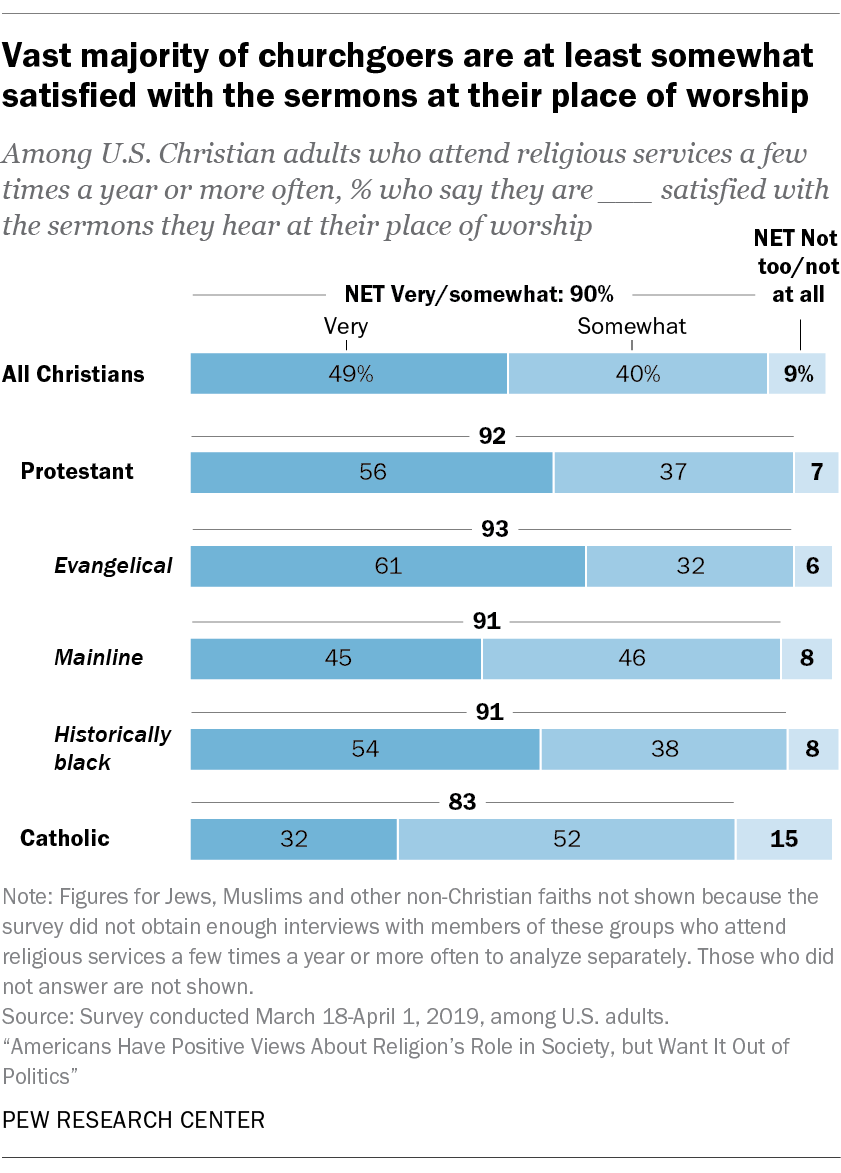
Source: Pew Research Center

What would happen to our churches and communities if most churchgoers were very satisfied with the sermons? How would that change the way they live? The people they invite to church?

What’s an Unengaging Sermon?

To know what makes an engaging sermon, you should also know what makes an unengaging sermon. A bad and unengaging sermon often lacks clarity and connection with the congregation. It may be filled with theological jargon or abstract concepts that are difficult for the average listener to understand. Instead of relating God’s Word to everyday life, it might focus on dry, academic details that fail to resonate with people’s personal experiences. Such sermons often lack a clear structure, making it hard for listeners to follow the main points or see how they relate to each other.

In an unengaging sermon, the pastor might speak in a monotone voice without enthusiasm or passion, making it difficult for the congregation to stay interested. There is often little to no interaction with the audience, leading to a passive listening experience. The use of outdated or irrelevant examples can also alienate listeners, making it hard for them to see the message’s relevance in today’s world.

Additionally, a sermon that fails to connect emotionally with the audience might lack the warmth and compassion that makes the message feel genuine and heartfelt. This disconnect can leave the congregation feeling uninspired and detached from the spiritual message.

Top 7 Techniques for Engaging Sermons

Top 7 Techniques for Engaging Sermons

And that’s everything you need to know about engaging sermons! It’s important to know what to look for and what to avoid so you can make your sermons as engaging as possible. Now, let’s go over our list of the top 7 techniques you can start implementing today to make some awesome sermons. Feel free to pick and choose these tips and figure out what works best for you!

1. Use Relatable Stories

Using relatable stories is a powerful way to engage your congregation during preaching. Stories can bridge the gap between abstract biblical concepts and real-life situations, making it easier for listeners to understand and apply God’s Word. By sharing personal experiences or anecdotes about your friends, you can create a connection with your audience. These stories should reflect common challenges or joys that people face in their daily lives, helping them see themselves in the narrative.

When listeners hear familiar scenarios, they are more likely to stay engaged and remember the message. Relatable stories can also evoke emotions, making the sermon more memorable and impactful. By weaving storytelling into your preaching, you create a dynamic and relatable experience that resonates with the congregation.

2. Ask Thought-Provoking Questions

Asking thought-provoking questions during a sermon is an effective way to engage your congregation and encourage deeper reflection on God’s Word. These questions invite listeners to think critically about their beliefs and how they apply to their lives. By posing questions that challenge assumptions or encourage introspection, you can stimulate interest and curiosity.

Questions can be used at the beginning of the sermon to introduce the topic or throughout to emphasize key points. They help create a dialogue between the preacher and the congregation, making the sermon feel more interactive. Encouraging people to consider how they would respond to certain situations or what God’s teachings mean for them personally can lead to a more meaningful and transformative experience during preaching.

3. Incorporate Visual Aids

Incorporating visual aids into your sermons can greatly enhance engagement and help convey your message more effectively. Visual aids make abstract concepts more tangible and maintain the audience’s attention. Here’s how to use them:

Visual aids make the sermon dynamic and memorable.

4. Vary Your Communication Style

Vary Your Communication Style

Varying your communication style during sermons can significantly enhance engagement by appealing to a wider range of listeners. Different people respond to different styles, so incorporating a mix of storytelling, humor, and emotional appeals can keep your audience interested. Storytelling helps convey messages in a relatable way, while humor can lighten the mood and make your preaching more enjoyable. Emotionally charged language can create a deeper connection with your congregation, inspiring them to reflect on the message.

By switching between these styles, you can maintain the congregation’s attention and ensure that your message resonates with everyone, regardless of their background or preferences. This dynamic approach keeps your preaching fresh and lively, making each sermon a unique and impactful experience.

5. Encourage Interaction

Encouraging interaction during sermons can significantly increase engagement and foster a sense of community within the congregation. When you invite the audience to participate, it makes the sermon more dynamic and personal. Asking questions and encouraging responses allows people to share their thoughts and experiences, making them feel more connected to the message. Small group discussions can also provide an opportunity for deeper reflection and sharing among members.

Interaction helps listeners process the message more effectively and see how it applies to their lives. It also allows them to build relationships with each other as they explore God’s Word together. By creating an interactive environment, you can make the sermon a collaborative experience that resonates with everyone and encourages active participation in their spiritual journey.

6. Provide Practical Applications

Providing practical applications during sermons helps listeners understand how to apply God’s Word to their daily lives. It makes the message relevant and actionable, inspiring people to live out their faith actively. Here are some ways to offer practical applications:

By providing clear and practical steps, you empower your congregation to implement the teachings in meaningful ways, creating positive change in their lives.

7. Pray for Guidance

Praying for guidance is essential for delivering a powerful and engaging sermon. Before preparing and presenting your message, seek God’s wisdom and direction through prayer. Ask for clarity and insight on how to best convey His Word to your congregation. Prayer helps you stay focused on what truly matters and ensures that your message aligns with God’s will.

By seeking divine guidance, you open yourself to the Holy Spirit’s influence, allowing Him to work through you. This spiritual connection can lead to a sermon that resonates deeply with your audience, inspiring and uplifting them. Prayer also helps you approach your preparation and delivery with humility and trust, knowing that you are supported by God’s grace. Ultimately, relying on prayer makes your sermon more authentic and impactful, reflecting your genuine desire to serve and guide your congregation effectively.

Innovating for Sermon Engagement

Innovating for Sermon Engagement

Incorporating these techniques into your sermons can transform your preaching and enhance the overall experience for your church. Using relatable stories and visual aids makes abstract concepts tangible and memorable, while varying your communication style keeps your message engaging and dynamic. Asking thought-provoking questions and encouraging interaction fosters deeper reflection and connection with God’s Word, making the sermon more interactive and relevant.

Providing practical applications empowers listeners to apply the teachings in their daily lives, leading to meaningful change. Most importantly, praying for guidance ensures that your message aligns with God’s will and reaches the hearts of your audience.

By thoughtfully integrating these strategies, you not only capture attention but also inspire and motivate your congregation. An engaging sermon fosters a sense of community, encourages personal growth, and strengthens the bond between the preacher and the congregation. Each element—stories, questions, visuals, and prayer—works together to create a powerful, transformative experience.

Embrace these techniques to enrich your preaching and make a lasting impact on those you serve, helping them to live out their faith more fully and deeply. Let us know below if there are any other techniques you’d suggest!
More Resources on Sermons

View Full Transcript

Episode Transcript

[00:00:00] Speaker A: One of the things that I am 100% against is boring sermons. So to help combat this epidemic, we have come up with seven tips that we find are helpful to make your sermons more engaging. Let's talk about them. You're listening to the Reach right? Podcast, the show dedicated to helping your church reach more people and grow well. Hey guys, I'm Thomas. [00:00:26] Speaker B: And I'm Ian. [00:00:28] Speaker A: And today we are talking about some strategies to make your sermons more engaging. I think it should be a good conversation. We have seven strategies that we are seeing and that I personally think I use most of these, some things that I'm thinking about and our content team helped us to come up with some of these ideas here. I think it should be a good conversation, though, Ian, looking forward to it. [00:00:53] Speaker B: It is, yeah. One we haven't really touched upon in all of the many podcasts we've done. We do have experience, both you more than me, but I've preached at many a time as well. But yeah, and also just, we both have heard many messages and we also deal with technology here and some of that will be mingled in with this. But yeah, no one likes a boring sermon, right, Thomas? [00:01:16] Speaker A: Right, absolutely. I think it's a sin to preach boring sermons. [00:01:20] Speaker B: The devil likes boring sermons. [00:01:23] Speaker A: He does, yeah. Before we do every episode, we record some intros to be used for shorts and TikTok videos and stuff and, yeah, that was one of our themes here today. So, yeah, I think it should be good. I really think that it is an important topic, hopefully. I know that I was counting the other day because I have a record of every sermon that I've ever preached in my Google Drive and I think I just crossed the 700 mark for sermons written and preached and all those things just when you, you know, you do it every Sunday for, you know, I don't know, 15 years, I guess, off and on in the pulpit. It really does tend to add up pretty quickly on things. So, yeah, so from a little bit of experience, but by no means the utmost authority on this topic, but I think it should be a good conversation. But why don't you kick us off with the first engagement technique? [00:02:18] Speaker B: I will, and I like this one. It's use relatable stories. We talk a lot about storytelling with digital marketing and Mediaev and everything else that is a big part of marketing and branding and just anything that you put out there. Now, I would say though, when you're preaching or, you know, giving a message, it might be even more important because though we will talk a little bit about technology that can be incorporated into a sermon. People are sitting there listening to you, you know, as the pastor, as the speaker, you know, for a good chunk of time. So storytelling from your mouth and giving those, you know, examples are really good. And I guess it could be with visuals as well, or video. But particularly, I think this is the keyword we used in that is, it makes you relatable if you're just going over Bible verse after Bible verse, which we do hope that you're preaching through the Bible and everything. We love expository preaching here. There's many styles and we're not going to dig into too many of that. But if it's nothing but just sermon points and scriptures, you're missing out on people being able to relate to you. And I think that's what makes the sermon more applicable is when you have a story that backs it up or a story that kind of coincides with maybe whatever your message is about or key scriptures. And I think they just keep people engaged, too. People love hearing about stories. They love to feel like they fit into a story, or maybe they're like, yeah, you know what? That's kind of, that happened to me, too, at a certain point in my life. So, yeah, it makes you relatable, but do some storytelling, break up things within the sermon to where you give some stories. [00:04:03] Speaker A: Yeah, I think that this is something that's so important. There's a certain, I don't know, group within churches nowadays that are kind of like anti story. And I've heard some of this kind of people say, oh, you know, this pastor gets up there and just tells a bunch of stories and talks about his kids all the time. And I get it if that's all you're doing, that you shouldn't be doing that. But my goodness, like a story is the way that Jesus taught. So he absolutely told stories in nearly every time he did a teaching, he would have some kind of a parable that he would do, and it was a relatable story that people could kind of see themselves in. He spoke the language of the people that he was talking to. He talked to mostly agrarian farmers, and he had lots of farming stories that be relatable. So I think this is super important to what you were saying, just like it is the way that people make a connection. And I think the more you make yourself relatable when you can tell stories that feel like it's common to everybody else. I'm in Hawaii this last time I preached a couple of weeks ago, I told a story about being what's called sent in at a surf break, because I talk to a bunch of, I don't know, maybe a third of my church are surfers, and everybody has at least a family member that surfs here in Hawaii. And so I told a surfing related story, and it was kind of, it brought us back to. It was about the protection of the father as the whole theme behind the story with that. But, yeah, absolutely. Jesus used stories, we should use stories. I think that's a key to engaging preaching. The next one is asking thought provoking questions. This is something that I like to do with every point that I have in the sermon is that I tie it to some kind of a question that someone needs to be asking themselves as a result of whatever that is. So case in point, if I just preached a message about the protection of the father that we have a. I was preaching about the passage about God providing for all of our needs. And in there, he talks about his church as little lambs, is what he says. And because we have a good shepherd, we can trust that us as little lambs are still protected, even though as little lambs we're very weak. But the question we have is basically, do you see God, your father, as your protector when it comes to your finances and these kinds of areas? And just asking questions like that after a story especially, it really can drive home what that point is. And it helps people kind of wrestle with some of the challenging things that Jesus is talking about in scripture or things we read in other parts of scripture. So, yeah, I think a thought provoking question timed right, usually right after a point, really helps you to get that whole point across. [00:06:52] Speaker B: Well, that's good. And we said Jesus told stories. He also would stop and ask questions, too. And some of those questions made the Pharisees very angry at him, but they were thought provoking for those folks, too. [00:07:05] Speaker A: What's my nickname? Ian. [00:07:06] Speaker B: Oh, mister questions. Yeah, we don't have time to go into that. But just so you guys know, listening out there, that Thomas asks a lot of questions, which is a quality of his and sometimes also not so anyway. No kidding. So next one is incorporate visual aids. We know everyone's visual. Most people are visual. Some people are more auditory, I guess. But in this day and age, with everything that we see and that everyone sees online and all of the visuals out there, not a bad idea to incorporate that into your messages as well. So this, obviously, we've known for a while that means engaging sermon slides, but maybe an image that pops up. I know my pastor's notorious for all of a sudden just randomly putting a picture of he and his dog up on the screen, you know? And this is randomly. Well, throughout a message. It wouldn't be random. I shouldn't have said, like, right during. [00:08:02] Speaker A: The altar call, just him and his dog. [00:08:05] Speaker B: That would not. That's not the time he would do that there, so. But, yeah, no, no, no. And that was just one thing that came to mind. But there can be a lot of images, but, yes, they should be tactful and strategic. Probably not random, unless you're just trying to wake people up or just get their attention with something. Maybe it can be random, but that props. One of the things, we had a guest speaker out at my church not too long ago, and I thought he was the funniest guy. So he's preaching on the bread of life. Okay. He brought in a bunch of bread, and he was able to make a lot of jokes about this because he was. He was from Australia. No, he was british. Never mind british. But anyway, we talked about how much he and his family loved bread, how he came, and as he spent time here, we love our meat in Texas and how all these people cut carbs. So he was able to make jokes with that. But the. One of the funniest things he did. So not only was he throwing bread out into the audience and to the members watching the sermon, he also brought some water. And we had happened to just get out of a youth event where there were, like, 200 some odd youths baptized, which was awesome that came to faith awesome, right? Well, he said, he went over the section, he started preaching towards our youth, and he said, you know, you got baptized, but I think you need some more water. And he actually threw. But he threw the water. He opened the water bottle and actually soaked them. And if that wasn't attention getting and, like, shocking to people, I don't know what was. So props, videos, images, those things make it exciting. Not saying you need to go throw water, wine on people if you're talking about water and wine. [00:09:46] Speaker A: But, yeah, I think that this something that is growing more on me, especially with simple PowerPoint stuff. One thing I'm trying to use more in my sermons is annotated scripture. So having the scripture come up, but not just being plain blocks of text, circling words that are key or highlighting certain areas, or using different colors and writing in notes, I think it helps people see scripture kind of come to life, and it can emphasize some of your points. And I think it's another reminder that there's so much life in reading scripture, that if you just kind of dig in and observe a little bit, that God can do great things. So I really like using this as well. So next one is varying your communication style, I think, from storytelling to direct statements on what ought to be doing, question asking, and then even humor, obviously, obviously, is something that I think you should incorporate. One of my favorite all time quotes is from Charles Spurgeon. He said his secret to success in preaching is to get them rolling in the aisles and then kick them in the teeth, is what he would say. So he would get them laughing, and then he would hit them with the gospel right to the teeth there. So, yeah, so I just think that there's so much value in that now. We're all made differently. And if humor isn't your thing, lean into that. We've heard know, I've listened to. I can appreciate pastors that are both funny and not funny. You know, you listen to a guy like John Piper or Francis Chan, they're not typically up there cracking jokes. They're, you know, very direct in the way that they teach. And then you listen to other people, and they're. They get you cracking up the entire time. So it's not for everybody. But find some varied communication styles. Don't just be monotone and in the same vein the entire time. Throw some curveballs, and I think you'll keep people more engaged. [00:11:44] Speaker B: It's funny you said that. You reminded me of back in the day when you and I first started working at a church marketing company. Before reach write was even a gleam in our eye. We got our start selling websites to churches over the phone, and these were. We did have some. We didn't have zoom back then and everything. Here I am dating you and I, a little bit in the gray and our beards is coming out. But we were over the phone, and we had to use voice inflection with something. If you remember, we always trained a lot about. So if we were talking all of a sudden, we had to raise our voice or do something like that, or if it was kind of a time to get serious, we would slow it down and do that type of thing and. But it is funny. It kept people engaged. And I think that's the thing, too, is that, you know, if you are. You said monotone. That's what made me think of this. If you are monotone. I do know that I've heard some of those sermons, and it's very easy for me to get off track and stop listening if someone's just monotone and they're not varying the way that they're communicating or at least attempting that. Not that, like you said, not that you have to change your whole preaching style, but lean into trying to make some of those changes. So, yeah, that's good stuff. Next one is encourage interaction. You know, it's funny, when I first saw this point we were going to talk about, I thought, well, it kind of depends, you know, because I know that there's some services or some churches, depending upon size and the kind of church that you may not want to encourage people to start asking you things and talking too much, or it made me think of the. And we love. I love this person that I'm about to name. But the affirmation people in churches, when the pastor says something, they're like, mm hmm, amen, and that. Or they'll. They'll say something else. And I'll never forget we had a lady that would repeat everything our pastor preached for several Sundays. She was sitting right by my family, and I. And he would say, you know, if you're thinking this way, you're gonna have a big surprise. And she said, surprise right after he said that and everything. So maybe be careful about the kind of interaction, because you, again, don't want people to be distracted from it. But I think these are, like, more of kind of on the vein of what we said with thought provoking questions, like, maybe it is, you know, something that can help your small groups throughout the week. If you ask a question for someone to think of during the week and talk about it in their small group or something like that. And sometimes it could be a raising of the hand. You know, are you this person? You know, do you like this sports team or whatever? But definitely encouraging interaction. [00:14:28] Speaker A: Yeah, I think you're right. It depends on the size of church. And I think that there are ways to do interaction in all sizes of churches, though. I've pastored small churches, I've pastored at medium sized churches. I've preached in front of larger crowds as well. And you have to vary it. So, you know, my church of 150 people, where you still can kind of walk around and, you know, most people's names, you know, we would have something called a community question, where we would have people kind of chime in something as we started our message, and I'd ask six or seven people to shout out their answers, and that was fine. That wouldn't work at a church like yours. [00:15:06] Speaker B: Yeah. [00:15:06] Speaker A: Um, and I know that, uh, at a church like yours, though, I think, um, you know, with thousands of people in attendance every, uh, in each service. I think having some ways to do digital interaction might make sense. Yeah, I've seen more and more churches do like, I don't know, maybe you guys do this, but like quick surveys on your phone where you can kind of ask people something and they can, you know, answer yes or no questions or uh, some of that kind of stuff to give opinions on things and, you know, being able to share it live, you have to have the skillset to be able to handle that kind of live information. If you're right, you know, you might get thrown a curveball on that stuff. But yeah, I think there's lots of ways to do interaction and it does help people stay more engaged with things. So next one should be obvious. I think it goes along with every episode we ever do, but it's provide practical application, also known as call to action. So give people a opportunity to respond and give them a very clear next step as a result of doing this. So right now, our church is in a 21 days of prayer and fasting. So we have been talking about that. And in every message over the last couple of weeks we have talked about how you can take some practical steps to grow closer to the Lord through prayer and fasting. Whether it's coming to some of our prayer nights or worship nights or some practical ways you can make decisions to start fasting. If it's not something you've done before, what does that look like? What are some things you can fast and helping people think through some of these processes? But every message is. It's not a message if you don't give someone an application. It's not a sign if you don't give someone some kind of a clear next step, I would say so something really important to make sure that you have a honed application you're ready to share with people in every message. [00:16:53] Speaker B: Yeah, no, I agree. Last but not least here, pray. Pray for guidance on these things. Pray for God to obviously help you in your communication of his word and the message that you're called to preach. And we say this, you know, it may seem like a no brainer to some, but we know that there are many pastors who may be great speakers and great preachers that don't pray enough for God to get creative with their messages or give them new ideas. And of course, we all should and want to be led by the Holy Spirit with our messages. And so, yeah, we leave that call to action. Pastor, ministry leader, whoever's preaching out there, don't forget to pray for guidance. [00:17:36] Speaker A: Yeah, I'd say this so the way I just practical, so you can kind of hear how I do it. I've done it a few. I've preached a few messages. So it's. I start with prayer, right? I make a point, and sometimes I get distracted and don't do this as well as I should. But I start with, lord, reveal to me what you want me to say in this passage, what I need to hear. Speak to me personally through it. And then one of my habits that I've got into that has really helped me with my preaching is that after I've started off praying, I spend time, I pray back and forth as I'm preparing. But when I have basically my outline written and I don't preach from a manuscript, I preach from a pretty long outline that I then pare down and stuff, I will pray through my outline. So I'll, you know, as I get to the passage of scripture, maybe that I'm reading, I'll say, lord, as I read this, I pray you would just speak to people or maybe convict people that need conviction about this passage. And as I get to the point that I'm going to make or the story I'm going to tell, lord, would you help me to tell this story really well? I pray that would resonate with people and that they would find themselves in it. And maybe I may I be able to make the connection to what you're speaking in this story here. So going through the entire outline and praying over it point by point, it's a great way for me to kind of refresh the outline in myself, as well as just giving it all to the Lord. So that's been a habit that's helped me a lot in kind of storytelling. [00:19:01] Speaker B: So I like that. [00:19:02] Speaker A: Yeah, that's it. Anything to add as we close up, Ian? [00:19:04] Speaker B: No, no. We just. We hope this was helpful, as we always say and as we always want. And if it's maybe one of these things that a pastor or preacher can implement that that makes a difference in someone to come coming to know the Lord or responding to your message, then it's worth it, isn't it? [00:19:25] Speaker A: Yeah, absolutely. Hey, I'll say this, too. I know that we have an audience that is full of pastors, and so I imagine that you probably have some things that you're finding make for more engaging sermons. Now, we'd love for you to share some of that information with us. So whether you're watching this on our site or in another podcast app or you're watching it on YouTube, where I think most of you watch these. I would love it if you would drop us a comment down below on something that you're doing that you're finding helps make your sermons more engaging. So I'm sure that there's as much as we shared today, there's probably even more out there for you guys to share with us, so we'd love to hear your thoughts on that. Also, if you haven't already hit the subscribe button, it would mean a lot to us to help to get this podcast out to more people. Thanks for being a part of the Reach Wright family and we'll see you next time. [00:20:16] Speaker B: See ya.

Other Episodes

Episode

September 04, 2025 00:30:38
Episode Cover

5 AI Tools Every Church Should Be Using Right Now

Artificial intelligence isn’t just knocking on the doors of the church; it’s already in the sanctuary. Church leaders everywhere are beginning to realize that...

Listen

Episode

October 30, 2025 00:24:51
Episode Cover

Why Your Church Isn’t Showing Up on Google (And How to Fix It)

If your church is struggling to show up on Google, you’re not alone. Every week, people in your city are searching for answers, community,...

Listen

Episode 0

February 22, 2022 00:33:22
Episode Cover

What First Time Church Visitors Are Thinking

Going to a church for the first time is scary.  You don’t know anyone and have no idea what you are getting yourself into. ...

Listen