Addressing Pastoral Mental Health: 10 Tips You Need To Know

January 25, 2024 00:26:00
Addressing Pastoral Mental Health: 10 Tips You Need To Know
REACHRIGHT Podcast
Addressing Pastoral Mental Health: 10 Tips You Need To Know

Jan 25 2024 | 00:26:00

/

Show Notes

We all know and love our pastors. They carry the weight of guiding their flocks through life’s twists and turns. But who guides them? These amazing leaders need to be supported in the same way they support us. Nurturing pastoral mental health is vital for the strength of any church.

This podcast dives into 10 simple yet powerful tips to support pastoral mental health. It’s a conversation starter—a reminder that pastors, just like anyone else, face challenges that can leave them weary. We’ll explore breaking the silence around mental health, setting boundaries, and fostering a culture of understanding.

From self-care routines to the importance of strong support systems, these tips are a beacon of light for pastors navigating the often demanding terrain of ministry. Let’s embark on a journey to ensure that those who tirelessly nurture the spiritual health of others find the support and resilience they need for their own well-being.

Estimated reading time: 10 minutes

10 Tips for Pastoral Mental Health

10 Tips for Pastoral Mental Health

Here are our top 10 tips for addressing and handling the mental health of your pastors. These people work long hours caring for the needs of the church and the congregation, and they deserve to be supported in the same way.

Some of these tips are for pastors themselves so they can better take care of themselves. Other tips are for the rest of the church community so that they can better support their pastors.

We encourage you to implement these tips in order to best care for your leaders.

Let’s jump in.

1. Self-Awareness for Pastors

Firstly, we have something pastors can start to work on in order to take care of themselves. Pastoral self-awareness is the cornerstone of a resilient and effective ministry. It involves pastors taking a close look at their own thoughts, feelings, and overall well-being.

By recognizing and acknowledging their mental and emotional states, pastors can better navigate the challenges of their roles. This self-awareness extends to understanding personal strengths and limitations. It’s a simple yet powerful tool for preventing burnout and maintaining a balanced life.

According to Barna Group, in 2022, 40% of pastors were at a high risk to experience burnout, and another 37% were at a medium risk to experience burnout.
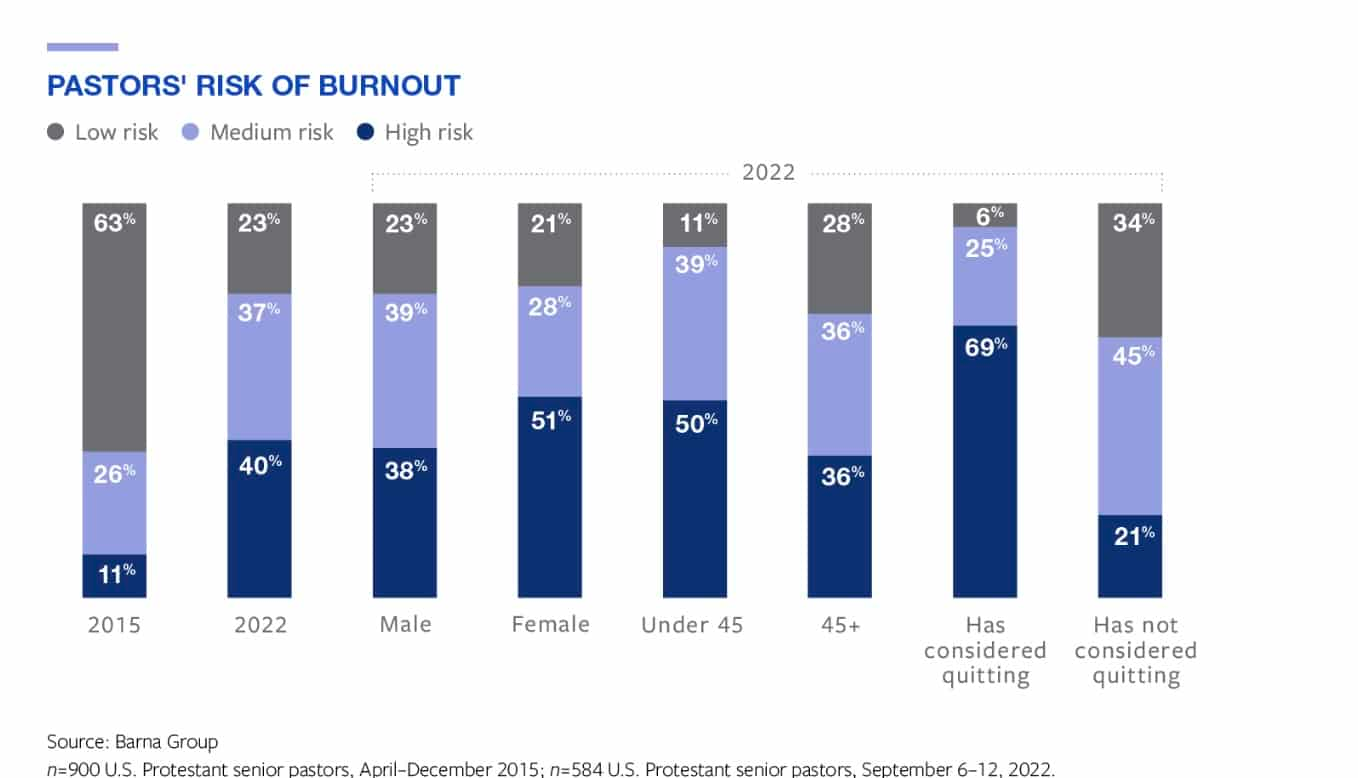
Avoiding burnout requires self-awareness and healthy boundaries. A pastor needs to be aware of their limits and how much energy they are using up versus the energy they’re gaining.

Pastors who prioritize self-awareness are better equipped to serve their congregations with authenticity and empathy. When they are aware of their strengths, weaknesses, limits, and boundaries, they can live a happy and healthy life.

2. Pastoral Counseling

Professional counseling plays a crucial role in supporting pastors facing mental health problems. Just as they guide their congregations, pastors, too, benefit from mental health services provided by trained mental health professionals. Seeking mental health treatment is not a sign of weakness but a proactive step towards well-being.

Pastoral counselors offer pastors a safe space to address the unique challenges they encounter in their roles. These services focus on understanding and managing mental health problems, ensuring pastors can navigate their responsibilities with resilience.

Even today, spiritual leaders like pastors seeking help in a clinical setting can be sort of taboo. Christians may also consider it as seeking help from human practices instead of from God. But professional counseling is not meant to replace God or spiritual disciplines, it is simply meant to partner with them to increase the mental health of your pastor.

By embracing professional counseling, pastors contribute to creating a healthier, more sustainable approach to ministry. It’s a resource that fosters self-awareness, equipping pastors with the tools they need to serve their communities while maintaining their own mental and emotional health.

3. Establishing Support Networks

Thirdly, pastors can enhance their well-being by establishing support networks that recognize warning signs and address increased risk factors. Creating these networks involves connecting with peers, mentors, and mental health professionals who can offer support when needed.

By fostering relationships within these networks, pastors can share concerns and receive guidance, minimizing the impact of potential warning signs. Increased risk factors, such as stress or burnout, can be effectively managed through the support and understanding of these connections.

It’s a practical strategy that not only helps pastors navigate challenges but also provides a safety net for early intervention.

In essence, establishing support networks is a proactive approach to mitigating risks, offering pastors the strength and resilience they need to navigate the demands of their roles successfully. It’s up to them to reach out and make these connections, and it’s up to these trusted individuals to support the pastor in their duty.

4. Prioritizing Self-Care

Prioritizing Self-Care

Prioritizing self-care is foundational for pastors, integrating both clinical practice and a spiritual perspective. Self-care involves intentional practices that maintain mental and emotional well-being, ensuring pastors can fulfill their roles effectively.

From regular exercise to adequate rest, these self-care routines contribute to a holistic approach that addresses both physical and spiritual needs. Pastors can view self-care not only as a personal practice but as a vital aspect of their therapeutic relationship with themselves.

By recognizing the interconnectedness of physical and spiritual health, pastors can establish a sustainable balance in their lives. This approach enhances their ability to engage in clinical practice – providing support to others while also fostering personal resilience.

In essence, prioritizing self-care is not just a personal choice; it’s a fundamental aspect of maintaining a healthy and effective life.

5. Work-Life Balance

Work-life balance is key for pastors to navigate the demands of their roles effectively. It involves finding a sustainable equilibrium between professional responsibilities and personal life. Pastors can achieve balance by setting clear boundaries. This involves designating specific times for work and personal activities.

This approach ensures that the rigors of ministry don’t overshadow essential aspects of personal well-being. Prioritizing family time, leisure, and rest contributes to a healthier work-life balance. By recognizing the importance of both professional and personal spheres, pastors can cultivate resilience and prevent burnout.

Work-life balance is not just a luxury but a practical necessity for sustaining long-term effectiveness in ministry. By intentionally managing their time and commitments, pastors create a harmonious rhythm that promotes overall well-being and enhances their ability to serve their congregations with dedication and authenticity.

6. Set Up Healthy Boundaries

Setting up healthy boundaries is crucial for pastors to maintain balance in their lives and ministries. It involves clearly defining limits on time, energy, and commitments to prevent overwhelm and burnout.

Pastors can establish these boundaries by prioritizing self-care, learning to say ‘no’ when necessary, and communicating realistic expectations with church members. By acknowledging personal limits, pastors create space for rest, reflection, and personal well-being. Healthy boundaries not only protect pastors from the pressures of an often demanding role but also contribute to sustained effectiveness and authenticity in their pastoral duties.

We recommend Cloud and Townsend’s Boundaries book series, which has a bible-centered view on creating healthy boundaries in life. Their book Boundaries for Leaders is especially helpful to church leaders like pastors.

Essentially, setting up healthy boundaries is a practical and essential step for pastors to navigate their responsibilities with resilience and ensure a fulfilling and sustainable ministry.

7. Sabatticals for Pastors

Sabatticals for Pastors

Sabbaticals for pastors are vital periods of extended rest and rejuvenation. These breaks allow pastors to step away from their regular duties, providing dedicated time for reflection, spiritual renewal, and personal rest.

Sabbaticals are not vacations but intentional pauses in ministry, allowing pastors to recharge their emotional and physical reserves. During this time, pastors can engage in self-care, pursue further education, and deepen their spiritual connection.

Sabbaticals play a crucial role in preventing burnout, enhancing overall well-being, and ensuring long-term effectiveness in pastoral roles. By embracing these intentional breaks, pastors invest in their own sustainability and contribute to the longevity and vibrancy of their ministry.

Sabbaticals are a practical strategy for pastors to maintain a healthy balance and longevity in their pastoral journey.

8. Involve Spouses and Families

Involving spouses and families is integral to supporting pastors in their roles. By recognizing the impact of pastoral duties on family life, congregations can contribute to a healthier work-life balance. Practical strategies for involving spouses and families include:

When spouses and families are actively involved, pastors can experience a more comprehensive support system. This therefore enhances their overall well-being and effectiveness in ministry. It’s a collaborative effort that fosters a sense of community and shared responsibility, ensuring the pastor’s personal life aligns with their pastoral responsibilities.

9. Financial Wellness

Financial wellness is an important and often overlooked aspect of a pastor’s overall well-being. It involves managing finances in a way that ensures stability and minimizes stress. Congregations can support pastors by offering resources and programs that address financial challenges.

From budgeting workshops to financial counseling, these initiatives empower pastors to navigate their financial responsibilities with confidence. Providing fair and competitive compensation packages is essential, recognizing the dedication and hard work pastors invest in their roles.

By fostering financial wellness, congregations contribute to a pastor’s peace of mind. This allows them to focus on their ministry without the added burden of financial stress.

Financial wellness is an integral part of supporting pastors holistically, ensuring they can fulfill their calling with dedication and financial stability.

10. Celebrate Achievements

Celebrating achievements is a fundamental practice in sustaining pastoral well-being. Recognizing and acknowledging milestones, both big and small, fosters a positive and motivating environment within congregations. Here’s how celebrating achievements contributes to pastoral support:

Firstly, acknowledgment reinforces the value of a pastor’s efforts, validating their dedication to the congregation and community. When achievements are celebrated, pastors feel a sense of accomplishment and purpose in their roles.

Secondly, celebrating achievements creates a culture of appreciation within the congregation. It encourages congregants to actively recognize and express gratitude for the positive impact their pastor has on their lives.

Moreover, celebrating achievements is an opportunity for congregational leaders to publicly commend pastors for their hard work and commitment. This public acknowledgment contributes to a pastor’s sense of fulfillment and reinforces their significance in the community.

In essence, celebrating achievements is more than just acknowledging accomplishments; it is a communal expression of gratitude, support, and encouragement. By actively recognizing and celebrating the achievements of pastors, congregations contribute to a positive and uplifting environment, ensuring pastors feel valued, motivated, and inspired in their ongoing ministry.

Addressing Pastoral Mental Health Issues

Addressing Pastoral Mental Health Issues

And there you have it! The well-being of pastors is a thread that weaves strength into the entire congregation. As we conclude this exploration of pastoral mental health, remember that simple changes can make a big impact.

Encourage open conversations, embrace self-care, and let compassion be the compass guiding your community. By prioritizing the mental health of those who guide and uplift, you can build a foundation of resilience and understanding.

The journey towards a healthier, more supportive environment for pastors is ongoing, but it begins with recognizing the importance of their well-being. As you and your church community implement these 10 tips, we pray that they develop a more healthy environment for your church. That it becomes a place where pastors can find solace, strength, and the support they need to continue shepherding with grace and joy.

God bless.

Further Resources for Pastors

View Full Transcript

Episode Transcript

[00:00:00] Speaker A: Well, for too long, churches have minimized the importance of pastoral mental health. And in this conversation, we want to unpack ten tips to help your church make major strides in that area. Let's do this. You're listening to the reach. Right? Podcast, the show dedicated to helping your church reach more people and grow well. Hey, guys, I'm Tom. [00:00:25] Speaker B: Us. And I'm Ian. [00:00:26] Speaker A: And today we're talking about pastor mental health and how it's a big issue. And we're going to be talking about ten tips that you need to know to address pastoral mental health. So, bigger issue, and it's more something that I think people are aware of now than they have been in my lifetime, at least. Ian, you agree? [00:00:45] Speaker B: Yeah, definitely. I agree. And I think something that's often overlooked in the grind of ministry or just ministry altogether. So, yeah, very important topic. [00:00:55] Speaker A: Yeah, I think what brought this up is we saw some stats out of Barna, and I'll let you bring up some of those. It's kind of our first tip is just being self aware of this kind of the mental health crisis, if you want to call it that pastors are facing. That's kind of the first tip is you need to be aware of it, and so I'll let you kind of tackle it. But we saw this stat, and it was pretty jarring to see some of these numbers that they found. They interviewed a bunch of pastors and kind of took a pulse of where they're at. But what did they find, Ian? [00:01:28] Speaker B: Yeah, and obviously a good source. Barna group, obviously has done a great job with all this stuff for years now. It's crazy. There's several things that were found here, but basically, in 2015, only 11% of pastors were at high risk for burnout. And then fast forward to 2022. Now, 40% are at high risk and then 37% medium risk. I think that's even still a big deal. But get this here, basically now, as of 2022, 69% are at high risk of considering quitting ministry. So that one, I think, is a really big deal. So that's kind of that number. That 69% is scary. [00:02:23] Speaker A: Yeah. And that's not even like the ones that are, like, kind of they might consider, like, these are people that have actually considered it. It seems like. It seems like it keeps going. Now, this study is from 2022. So it's at least 13 months old, I guess, at this point now. But I think that these numbers, they don't show signs of really changing, perhaps coming more out of the pandemic and maybe seeing some bounce back to regularity. They have improved, it seems like. But there's no question that kind of addressing these things and taking mental health seriously is more important. We need to be aware of it, I guess. Of course, I was really kind of shocked about some of that, some of the numbers, when we unpack it a little bit further and maybe you have that right in front of you there, Ian, you can give us the exact numbers, but I think I saw in there that like under 45 pastors under 45 were more likely to be at high risk than those that are over 45. Was that right? [00:03:19] Speaker B: Yeah. And that was interesting to me too. You're exactly right. 50% are at high risk that are under the age of 45. [00:03:26] Speaker A: Yeah. And what was it for? [00:03:28] Speaker B: Over 36%. So that's pretty significant jump. Yeah. [00:03:33] Speaker A: Right. [00:03:34] Speaker B: Yeah. [00:03:34] Speaker A: So they did a whole breakdown, like women are more at higher risk than men of burning out and they did a whole breakdown of this. And we'll put a link in the notes here where you can see all the stats or the numbers from Barna themselves. But it's just something that as someone who has pastored for the vast majority of my adult life, I never pastored a church in the pandemic or post pandemic season. [00:04:01] Speaker B: Right. [00:04:01] Speaker A: So I can't relate there. But I do know that it is one of the most high stress jobs that you can have. There's so many challenges that come with it and interpersonal issues that we have to work out. I just really feel for our audience. I know most of our audience are pastors, or at least we're church leaders. Everybody, I feel for you. If you're watching this and you're not involved in leadership at a church for some reason, you like to listen to these kinds of things, but chances are our audience here is involved in a church in some level. So, yeah, it's just something that I think is something we have to be aware of, take seriously. And so to that end, we wanted to talk through some ideas. So the first thing and what we would encourage people to, is to not be resistant towards pastoral counseling. I know, just as people that often are the ones that provide some kind of biblical counseling, or I don't know if you don't usually use the word counseling in my circles, but when we do provide pastoral care or pastoral coaching, it's sometimes hard for us to receive that and say, hey, that I'd be open to it and perhaps I even need some kind of counseling, professional counseling in my life. But in everything that I'm seeing everything that I read, it seems that is something that you cannot shy away from. I know at the church that I am involved at now, lots of our pastoral staff, it's almost like mandatory that they encourage everybody on pastoral staff to get regular counseling to help them talk through some of these kinds of things in their own lives. So, yeah, I think that something that for a long time has been, we've shied away from it, but it's something we need to really look towards and embrace now. [00:05:41] Speaker B: Yeah. And I think that's well said, thomas. And also just, I think this pastoral counseling is overlooked for pastors because they're the ones giving that, like you said, and they're the ones expected to give that. So I think it's kind of hard for, it's a tough pill for maybe a lot of pastors to swallow to say, hey, I need to get counseling myself. But like we just said at the beginning of this, once the problem is identified, which these stats definitely identify the problem, and once it's been identified with the individual pastor, this is, I guess, the first step, we would say, to consider and not overlook, for sure. [00:06:15] Speaker A: Yeah. [00:06:16] Speaker B: But next one is establishing support networks. First thing that comes to mind is, again, you and I both have, but me, particularly here at reachwright, being on the front line, so to speak, connecting with pastors day in and day out, I've seen for years that a lot of pastors, they're a one man gang, if you will. Now, of course, they have other leaders in the church. They have their wives, they have families than they have, but often they're all alone. When I say all alone, not all alone, but they're operating to a large degree alone. They are the leader of the church and they need a support network as well. And this could be other pastors that are at a similar churches locally, in your area or regionally, but having some sort of support network, maybe it's mentors. All of those things can really, when you have someone to bounce similar issues off of that other pastors that are dealing with similar things, challenges, it's going to really only encourage pastors further, I think so, yeah. [00:07:26] Speaker A: It's so hard because you're in this place where you obviously want to have healthy, life giving relationships with people that are within your church, but there is a limit to how far you can take those kinds of relationships. And they have to, by their very nature be somewhat one sided because it's a pastor. While we encourage authenticity and being open about struggles and things that we have, there is obviously just things that you cannot get into full detail with, with every single member of your church, or even any member of your church, because it changes the dynamic of things. It's just not something you can go towards. So I think what a lot of pastors struggle with is just that having this place where they can be totally candid and do that. And I think you're right. Like, having a network of other pastors is always a great idea. I think even above that, having a network of people that maybe even aren't pastors, but not maybe in your community, maybe. I know there's lots of online support groups and things that have grown. If it's a specific issue you're needing care over, you can always find support groups for those. But just having people you can relate with, I think a lot of times just even old friends, people that maybe you went to college with, some people that might not be in ministry, and you need to find some kind of way to connect with them again, rekindling some of that can be a really good foundation for that kind of support there. So, yeah, good stuff. [00:08:50] Speaker B: That is good. [00:08:52] Speaker A: Awesome. Next one. Prioritizing self care. That's something else that pastors need to really take seriously. I think things like, the thing that comes to mind for me with this is Sabbath. I know that this is something that was revolutionary for me in my ministry, is that I was a serial Sabbath breaker when I was in ministry. I kind of reasoned it away and said, well, my whole life is a Sabbath and I get to spend time with the Lord, but it's not the case. And so really prioritizing self care, having a true Sabbath established in your life where you don't do work, you don't do things that don't bring you joy in your life. Having a day, a week where you get to really spend that time doing those things. And I know for a lot of us, I know what I did for years was my Sabbath, was the day that I had a day off from work, but it was the day that I did all the other stuff I had to do in my life, right? The day I would mow lawns, and that's really what I had to do and go to soccer games and all the stuff that I had to do. So really finding ways to take that back, and I'll be the first to admit, it's hard. It's hard to organize your life and prioritize and get everything else done. You have to work really hard the other six days in order to have a day that you just spend time resting and eating the foods you want and spending time with your family and kids and those kinds of people. So anyway, that's where I think self care should start for most pastors. [00:10:22] Speaker B: Well, it's funny you say that. One thing that came to mind was, I know that Monday is often that day off for a lot of pastors, probably most of the pastors that I speak to. And I'm surprised how many of them I speak to on a Monday. And I'm almost like, you shouldn't be talking to me. Hey, take that time off. And I do say that sometimes just in love, just to say, hey, if we need to reschedule, let me know, because I know that you need that Sabbath rest. And I knew you were going to mention that one, Thomas. I know that's a big one for you. I want to mention one more, too. I think exercise and regular exercise, rest. And I'm not just saying that because I like to work out and all that, but I will say personally, as someone who hasn't pastored full time, per se, but I have pastored, been active in ministry. But not only that, with what we do here at reach, right, working hard, have a family, all of that exercise has always been a great stress relief. And of course, it comes from the Lord. Your rest and your peace and all of that. But I don't like that. A lot of pastors have been known for being very overweight, out of shape people for years. This sounds funny, but in the Bible belt, you always think of the potlucks and just how that's potlucks and going to lunch, taking people out to lunch and eating a lot. Look, that's fine. I love my food, too. Eat, pastor, you deserve it. But get exercise. It relieves stress, it's good for your body and it does affect your overall mental health. So I think a lot of tubby. [00:11:53] Speaker A: Temples out there, right, Ian? [00:11:55] Speaker B: That's right. Yeah. It's a funny word for it, but yes, that's it. Well, next one is work life balance. I like this one here because tubby temples, I'm still laughing about that. I'm trying not to laugh a little bit like the Sabbath here. I mean, I've talked to a lot of pastors that just, they don't even get a break. They're working into the hours, they're going to hospital visits late at night. They're not saying there's not a time for that. And there are emergencies in Cris, but don't be that one man gang. Set boundaries, set time frames where just like anyone else you're working and not working. Also, delegate things to other leaders. And the reason I'm saying this with work life balance is first get that set, and then, of course, making sure that you're doing life with your family. You're not neglecting your wife, your kids, and just making sure that you're balancing the work you're doing, plus the other social and extracurricular activities. So it's very important for mental health. Yeah. [00:13:01] Speaker A: I'm not going to tell pastors anything they don't know when I say this here, but I just want to say it as a way of a reminder that your church and your ministry is, in most cases, the fourth most important thing in your life. So your first most important thing is your relationship with Jesus. After that, if you're married, it's your spouse. After that, if you have kids, it's your kids. And then at best, your ministry is in the fourth position. It's great. But I know for myself there have been times where it has been, number one, that it takes the place of Jesus, my spouse and my kids, and it has full priority. And it's something that I have to. I think any pastor that's doing an honest assessment of their lives, they can honestly say that that has been something that they felt that they eat, breathe and sleep their ministry. They literally sleep it. You wake up and you have nightmares about ministry and conversations you have to have but you don't want to have. And it's just something that is all consuming that way. So this is a sign that maybe your work life balance is off, if that's something that you struggle with. So it's something that, I think it's good to take regular assessments. Am I in that order? Am I Jesus wife or spouse, kids? And then my ministry. Is that the position for me? [00:14:17] Speaker B: No. Well said. Even if, like you said, it's telling Pastor something they already know, that doesn't mean we don't need to be reminded of that. Right. And assess that and see if that needs to be reset. [00:14:28] Speaker A: Well, next one, you kind of got into what I was thinking on this, but it was just setting up healthy boundaries. And this can be a lot of the things we've been talking about, making sure you have those timelines where you're saying, I have a proper time for Sabbath, but I think healthy boundaries around what I will and won't eat, what I will and won't do for exercise commitments to my own self development. I know one thing for me is just doing regular walks and listening to audiobooks and having that kind of boundary and margin in my life, that I have the time to do that every single day, to be able to continue to grow as a person, as well as just getting exercise and doing that kind of stuff. So I think take some time to really draw out. And I think, here's the thing about boundaries is if they're just kind of things that you think would be good ideas, you haven't actually made boundaries. If you've said, I don't want to go out on weeknights anymore and miss family dinner, let's say that's a good, healthy boundary. Or maybe you say, I'm only going to miss one per week, one family dinner. You have a boundary around that. But unless you actually write it down and tell somebody, unless you tell your wife that, hey, I'm only going to miss just Tuesdays, that's the only night I'm not going to be at home every other night. I'm going to be here. Whatever that boundary is going to be, you have to write it down for yourself so you know, and commit to it and tell people in your life that this is your boundary and have them hold you accountable to it. [00:15:56] Speaker B: Accountability, I like that you touched on that. Yeah. That's good. So next one is sabbaticals for pastors. And what I like about this one here is that it's important to remind people that a sabbatical is not a vacation necessarily. It's taking time off to pause for ministry, rest, recharge, even get closer with the Lord. With your spiritual connection now. Sure. Could it be done in a nice place and kind of vacation like? Yes, but I think it's important to understand what it is first. I think that's huge for pastors to be able to step away, trust other leadership at their church. Undial, and you come back stronger and more effective for your ministry, too. [00:16:47] Speaker A: Yeah, I think a sabbatical is. I never took one in my years in ministry. I think it's just because I moved around. I was in one church for six years, was the longest I was in one place, and I was very ready for a sabbatical there. But the Lord moved us on and out of state right at that same time there. So I think that there's lots to a sabbatical. I think one of the things you were talking about, you said it well, is trusting your leaders to run the show. This is what scared me as a pastor, to be really frank about it. I would have loved to take a sabbatical, but I was terrified of what I would come back to, and this is not a reflection of anybody else. Everything would have been fine. It's a reflection of me and probably my own pride and some of the things that are there that I feel like I need to be the one that does everything and I can't really trust. And if I did have issues there, that's again, a reflection of me as a leader, not being able to raise up people that I think are able to do the things that need to be done to run a church there. So it's something that I think that is scary, I think. But I think that every five years or so is an appropriate increment that you should consider taking a sizable six week sabbatical, something to that effect, take some time off in the summer and really just seek the Lord and a refreshment in that area. So, yeah, good stuff. [00:18:06] Speaker B: That's good. [00:18:07] Speaker A: Next one is involve spouses and families. This is something that for our own mental health, it should be so obvious. It's something that every pastor worth his salt is counseling his church. To do the people in his church is to be spending time with your wife, with your kids, involving them, living your life, getting joy from those things that are designed to bring joy to our lives, but yet we have a hard time taking that for ourselves. But just taking a step back and really prioritizing, again, getting that priority chain right of spouse and kids, getting those things at the second and third position in your life, I think it's really important. [00:18:46] Speaker B: Yeah, that's good. And we kind of mentioned that a little bit earlier with some of the other points, but cannot neglect the family and let your family slip away, so to speak, in the midst of all of that and keeps you healthy. So next one is financial wellness. This is a big one, too. So if a pastor is worried about financial stuff, that's obviously going to cause stress and some issues. So are you as a church looking after their well being with that? So whether or not it's financial counseling and other initiatives, budget, not budget necessarily, but workshops, if you will, what programs are out there to ensure that your pastor is doing well financially and just has a healthily outlook of that. We've talked about this on podcasts prior, just that, whether or not pastors are paid enough, but just how that is a financial stress for a lot of pastors these days. They're doing a lot of work for earning less than a lot of other vocations and trades. So that's something definitely to bear in mind. [00:19:59] Speaker A: So I have no way to prove this. I'm not a data scientist, but the Barna study, it did not surprise me to see that the younger you are, the more likely you were at a burnout risk, I would say, and the under 45 crowd like me, and then the over 45 crowd like you. [00:20:17] Speaker B: Well, at 45, thank you. But yes. [00:20:20] Speaker A: Not under 45 crowd like you. Yes. So there's a dramatic difference that my generation is much more likely to quit. Your older generation is much more stable. [00:20:30] Speaker B: No, but here's a few listening. In a few months, he's going to be right where I'm at. So there you go. [00:20:36] Speaker A: That being said, and when I think about this, it does not surprise me. I think a lot of it comes down to the financial realities for younger people that exist right now. Not to say that it's easy for people that are over 45. I think there's all kinds of financial challenges out there, but I talk to pastors all over the world, primarily United States, and when I talk to young pastors in big city environments, so I'm in Honolulu, so it's the most expensive state in Hawaii in the country, and Honolulu itself is astronomically expensive. The average three bedroom, two bath house in my community is over a million dollars. And so it's just, it's all kinds of. And then on top of that, our expenses are just through the roof because everything gets shipped here. That being said, our salaries for pastors are basically the same as they are in rural areas. And so it's really financially daunting, I think, for especially people that didn't get established in buying a house, family, it's hard to look out. So all that being said, we did a whole episode where we talked about reasons why your pastor is probably underpaid. And we got tons of pushback, mostly by people that aren't pastors and aren't involved in church leadership. Right. That they said, well, pastor shouldn't be paid at all, and all kinds of silly things that were being said there. But I found that I think that might be helpful to you. Chances are you're probably underpaying your pastor. I'm someone that, as I coach churches, I see this as a chronic challenge within churches, is that pastors, I know we're very cautious of kind of that megachurch or like the televangelist reputation. We don't want our pastor to feel like that or anything. And there is all kinds of things that as pastors we need to do to be good stewards of the little resources that we have. But I see the problem. 90 some percent of the time at least is that pastors are getting paid too little from their churches. And I'm always an advocate that you should be paying your staff more with that. So check out that other episode if you want to dig in deeper on that topic. But financial wellness is a huge source of pastoral discontent and some of the stresses that pastor feel there. So anyway, big time, let's end with this last tip. I guess if it were, is that a great way to combat some of the mental health challenges is just to celebrate achievements. I want you to know if you're a pastor or if you're someone who is on a church staff somewhere, that chances are your pastor, they probably get a lot of this light encouragement where people will come up to them and say, oh, great message today and that kind of stuff. And that feels good. Keep doing that, don't stop that. But I feel like that we lack that. I know that every company out there, they have things like they do some kind of award system and things to celebrate their staff and employee of the month and they do that kind of stuff. And nobody's getting into ministry so that they can have employee of the month awards. I get that kind of stuff. They don't want the special parking space because that's not why they do it. [00:24:03] Speaker B: Maybe a gift card or something or a bonus. Sure. [00:24:06] Speaker A: Absolutely. Yeah. Again, back to the financial wellness. [00:24:09] Speaker B: Yeah, right. [00:24:10] Speaker A: I just think that celebrating pastors is something that is not done enough. I know we have a whole month dedicated to it. I know a lot of churches under celebrate in that month as well, too. They don't do much to honor their pastors plug for that. We actually have a video about that, too. We have some really great ideas on how you can celebrate pastor appreciation month. We'll link to that in the description here as well. But yeah, just think through that. I think pastors are not celebrated enough. And I don't mean just on Sunday mornings because that can be too repetitive. But just on a personal level, write them letters talking about specifics of why what they're doing is mattering and why they've been encouragement to you. And when they make big achievements, when they hit big milestones, if they've been there for ten years or 20 years, throw a party, celebrate those kinds of things, that's a big deal. And I think pastors should be honored in that way. [00:25:02] Speaker B: Yeah, it's a big deal. Pastors deserve it. It's a tough job. It's a stressful job. You're dealing with people issues, you're dealing with spiritual things on top of that and all of the things that come with this spiritual battle that we're all in. So. Yeah, good. Well said there Thomas. Celebrate your pastor's achievements. Commend them. They're not just there as the big strong leader of your church that is so godly that they don't need to hear anything positive about what they're doing. Yeah, that's a good reminder. [00:25:33] Speaker A: Well, good stuff. If you guys have any ideas of things that you've seen help your pastors, or maybe you're a pastor and you've found something that has really helped you kind of get over some of those mental health humps, we'd love to hear about those. So drop a note down in the description there. That would mean a lot to us. It helps the algorithm pick this up if you haven't already hit that subscribe button. Thanks guys for being a part of the Reachwrite family and we'll see you next time. [00:25:59] Speaker B: See ya.

Other Episodes

Episode

May 01, 2025 00:30:30
Episode Cover

Don’t Use The Google Ad Grant Until You Know These 9 Things

The Google Ad Grant is like a dream come true for churches. Google offers $10,000 in free advertising every month, helping ministries reach more...

Listen

Episode 0

May 25, 2023 00:27:53
Episode Cover

8 Tips To Get More Engagement on Sermon Videos

In today’s digital age, it’s essential for ministries to adapt and leverage online platforms to reach a broader audience. This conversation focuses on a...

Listen

Episode 0

October 04, 2022 00:22:16
Episode Cover

How Do You Figure Out Fair Pastor Compensation?

How much you pay your pastor is a touchy subject. Some think pastors are paid too much, while others argue they’re not paid enough....

Listen