Navigating the Era of Smart Assistants: Church Voice Search SEO Strategies

May 23, 2024 00:18:25
Navigating the Era of Smart Assistants: Church Voice Search SEO Strategies
REACHRIGHT Podcast
Navigating the Era of Smart Assistants: Church Voice Search SEO Strategies

May 23 2024 | 00:18:25

/

Show Notes

In today’s world, talking to machines isn’t just for science fiction anymore. Smart assistants like Siri, Google Assistant, and Amazon Alexa are everywhere, ready to help with a simple voice command. But what does this mean for churches?

Well, it’s changing the way people find information online. Instead of typing into a search bar, they’re asking questions out loud. This shift to voice search means churches need to adapt their online presence to stay relevant.

That’s where Voice Search SEO comes in. By understanding how these smart assistants work and optimizing their websites accordingly, churches can ensure they’re not left behind in this new era of technology.

So, let’s explore how your church can navigate the world of smart assistants and make sure your voice is heard. Ready to learn more?

Let’s jump in.

Estimated reading time: 11 minutes

What is Voice Search Optimization?

What is Voice Search Optimization?

Voice Search Optimization (VSO) is all about online visibility. It’s about making sure your church’s website shows up when people ask their smart assistants for information. It’s similar to normal search optimization, except instead of optimizing for what people type into search bars, it is optimized for what people say into their search bars.

According to PwC, it looks like everyone will be increasing their voice searching. No matter the age group or the device, all statistics point to an increase in voice search activity.
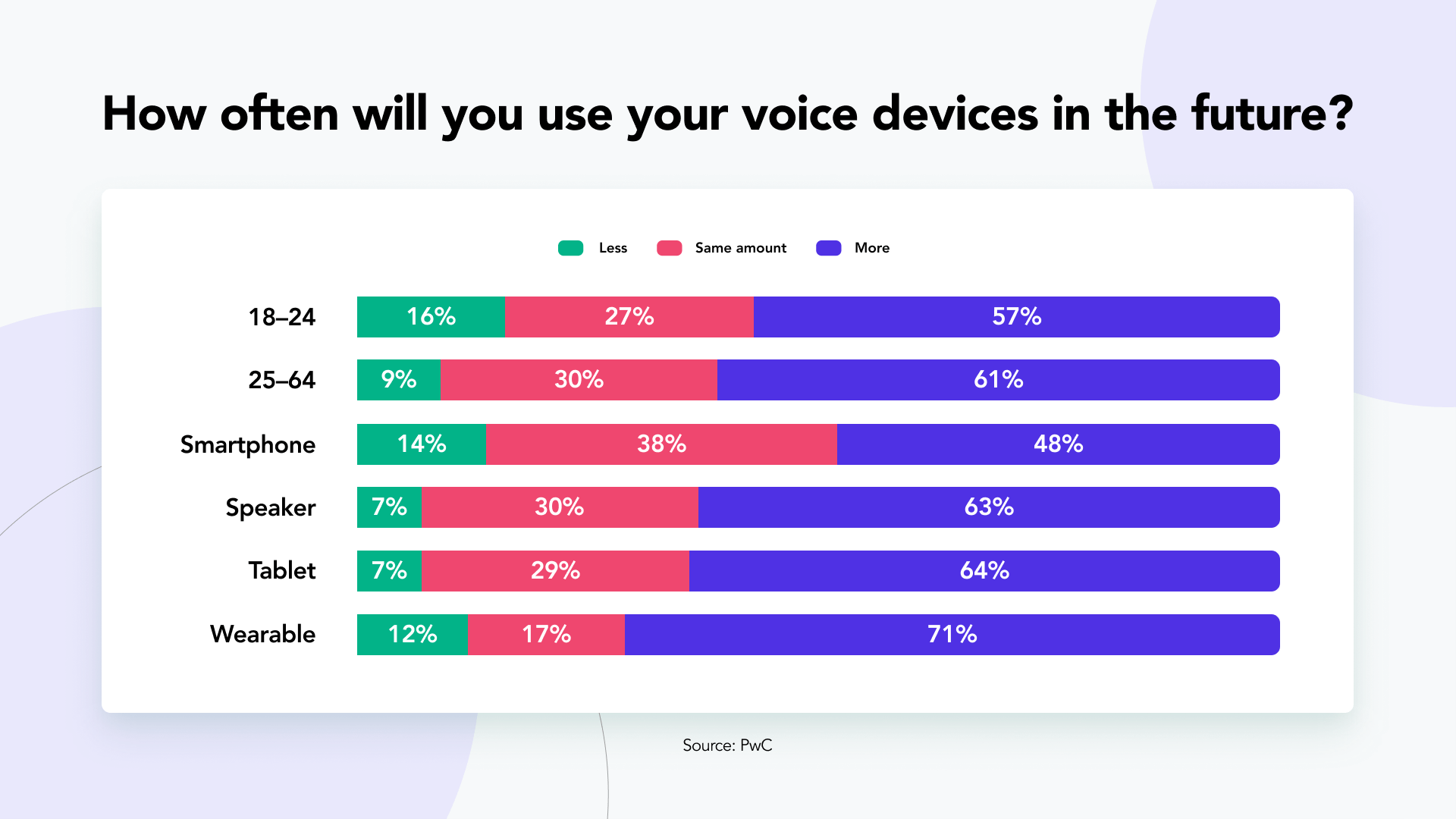
PwC

Let’s learn a little more.

Understanding Voice Search

When people use smart assistants like Siri or Google Assistant, they don’t type their questions. Instead, they speak them out loud. These questions are called voice search queries. VSO helps your church’s website be the answer to these queries.

Instead of just focusing on regular search engines, VSO pays attention to how people talk. This means using natural language and phrases that people might say when asking for information. Turns out, people talk a lot differently than they type.

Optimizing for Voice Search Results

When someone asks their smart assistant a question, it doesn’t just show a list of websites like regular search results. Instead, it gives a direct answer, often taken from a website’s content. VSO helps your church’s website be that direct answer.

By structuring your website’s content in a way that smart assistants can understand, you increase the chances of your church being featured in voice search results.

In essence, Voice Search Optimization is about making sure your church’s website is easy for smart assistants to understand and feature in their results. By focusing on natural language, structuring your content effectively, and paying attention to local SEO, you can improve your church’s visibility in the world of voice search.

Key Components of Church Voice Search SEO

Key Components of Church Voice Search SEO

What is SEO?

SEO, or Search Engine Optimization, is like a map for the internet. It helps websites show up when people search for things online. Imagine you’re looking for a recipe. You type “chocolate cake” into a search engine like Google. SEO helps the search engine figure out which websites have the best recipes and shows them first.

It’s like giving your website directions so it can be found easily. SEO involves using specific words, organizing content neatly, and getting other websites to link to yours. With good SEO, your website can be seen by more people.

Many voice search queries are about finding local businesses or organizations, like churches. That’s why SEO is crucial for VSO. When someone asks their smart assistant for “churches near me,” you want your church to be at the top of the list. Optimizing your website with location-specific keywords and information helps smart assistants connect your church with people in your area.

When it comes to Voice Search SEO (VSEO) for churches, there are three key components to pay attention to:

Keyword Research for Local Search

One of the first steps in VSEO is conducting keyword research specifically tailored to local voice searches. This means identifying the phrases and terms that people in your area are likely to use when searching for a church.

For example, instead of just targeting generic keywords like “church services,” focus on terms like “churches near me” or “Sunday services in [your city].” By understanding the language your local community uses, you can optimize your website to appear in local search results.

Structured Data Markup

Structured data markup is a way of organizing the information on your website in a format that search engines can easily understand. For churches, this means using structured data markup to highlight important details like your church’s address, phone number, and service times.

This information can then be displayed prominently in search engine results and local listings, making it easier for people to find your church when they perform voice searches.

Local SEO Optimization

Local SEO optimization is all about ensuring that your church’s website appears in local search results when people in your area are looking for a church. This involves a variety of tactics, including optimizing your website for local keywords, creating and maintaining local listings on platforms like Google My Business, and earning positive reviews from members of your community. You’ll want to make sure you have things like a Google Business profile in order to get the most out of this.

By focusing on local SEO, you can increase your church’s visibility in your church’s local listings and make it easier for people in your area to find you when they perform voice searches.

In summary, the key components of Church Voice Search SEO are keyword research for local search, structured data markup, and local SEO optimization. By focusing on these areas, you can improve your church’s visibility in local search results and make it easier for people in your community to find you when they perform voice searches.

6 Strategies for Optimizing Church Websites

6 Strategies for Optimizing Church Websites

Now we fully understand SEO and optimizing for voice search. Let’s dive into our top 6 strategies for optimizing your church website for voice search SEO. These range from the words you put on the website to different programs to implement into your website. Ready to learn more?

Let’s jump in.

1. Natural Language Content

Natural language content is written in a way that mirrors how people speak in everyday conversations. It avoids overly formal language and incorporates phrases and expressions commonly used in spoken language. This approach makes the content more engaging and accessible to readers, including those using voice search.

By using natural language, websites can better match the queries entered into voice assistants. This increases their chances of appearing in voice search results. It’s about creating content that feels conversational and relatable, enhancing user experience and improving the likelihood of capturing the attention of both human readers and voice search algorithms.

2. FAQ Sections

FAQ (Frequently Asked Questions) sections are dedicated parts of a website that address users’ common queries. By compiling and answering these questions concisely, they provide valuable information to visitors and enhance user experience.

In the context of voice search SEO, FAQ sections are particularly beneficial. This is because they align with the natural language queries users pose to voice assistants. By optimizing FAQ content with conversational language and addressing relevant topics, websites increase their chances of being featured in voice search results.

These sections not only assist users but also contribute to a website’s visibility and authority in search engine rankings.

3. Structured Data Markup

Structured Data Markup

Structured data markup is a method of organizing and presenting website content in a format that search engines can easily understand. It involves adding specific tags or metadata to HTML code to provide context about the content on a page.

This structured data helps search engines better interpret and categorize the information, increasing the likelihood of rich snippets and other enhanced search results.

In the context of voice search SEO, structured data markup plays a crucial role in optimizing websites for natural language queries, improving their visibility and relevance in voice search results.

4. Schema Markup for Events

Schema markup for events is a structured data format that provides search engines with detailed information about events hosted by a website. It includes essential details such as event name, date, time, location, and description.

By implementing schema markup for events, websites enhance their visibility in search engine results. It also increases the likelihood of being featured in rich snippets or event-related search features. This structured data helps search engines understand the context of events listed on a website. This makes it easier for users to find relevant information. This is especially true when using voice search to inquire about upcoming events in their area.

5. Featured Snippets

Featured snippets are concise summaries of information displayed at the top of search engine results pages, providing quick answers to users’ queries. Here’s why they’re important:

Optimizing for featured snippets involves providing concise, relevant answers to common questions, structuring content logically, and using clear headers and formatting.

6. Monitor Voice Search Performance

Monitoring voice search performance is crucial for ensuring your website remains competitive in the evolving landscape of search. By tracking the frequency and ranking of your site in voice search results, you gain insights into its visibility and relevance to users.

Analyzing user interactions, such as click-through rates and engagement metrics, provides valuable feedback on the effectiveness of your optimization strategies. This data enables you to identify trends, refine content, and prioritize areas for improvement.

By staying vigilant and responsive to voice search performance metrics, you can adapt your approach to maintain or enhance your website’s presence in voice search results. All in all, this will maximize its impact and reach.

What Does the Future Hold?

What Does the Future Hold?

Evolution of Voice Assistants

As technology advances, voice assistants are expected to become even more integrated into our daily lives. They may evolve to understand and respond to more complex queries, becoming increasingly conversational and intuitive.

This evolution could include improvements in natural language processing and the ability to understand context, leading to more accurate and personalized responses. Additionally, advancements in artificial intelligence may enable voice assistants to anticipate users’ needs proactively, providing assistance before even being asked.

Impact on Search Behavior

The growing prevalence of voice search is likely to reshape how people interact with the internet. As voice technology becomes more sophisticated and accessible, users may rely on voice assistants for a wider range of tasks beyond simple queries, such as making purchases, scheduling appointments, or accessing information hands-free.

This shift in search behavior will influence the way websites are optimized. This emphasizes the importance of conversational content, structured data markup, and mobile-friendliness. Businesses, including churches, will need to adapt their online strategies to accommodate these changes and ensure they remain visible and accessible in the evolving landscape of voice search.

Voice Search SEO for Churches

Voice Search SEO for Churches

As voice search continues to gain traction, churches and organizations must prioritize adapting their online presence to meet the evolving needs of users. By embracing voice search optimization strategies such as natural language content, structured data markup, and local SEO, churches can enhance their visibility and accessibility in voice search results.

Furthermore, staying vigilant in monitoring voice search performance and anticipating future developments in voice technology will be essential for maintaining relevance and reaching audiences effectively.

By embracing these changes and proactively optimizing for voice search, churches can ensure they remain accessible and engaging in the digital age. We pray for success for your church’s business! God bless!

More Resources for Churches

View Full Transcript

Episode Transcript

[00:00:00] Speaker A: While my kids make fun of me for doing it, more and more people are actually using voice search to find what they're looking for online. But a lot of churches don't really put much thought into voice search. And in this conversation, we're gonna unpack what your church can do to show up and reach people when they search for you on their phone using just their voice. Let's do this. You're listening to the reach, right? Podcast, the show dedicated to helping your church reach more people and grow. Well, hey, guys, I'm Thomas. [00:00:35] Speaker B: And I'm Ian. [00:00:36] Speaker A: And today we are talking about voice search optimization for churches. In the era of smart assistants and people talking to their phones, it's becoming more and more obvious that optimizing not just for typed in searches or texted in searches, but actually optimizing for voice searching is actually kind of a new skillset within search. Search engine optimization that I think churches need to be taking a look at. And something we want to discuss today. So should be a good conversation. [00:01:10] Speaker B: Yeah, I think so. And maybe one that, you know, isn't top of mind to everyone, but something that is on the rise and something to definitely help churches engage more visitors, which is, again, what all of us are. [00:01:23] Speaker A: We've done dozens of episodes over the years. You know, you do 200 and you're, you know, one of our main things we talk about here is search engine optimization, things that churches can do to reach more people. And this isn't. I wouldn't put it as like, a different category. It's still all of the same principles apply to search engine optimization that we, we already do for written searches, that we would also do for voice searches. But there are a few tweaks that we are kind of seeing coming. I think, when it comes to how you can optimize your search performance for the rise of people doing more and more searches this way. So there's two big things that are shifting in the search engine optimization world right now. I think this is one that we've been aware of for a few years, and then the other enormous, like, Boulder that is hitting right now is AI and what role that's going to play in search engine optimization. There's some question mark as to whether people will be searching the same way that they are right now with AI being able to tell them a lot of the answers that people are looking for. So there's a lot of question marks out there. But I do think that more and more people are using voice search. I don't know. My kids, they make fun of me for voice searching, or even more, they make fun of me for voice texting, where I'll kind of speak to my phone to get it to text. Is that an old person thing, do you think, Ian? For me? Yeah. [00:02:46] Speaker B: My kids make fun. [00:02:47] Speaker A: What's that about? [00:02:48] Speaker B: They make fun of me as well for that. I don't voice search is my, as I voice text, I do voice text, and it's just faster for me. I'm just, that's what I tell them to. I'm like, you're making fun of me, but it's, it's fast and I just get it done. [00:03:01] Speaker A: Yeah, I'm all about efficiency. It's a hack is what it is. So I don't know, it's something that us guys in our forties that we, I don't know, I think we're more likely to do it than my teenage children are, so. [00:03:12] Speaker B: Guess so. [00:03:13] Speaker A: But anyway, I think it is important and I think that it will only continue to rise, being able to interact with our devices in a seamless way, especially if I'm wearing AirPods or something like that, and can just kind of have that conversation immediately. It's actually really convenient in a lot of ways. So that brings us to this question of what do we need to do differently to show up on searches when people are doing voice search. So if someone is, you know, I guess, I suppose it could be kind of a standard search. Like, I don't think a lot of people are doing, like, churches near me as a voice search, but usually voice searches are going to be more targeted towards actual questions that people have. So we'll talk a little bit about that and what it looks like for us as churches. What kinds of questions are we going to be answering? But I think you and I, we came up with six different ideas that churches could implement, and I don't know, you want to kind of. Well, should we talk through them, Ian? [00:04:13] Speaker B: Yeah, yeah. And I know this, this is an area you've done a little more research on, and it's kind of in your, your area of expertise here. Thomas, I know you're passionate about voice searching. Kidding. But also, you did some good homework on it. [00:04:28] Speaker A: I don't know if I'd go that. [00:04:29] Speaker B: Far, but, yes, but I will definitely. Yeah. Let me ask you about some of these, because some of these were new news to me. But, yeah. We have six strategies for optimizing your church website specifically for voice search. So first one is natural language content. What do we, what do we have in mind when it comes to natural language content on your website. [00:04:53] Speaker A: So the idea behind this is that we have to realize that when people use voice search, they speak in a different way than what they would type into a search engine. So it's much more often that people are, like we said, they're asking questions than they are putting in just a statement to do research. People don't usually do voice typing for research. They do it more to get quick answers for things. So you want to make sure that you are using natural language, the way that people talk and, and not more formal language that you would maybe do in blog posts and things. And even if you are doing it in blog posts or sermons, that you would make sure you'd have parts of that that would be just kind of more natural language, the way that you and I speak, then it will be more likely to match someone's query. So if I was going to be looking for a plumber, let's say, for instance, I would probably say something in voice search. I'd probably say something more like plumbers near me or best plumbers in, in my city or something like that, as opposed to if I was actually doing some research on there, I might type in plumbers in Hawaii Kai and, you know, do some more digging on things. And we have to remember also that people are going to be looking for much quicker answers with this and we'll talk more about that as we go. But as you think about things, like try to find ways to use the way that people naturally talk in your content and you'll usually do better on voice searches. [00:06:32] Speaker B: That makes sense. Second one that also is important here is FAQ sections. Now, we do know, I mean, faqs are pretty common on websites and church websites. But what do we specifically mean with this for voice search? [00:06:47] Speaker A: Well, so this is a perfect example of faqs are trying to answer those questions that are frequently asked. And so if people are more likely to do quick questions into a voice search, then your FAQ content is very often going to be the thing that it's most likely to key in on and give you rankings when you do those kinds of things. So, you know, a lot of times in churches we use our faqs. We have one FAQ and it's usually the same content. Like, you know, where do I show up and what do I wear? We make a joke about how you can wear whatever you want, but you have to wear clothes and, you know, that kind of stuff. So we have a lot of those things. But one of the things we've tried to implement is on almost all of our kind of researched blog posts. We try to include an FAQ section in every blog post. Yeah, or maybe a church. I mean, as an idea, I haven't seen a church do this, but I think this would really do well if you were to include in your sermons that you put on there, that you would have maybe an FAQ section at the end of your sermon content, not in the actual sermon you deliver, but in the actual one that you've put on your site, that maybe you have a synopsis of the sermon or a transcript. And then in there, if you included an FAQ section, it's very likely that those are the kinds of questions that people will be asking. Like, so if you did a message on tithing, what would stop you from at the end of the post for your sermon on the site, including some content like what is the tithe? How much is the tithe? And one of the best sources for this is if you type in whatever your main topic is of your sermon or your blog post, you type it into Google and you head about ten results down. Usually you'll see a section that's called people also ask. And this is real data from Google that they are saying. When people research tithing, we notice that they also ask about how much is the tithe and is tithing for today, is tithing biblical? Is tithing in the New Testament? All those kinds of things are what you're going to see there. And so if you kind of build an FAQ section around those, people also ask questions, it's very likely you're going to be able to rank for some of those kinds of questions because Google's already telling you that people are searching for it. They already ask this. So it's kind of some free information that's a search hack you can take to the bank, whether it's for natural language or not. But yeah, faqs are going to be really important. [00:09:14] Speaker B: That's cool stuff. Yeah, that's good. Thanks for elaborating on that. What about us? This next one's interesting. Structured data markup. What are we talking about here? [00:09:24] Speaker A: Yeah, so when we talk about structured data, it's just using the right formats for all of your content on your site. So when we say this, it's, there's, when you write online, you have different levels of headings, and you probably see this in, you certainly see it in your Google Docs or on a word document. You'll have things like heading one and heading two all the way down to heading six and you want to make sure that you're using that. You're using body copy for body sections, you're using bold for bold sections, you're using quote structures for quotes if people are looking for those kinds of things. So these are the kind of things that people are going to be naturally searching. And so you want to make sure that you're using the structure that your website provides and make sure things are formatted properly. One of the mistakes I see a lot of churches make is you'll have maybe a title and then you'll have a block of text that's 1000 characters long without any kind of breakup in that or subheadings or any of that stuff. And just by adding that, it helps Google and other search engines categorize the information and make it more approachable, especially for voice searching. So you want to pay attention to that. [00:10:35] Speaker B: That's good. And here's another markup one which is schema markup for events. [00:10:43] Speaker A: Yeah, yeah. So one of the things that we see is that a lot of churches, the content that's most likely to be found on a voice search is going to be event related content because that's something that people in your community are searching for. So it wouldn't surprise me for someone to pick up their phone and say Christmas Eve services near me or Halloween events in my city or vacation Bible schools and they'll, they'll do those kinds of searches there. And so there is very specific markup language that you can use for your events. So rather than just having a section on your page where it's just a block of text that says we start here, we end at this time and it's on this date, that information, you can actually use markup language. And any good like events plugin, if you're on WordPress or using an event system is going to help with this markup language. If it's, if it's a good piece of software, it'll always do that for you. But what this does is it tells Google that this time is the event start time and this time is the event finishing time and this is the event date, this is the event title, here's the description. And when you have all that kind of information, it just helps Google realize this is an event that's happening and it's a good piece of content to show to someone that is doing a voice search for events in their area. So just kind of staying close to Google's best practices, especially with this markup language, that's really, that's really half the battle with this. [00:12:14] Speaker B: Yeah, and that's how a lot of churches reach first time visitors is through events too. So not just their, their membership, you want to be visible for that and searchable there. So good. Next one is featured snippets here. So snippets, what we're talking about, like concise summaries that you want to have content for. [00:12:34] Speaker A: Yeah, kind of. So when we talk about featured snippets in a search engine kind of way of thinking, when you do a search, especially for questions, you'll probably notice that usually the first result on a Google search is going to be just an actual answer to your question. That makes someone not even have to go into the site. But a lot of times what that does though, is it they'll also give you the top position in the ranking. So let's say that someone, let's go back to that tithing sermon you did, and let's say someone types in a question like is tithing in the New Testament or what New Testament verses talk about tithing? Well, if you have an FAQ section on your site and you answer that exact question in a very simple, like one or two sentence kind of way that says that this verse in the New Testament addresses tithing and then you have the verse on there, there's a good chance you could rank for the featured snippet, which would mean that your question, your answer would come up at the very top of a Google search. And then if they wanted to learn more, your site would have number one billing for that particular question there. So this is something that you want to really target. And the way that you do that is you, again, you use that people also ask section there and then try typing that in. You try type, if you maybe are typing and you can go ahead and try this as you're listening to this podcast, type in a search like is tithing for today and chances are you'll get a featured snippet. Not every search has a featured snippet. And look at what, who has the featured snippet and what are they doing? And is the answer as good as it can possibly be? Is this the best possible answer for that? Really, featured snippets are kind of a shortcut that a lot of churches miss because it doesn't really matter that much if you have a lot of links to your site or you're a really big church or not really, just about any church can rank for a question. If you actually word it right and you're really clear and concise and give a really great answer to a question. So something to be thinking about is how you can get those featured snippets, because those voice searches, oftentimes they're not going to be that. People just want an answer, right? So they're not going to be looking at their phones and then clicking onto the site and doing research. They actually just want the voice assistant to tell them the answer and you have a chance to kind of dictate what that is. So, pretty cool opportunity. [00:15:09] Speaker B: That is cool. And that's interesting. Well, last but not least, we always end with some way to measure results or calls to action sometimes when we're talking about marketing, but we're talking here about monitoring your voice search performance. So obviously, if you're doing these things, you want to be able to monitor and track it, right? [00:15:28] Speaker A: Yep, absolutely. So the best resource for this is going to be using Google Analytics and really measuring, using Google's tool to see where searches are coming from, what kind of device they are on. And now you can measure whether they're done via voice or they're done by being typed in on a mobile device. So there's lots of flexibility there. But you want to take a look at that. I think the best thing to look at is the featured snippets that you're ranking for. These will be one of the primary ways that you will see whether voice search is working or not. And you can measure this kind of information. You can find it in Google Analytics. We use another tool called SEM Rush or Semrush is another one called hrefs or ahrefs.com. those two tools are the two biggest ones for measuring these kinds of things. But you want to see, you know, are we getting rankings for featured snippets for this particular topic that we want to be talking about? You keep an eye on that kind of stuff. These things do tend to fluctuate. Just because you have a featured snippet today, it doesn't mean you'll have it three days from now. So you do want to keep an eye on that. It's something that we watch here at retry. When people are searching for natural language type terms, we notice that these fluctuate all the time. So, yeah, keep an eye on it and as things change and maybe you have a chance to move up or maybe you're moving down, make some course corrections and you can keep ranking. [00:16:52] Speaker B: Absolutely. And again, at the end of the day, it's for churches to be more visible, to reach more visitors and get them plugged into the life of the church. [00:17:00] Speaker A: Yeah, I know it's a little bit more of an advanced SEO technique. I know that not every church is going to be diving in deep to voice specific search engine optimization strategies. So, you know, we are a pretty tight niche with this kind of thing, but it is something that I think has the potential to reach more visitors, and that's why we talk about it. If you are looking for some help at your church in just kind of getting started in search engine optimization, we have a lot of other great video content. We also offer a totally free local SEO report for churches. So you can put in just your church name and we'll actually do a lot of the research. It's a totally automated tool. We send a report right to your inbox and you can see where you rank specifically for people doing local searches. So someone types in churches near me or something to that effect. You'll see kind of how you guys stack up right there and yeah, take advantage of that. Totally free if it's something. If you're a church, we'd love to provide that for you. Anything to add as we close, Ian? [00:18:05] Speaker B: No, no, no. Very well put, Thomas. [00:18:07] Speaker A: Awesome. Thanks man, and hope this has been helpful to you. If it has, it would mean a lot to us if you would hit that subscribe button. If you're watching on YouTube, follow us. If you're listening on a podcast player on your phone. Thanks guys, for being a part of the Reachwrite family and we'll see you next time. [00:18:23] Speaker B: See ya.

Other Episodes

Episode 0

September 12, 2024 00:18:31
Episode Cover

Church Growth Unlocked: 9 Proven Tactics for Expanding Your Congregation

We all want to grow our churches. The reason we lead a church in the first place is because we believe we have something...

Listen

Episode

August 08, 2024 00:20:06
Episode Cover

Church Branding Design: 5 Keys to a Memorable Church Identity

Every day, people are bombarded with hundreds of ads and images and voices from a hundred different companies, influencers, and organizations. If you want...

Listen

Episode 0

March 30, 2024 00:23:27
Episode Cover

Mother’s Day Worship Service Ideas To Bless Moms

Mothers Day Service Ideas to Bless Moms Hopefully, you’re ready to celebrate one of the biggest holidays of the year for churches – Mother’s...

Listen