Episode Transcript
[00:00:00] Speaker A: The landscape for marketing your church has changed drastically over the years. But there are a few things that I would consider low hanging fruit that are really easy opportunities for your church to see more visitors and grow. And we're going to unpack them in this episode. Let's do this.
You're listening to the reach, right? Podcast, the show dedicated to helping your church reach more people and grow.
Hey, guys, I'm Thomas.
[00:00:26] Speaker B: And I'm Ian.
[00:00:27] Speaker A: And today we're talking about digital marketing strategies for churches. And we want to hone in on the ten that are working best in 2024 because this landscape changes all the time. So it's so important that we kind of keep fresh on things. So if you're looking for some new, fresh ideas, I don't think everything in here is going to be something that you've never heard of before. But I bet you'll find something in here. I know as we thought about this, there's things that we've never really talked about before on this podcast, which is saying something 200 or so episodes into this podcast that left topics on digital marketing uncovered. So I think you'll find something that's going to be helpful. So, good topic to dive into, right, Ian?
[00:01:05] Speaker B: Absolutely. And like you said, the landscape always changes, and churches need to be up with not just trends, but like we're saying, just effective strategies that are working now, and it will continue to work, so.
[00:01:17] Speaker A: Exactly right. So that's good. Well, I'll kick us off then. The first one is podcast and audio content, making sure that your church, I don't think it's for every church, but I think it makes sense for more churches than actually do it. You know, as someone who does a podcast, you and I, Ian, we know that this is something that is really important, and it's a big driver for us and kind of the attention that we get on our brand. But I think churches have probably an even bigger opportunity. There's two routes to go with this. I want to cover both of them. So there is the Sermon podcast, where you basically just take your sermon. Usually it's good to put in an intro and an outro into that. So like a 32nd, hey, here's the sermon. Learn more about First Baptist church at this web address. Then there's kind of a thank you for listening at the end of it. So that is still a viable strategy. I think that's something that most churches probably should do because it's a great way to take to get sermon content out to more people within your church. Beyond that, there's the kind of broader podcast idea. So, so many pastors are kind of dabbling in this right now and trying to get started on some bent of the faith that they want to be talking about in a weekly podcast. So have some kind of an angle. Maybe it's on some theological topics, maybe it's on christian living and what that might look like in this time. You know, whatever God would put on your heart with those kinds of things, I think there's really some good opportunities there. On that one, I would caution our audience that that's not for the faint of heart. You and I know, Ian, that this podcast, while we love doing it and it's been a success for us, you know, it's 200 times or close to that at this point that we've done this, feels like doing it remotely. There's, you know, we spend hours writing out content and figuring out the list of things that we want to be working on. We have producers that help us with some of that kind of content here, so it's not for the faint of heart. And so my caution. Cause I saw a stat recently, the average podcast does not make it five episodes. So, and I see it, I've seen so many people start podcasts, it seems like a great idea, but they just realize the amount of work that goes into it. I think realistically, between production time, filming time, editing time, and publishing time, we're probably putting in like a half time job. I think for one person is what it would be like. So 20 hours a week, something like that. So count the cost. It's not for every church. If you find the average pastor and say, do you have an extra 20 hours a week to put into this? Probably not. That's something that's a big undertaking. But I think for those that are interested and want to do it and can commit to doing it, I'd say for a minimum of a year, I think it might make sense. Thoughts?
[00:04:08] Speaker B: Yeah, hard work pays off, right? So I mean, again, count the costs, but also know that there could be a tremendous benefit in how many people you engage and that start following your content and that they start sharing your content. So in a sense, this can really take you viral, if you will. And what church would not want that to obviously impact more people for the gospel? So, yeah, it definitely count the cost, but hard work will pay off. So we encourage it for sure if, if a pastor and or ministry leader can commit to it. So.
[00:04:42] Speaker A: Yep.
[00:04:43] Speaker B: Well, good. Well, next one's video marketing kind of sounds like duh, but at the same time, video has become even more valuable for churches. I hate always saying since the pandemic, but now here that we're in 2024. But at the same time, it did help churches really up the ante on it, and it boosted a lot of creativity, you know, for video. And if your church is not using at least YouTube, that's something you got to get on board with right away, I would say, you know, just to get, not just your sermons out there with video, that's thing number one, but other sorts of, you know, stuff that you may be doing for outreach. Obviously, testimonials, these have been a thing for a long time and will continue to be a thing until the Lord comes back. And so those types of things, definitely, there's so much opportunity now, too. And when I say opportunity, it's a lot easier to edit videos and make them. It still takes work, but to make videos look good and to do effects and, I mean, just the technology has increased that if you're not doing video to a certain degree for your church, you're really missing out. And then that being said, as we've said before, like, when it comes to sermon streaming and live streaming, it's not for every church. If you cannot do a very good job of pulling that off and that it fits with your, your type of church. But some sort of video content always will make sense.
[00:06:17] Speaker A: Yeah. We'll talk more about live streaming a little bit later in this episode here. That's one of our topics to discuss. But I'll just say, as marketers, Ian, you and I, we see that just the era of photography, like that being the primary tool that people would use to market that is, it still is possible. And there are still some campaigns that use photography really well. But I have just really had a hard time in everything that we do and reach right here. And with the churches that we help, we're always performing better in all of our marketing when we're able to use video content with it. So if you're doing Facebook ads, you'll do better with video than you will with imagery, probably. You know, I'm sure that there are some situations, and if you, if you're in that camp where you're doing much better with photography or graphics that are stills and not video, let us know in the comments. I'd love to hear what you're doing and maybe see some examples of your work. That would be awesome. But, yeah, I just think whether it be Facebook marketing or obviously the opportunity that's on YouTube, all the short form video content on TikTok. Video marketing is the place you probably ought to shift your focus here in 2024.
[00:07:29] Speaker B: Yeah, that's it.
[00:07:30] Speaker A: Cool. Next one is user generated content. This is something that maybe this is something we haven't talked much about in the history of the retrite podcast, but I see a big opportunity here. I know that that's something that we try to do here at retwrite, like, so I ask you for things like, hey, if you. I just did it. If you have something that's working for you with a still photography, put it down in the comments. That's an example of us doing user generated content. It's someone, I hope that someone comments down below and then maybe we can have some conversation back and forth that people will see. I also would love to, if that's working for someone, maybe that's a new podcast episode that we're going to do. We're going to talk about, hey, this is what's working. If you want to still use photography on these platforms, this is what's working for these churches. That would be the kind of thing we're going to wanted to do. So churches, we can do the same thing where we're asking people to help us create content, and the most obvious way is through photography and video that people take at church events. So you have a big church event, let's say it's vacation Bible school this summer. Chances are that everybody has their phone out at one point or another. They're taking pictures, whether they be pose shots or candid shots. Ask people to share this content. And that is a treasure trove for you as a church to use to put out new content and kind of share the life of what's happening there at the church there. So not all of it will be good. You know, the vast majority probably won't be usable, but you will get some gems in there. And that's the kind of thing that I think churches that are forward thinking with this are really taking advantage of.
[00:09:02] Speaker B: Yeah, definitely. And nothing much to add there. The next one we talk a lot about is SEO optimization. If you are hearing that for the first time, SEO, that acronym stands for search engine optimization. Basically that means how visible you are when people are looking for churches in your area. That is what people are doing now. They are googling 80 some odd percent of the time.
Churches near me, churches in Austin, Texas, wherever your church is located, and really how well you rank, how visible you are in that initial search, really can be one of the biggest determining factors. Whether or not someone actually comes to your church if they weren't personally invited already, which a lot of people are not often personally invited, this is a big way for you to be found. One thing we'll mention, too, if this is new to you and you want to see how your churches rank, we offer a free SEO test on our website to where you can actually see how you stack up and how visible your church is with people doing searches on Google or even Bing and even on Google Maps and all of those types of things. But it's huge. It's huge, and it's what makes your website found.
And I come across churches daily that just have not done anything for this and they're really missing out on reaching a lot of visitors. So it's something we love to help churches with. We do help churches with it, but even if we can't, we recommend every church do something about this.
[00:10:33] Speaker A: Yeah, yeah. We'll put a link down in the description here. If you're watching this on YouTube or in the, on our website, there'll be a link down below where you can get over to that totally free review where we're going to take a look at your local rankings, basically, and you'll see where you stack up. So it's kind of where you would show up on a Google Maps search. To me, Ian, this is like the low hanging fruit for churches. This is something that so few churches take advantage of, but it makes probably, I mean, some of the biggest results you could see. It's for people looking for churches near me. They're actively looking to find a church. What are you doing to show up in those kinds of searches there? It's such a few little things you can do and it makes a huge difference. So next one is kind of like it. It's so important that you actually, with search engine optimization, here's a new thing, and I don't think we've talked about this either. It's voice search optimization. Yeah. Ian, are you, do you use voice, like search, like, do you talk to your phone or are you always typing?
[00:11:32] Speaker B: I do, no, I do. I will do a voice search for like a Google search if most the time I type there, but I do sometimes do that. I definitely do voice to.
[00:11:42] Speaker A: For text. Yeah.
[00:11:43] Speaker B: So, yeah.
[00:11:44] Speaker A: Do your kids make fun of you for it?
[00:11:47] Speaker B: You know, maybe they have mine.
[00:11:49] Speaker A: Do my boys make fun of me all the time? Yeah. You know, being that old man, I'm.
[00:11:53] Speaker B: Not as fast as my kids, my teenagers, it's insane.
[00:11:58] Speaker A: So, yeah, that's their native language, I think is typing on a phone there, so. Well, okay, so we're dating ourselves a little bit, but I don't think that it's only us senior citizens in our mid forties that are the ones that are voice searching. All the data seems to show that more and more people are using voice search, but the thing we're finding is that people, they speak differently than what they would type into a search engine. Yeah. So this is something that I think we're just starting to explore a little bit. And we're doing some of this optimization here at Reachwrite. And we don't have a lot of data yet for churches, but something I'm thinking about is how can we optimize church websites for the things that people speak into their phone, not just the things that people are typing into their phones. So, something that we're kind of exploring there, something for you guys to be thinking about if you're doing some voice search optimization. Another thing, we'd love to hear what you're doing for that in the comments. Let us know down below.
[00:12:54] Speaker B: That's good, that's good. Next one is social media communities. So let's be specific with the kind of social media we're talking about.
If your church has a large homeless outreach and you have a good portion of your members that are actively serving in that ministry, that area ministry would be great for them to have their own group page, whether or not that's Facebook or whatever platform, Instagram, Twitter, you know, having specific groups and communities that are segmented for different areas of ministry. And maybe you have a booming kids ministry, and we're not. I guess what we're not saying right here is that you need a social media channel or page for every different ministry. We don't recommend that, but for specific groups of people to where they can interact and engage with one another because of certain involvement that they have, that would be a healthy thing, we think so, yeah.
[00:13:56] Speaker A: I think this is a really big opportunity for churches. I think that there's a real potential for groups to extend beyond the walls of your church there. So let me just take a step back. When we're talking about, like, Facebook groups, this is one of the few places that I think a lot of people still really like Facebook.
I personally, I use Facebook for Facebook Marketplace. I use that, and then I use groups sparingly, mostly around kind of church marketing groups and some of these kinds of things, and business leadership groups and ministry groups.
But groups are different from pages on Facebook, right? So pages are more like brand accounts where they live. They're more like profiles, like our personal profiles. A group is more a community where people have conversations, ask questions. There's some really great ones around church marketing and some of those areas.
And I think there's an opportunity for churches to build groups for initiatives within their city. So let's say you're in Austin and there probably is one of these already. I didn't check ahead of time, but a end homelessness in Austin group. Right. Let's say a church was a founding member of that, and it started to build some traction because how many people in the city of Austin would be interested in seeing less homelessness there in Austin?
[00:15:17] Speaker B: Right.
[00:15:17] Speaker A: A ton, like thousands and thousands of people. Right. So what if your church was one of the leading voices and moderators and kind of the one driving the conversation around ending homelessness in Austin? What an opportunity that would present to you. Right. So it's fine for like, hey, we have our worship team group and, you know, but I think groups are really valuable when there's thousands of members and lots of input and lots of conversation that happens on there. And it's an undertaking. There's lots of moderation and stuff you have to do. But what a great outreach strategy to, like, have a common cause that you have with your community, that your group, your church gets to be one of the leaders in the conversation. Really a cool thing you can do, for sure. Awesome. Next one. We mentioned this before, but live streaming for a select few. This is a cutting edge strategy that is working.
We have been doing some video content around some of the fastest growing churches in the country. Keep an eye out for some of those videos. And if they're out, we'll link to that up here. So you can take a look at one of those videos that we just did about fast growing churches. One of the things that I found on those is that all of the fastest growing churches we were looking at all have pretty successful live streams. So there is, again, correlation doesn't necessarily equal causation. I don't necessarily think that, like, just because you do a live stream, you will be one of the fastest growing churches. Right. But there is some kind of a correlation that it seems like is happening there.
We have done episodes of the podcast. We've done entire other videos about how most churches probably shouldn't be live streaming. I still stand by that. That hasn't changed. I don't think most churches, with the average size church being 70 people, most 70 member churches cannot, don't have the manpower, I think, to execute a well done livestream. So for those churches, you know, really count the cost, it probably isn't for you, but for larger churches.
[00:17:13] Speaker B: Well done.
[00:17:14] Speaker A: Exactly. Yeah. Yes. For midsize to larger churches. I do think it can make sense to do a live stream if it's well done, like you were saying there. So still a good opportunity.
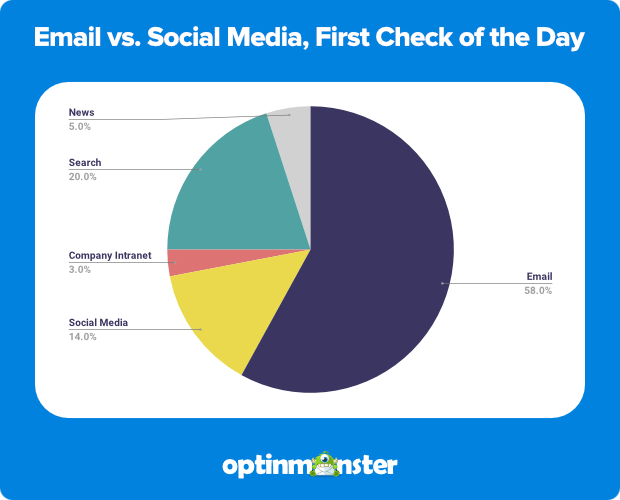
[00:17:24] Speaker B: For sure. For sure. Next one is automated email marketing. We talk about email a lot. We, we still believe it's one of the most effective tools for churches and just tools out there in general for business, personal use. I guess there's this stigma or this notion that email is fading away, but some data that actually we came across here. So what is this from, Optin monster or Opti monster? Optinmonster.
[00:17:51] Speaker A: Opt in. It's Optinmonster. Yep. Opt into an email list. That's what it is.
[00:17:58] Speaker B: I like it. Clever.
So what do people check on email versus social media? First check of the day, 58% of people are checking their email first thing.
First thing in the morning, I guess. When they start. What do you start their day? I do, I do.
[00:18:16] Speaker A: That's your first thing you look at in the morning?
[00:18:17] Speaker B: And then I look.
[00:18:18] Speaker A: It's funny, I look at the Bible first.
[00:18:20] Speaker B: Oh, very spiritual.
That's third for me. Thomas, I'm kidding.
But anyway, so the email would be 58% social media, 14%.
A Google search actually trumped social media for 20%.
[00:18:39] Speaker A: And then start your morning with what Google search do you do first thing, I wonder. That's interesting.
[00:18:43] Speaker B: Yeah, I don't know. I don't just start searching on Google right away unless it's like, what am I going to go looking for breakfast tacos near me, maybe. So anyway, but again, automated email is what we're talking about here. But that was just some good data to be aware of that obviously it's still very alive, your church sending out auto reminders of events, you know, timely messages, updates.
We've talked also about for newer visitors at a church that are being like assimilated and, you know, them getting auto emails for next steps of engagement at a church or assimilating. So definitely something that's still very effective for sure.
[00:19:23] Speaker A: I'm still floored by that stat of that email being the first thing that people go to. I hadn't, until we saw that and putting this episode together, I hadn't seen it.
[00:19:31] Speaker B: Yeah, yeah.
[00:19:32] Speaker A: They're a reputable source with those things. What? So I, I kind of think about this. I have kind of my morning routine and I found myself, I was joking before about the Bible thing. Like, but that is, I've, I found that I naturally want to look at Twitter and my email and my portfolio or whatever, you know, kind of what is the stock market doing? Yeah, that kind of stuff is what I look at first. So I had to like, you know, kind of atomic habits. This I had to habit stack. And so I say I'm not going to allow myself to look at any of those things until I've done my bible reading for the day. And so I kind of choose to do that first before I look at any emails or anything. So it is something that I was messing with you before, but it's something that I found to be helpful for me. But, yeah, with the, I do read.
[00:20:17] Speaker B: My bible in the morning. I just have to wait for my kids to be out of the house and off to school.
[00:20:22] Speaker A: There you go. That's true.
Yeah.
So yes, email marketing is a, it is. Again, it's one of the other low hanging fruits, I think, because most churches do not do it well. I think you hit it right with the weekly emails are great, but those new visitor sequences are so important. Someone came for the first time, build out a sequence that kind of helps them down that path of taking their next step, of coming back to another service, going to your assimilation process and getting involved in a place of ministry, doing all those kinds of things. That's going to, that is seriously low hanging fruit for churches. So good stuff. All right. Data driven marketing, that's number nine. So this is something that digital marketing has given us all kinds of new data. And you need to make your marketing decisions based on the information of what's working for you and what isn't. Yeah. So we do this all the time here at reach. Right. We have numbers on everything and I think churches need to do the same thing. So you'll find as you do things that a lot, like, I'd say even most of the stuff that we try here at retwrite, it has mediocre results. But most of our results come from like 20% of the actual marketing things that we do. Those are real home runs. So it's kind of like that 80 20 rule that you see this in all kinds of things. I think it's absolutely true with marketing is that 20% of the work you do is going to give you 80% of your results and 80% of your work is, meaning it's going to do only 20% of your results. So you need to measure what's working and you want to double down on those kinds of things and that's for everything. If you find that the way you title your sermons, it works well for you. When you're making it more keyword focused, do more of that. If you find that people are really responding to reels on Instagram and Facebook more than they are on TikTok, put more of your effort into Instagram and Facebook and just kind of keep doubling down and make your decisions based on that. So, so important. And I think, number ten, you can go with that one.
[00:22:31] Speaker B: Ian.
[00:22:31] Speaker A: It kind of goes along with that.
[00:22:33] Speaker B: It was a good segue to that is improvement in adaptation. So be willing to adapt, stay relevant. Look, like we just said, look at what's performing with all of your digital marketing. Track it. If you're not tracking it, that's huge, right? And especially if you're as a church, investing in marketing, why would you not want to track the results, of course. And be a good steward with that? So, yeah, for sure. See what is working for you, see what the trends are out there. Always be willing to adapt and improve on what you're doing. And maybe out of these ten things we've mentioned today, or these several things, if there's two of these things working really well for your church, that's good to know. If you're doing, like, seven different things marketing wise, and two are really outperforming the rest, then you need to continue to improve on those. And then, of course, that also helps you evaluate the things that are maybe not working. How can you improve there? So, yeah, it's definitely something. It's an ongoing commitment, for sure.
[00:23:35] Speaker A: So, yeah, double down on the stuff that's working there. So, hey, let me say this before we wrap up. If your church is kind of doing marketing, and maybe you're wondering, hey, what's working, what isn't? We offer a completely free church marketing strategy review, right? So we take a look at your church's exhaustive marketing. We'll send this to you in your inbox. You fill out a form, answer a few questions. We'll get you some information on what's working and what isn't, and then that'll maybe help you with what you need to be doubling down on and what maybe you need to back off from. So it's a hundred point assessment, and we'll give you marching orders and some good ideas totally free. Right, Ian? That we don't charge for that at all.
[00:24:16] Speaker B: Totally free.
[00:24:17] Speaker A: Yeah. Yeah. So take advantage of that. I'll have a link for that down in the description as well. Anything else to add as we wrap up, Ian.
[00:24:24] Speaker B: No, you can do it and do it if you're not doing it. Pastor yeah, good stuff.
[00:24:29] Speaker A: Hey, drop us a comment if you have something that's working for your church as well. We'd love to hear what marketing or what's reaching a lot of people. What is that 20% that's getting you 80% of the results for your church? Let us know down in the comments on that. Hit that subscribe button if you haven't already, if you're watching on YouTube, thanks for being a part of the retried family and we'll see you next time. See you.