Church Digital Giving Strategies for Maximizing Contributions

March 14, 2024 00:21:20
Church Digital Giving Strategies for Maximizing Contributions
REACHRIGHT Podcast
Church Digital Giving Strategies for Maximizing Contributions

Mar 14 2024 | 00:21:20

/

Show Notes

Church giving, tithes, and offerings don’t function like they used to. In today’s rapidly evolving world, church digital giving has appeared as a way for churches to boost their funds and support their missions.

With the rise of technology, churches are finding innovative ways to connect with their members and streamline the giving process. From online giving platforms to mobile apps, the landscape of church giving is changing, making it easier than ever for individuals to contribute to their faith communities.

In this podcast, we explore six simple yet innovative strategies that churches can implement to enhance their digital giving efforts. These strategies range from creating user-friendly donation portals to leveraging social media platforms for fundraising campaigns.

By embracing digital tools and modern methods, churches can reach a wider audience and cultivate a culture of generosity among their members.

Let’s jump in.

Estimated reading time: 10 minutes

Church Giving in the Modern Age

Church Giving in the Modern Age

In today’s digital age, churches are embracing online giving platforms to simplify the donation process for their congregations. These platforms offer convenient solutions that cater to the needs of modern churchgoers, making it easier than ever to support their faith communities.

The Rise of Online Giving Platforms

Online giving platforms have revolutionized the way churches collect donations. These platforms provide secure and user-friendly interfaces that allow members to contribute from the comfort of their homes or on the go. With just a few clicks, congregants can make their online church donations without the hassle of writing checks or carrying cash.

Streamlining with Recurring Donations

One of the key features of online giving solutions is the option for recurring donations. This feature allows church members to set up automatic contributions regularly, whether weekly, monthly, or annually. Recurring donations provide stability for churches by ensuring a steady income stream, making it easier to budget and plan for future initiatives.

Accessibility Through Mobile Giving

With the prevalence of smartphones, mobile giving has become increasingly popular among churchgoers. Mobile giving apps allow members to donate anytime, anywhere, using their smartphones or tablets. QR codes or text to give options provide an even easier way to use phones to give.

Whether they’re attending service in person or participating remotely, congregants can easily contribute to their church’s mission with just a few taps on their mobile devices.

According to crowd101, 54% of donors worldwide prefer to give online instead of in-person, and 34% are more likely to give on websites that are mobile-responsive.
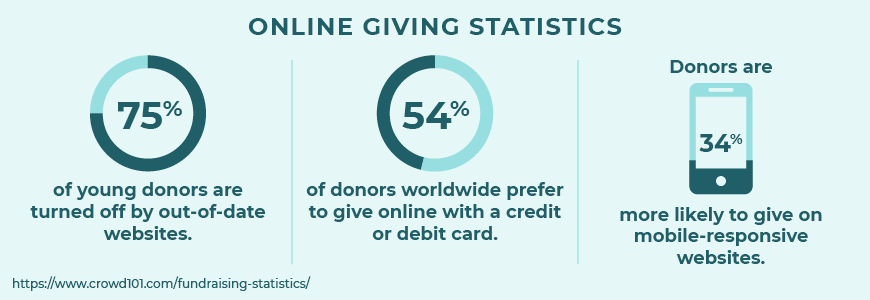
crowd101

Implementing Online Giving

Implementing an online giving solution may seem daunting at first, but with the right approach, churches can successfully transition to digital donations. Here are some practical tips to help churches make the most of their online giving efforts:

1. Choose the Right Platform

When selecting an online giving platform, churches should consider factors such as ease of use, security features, and compatibility with existing systems. It’s important to choose a platform that aligns with the church’s needs and preferences. This ensures a seamless transition for both administrators and donors.

2. Promote Digital Giving

To encourage the adoption of online church donations, churches should actively promote their digital giving options to members. This can be done through announcements during services, email newsletters, social media posts, and dedicated sections on the church website.

By raising awareness and highlighting the benefits of online giving, churches can inspire greater participation among their members.

3. Provide Support and Guidance

As churches transition to online giving, it’s essential to provide support and guidance to members who may be unfamiliar with the process. This can include offering tutorials, FAQs, and dedicated support channels to assist donors with setting up their accounts and making contributions

By empowering church members with the knowledge and resources they need, churches can ensure a smooth and successful transition to digital donations.

Embracing the Future of Church Giving

Online giving solutions offer churches a convenient and effective way to collect donations and support their ministries. By leveraging online platforms, implementing recurring donations, and embracing mobile giving, churches can streamline the donation process and create a culture of generosity among their members.

With the right approach and support, churches can embrace the future of church giving and continue to fulfill their mission of serving their communities and spreading the message of faith.

6 Digital Giving Strategies

6 Digital Giving Strategies

Here are our top six digital giving strategies to help you enhance and streamline your church’s online giving process.

1. Website Integration

Website integration is essential for churches’ online giving efforts to reach their full potential. By seamlessly incorporating donation forms and payment processors into your website, your church can provide a convenient and secure way for members to give.

This integration ensures that visitors can easily navigate to the giving section, making the donation process straightforward and user-friendly. With clear instructions and intuitive design, your church can encourage greater participation in online giving and foster a culture of generosity within their congregations.

Additionally, website integration allows churches to track donations more effectively and provide transparent reporting to donors. By prioritizing website integration for online giving, your church can maximize its impact and empower members to support the church’s mission from anywhere, at any time.

2. Social Media Campaigns

Social media campaigns can play a vital role in helping churches accept donations and engage with their communities effectively. Platforms like Facebook, Instagram, and Twitter provide your church with powerful tools to share their mission, stories, and fundraising efforts with a wide audience.

By crafting compelling posts, sharing impactful stories, and using eye-catching visuals, your church can capture the attention of their followers and inspire them to contribute. Social media campaigns also allow churches to reach new audiences and connect with individuals who may not be familiar with their work.

Using social media comes with the ability to share donation links, host fundraising events, and amplify donation appeals. It then becomes a valuable channel for churches to raise awareness and encourage generosity.

If you are able to leverage the reach and engagement of social media platforms, your church can expand its reach and make a meaningful impact in your communities through online giving.

3. Donor Recognition

Donor Recognition

Donor recognition is a way for churches to express gratitude and appreciation for the generosity of their supporters. It involves acknowledging donors publicly for their contributions, whether big or small. Simple gestures like sending thank-you notes, featuring donors in newsletters or bulletins, or creating a donor recognition wall in the church can make donors feel valued and appreciated. By recognizing donors, churches not only show their appreciation but also inspire others to contribute.

Donor recognition builds a sense of community and strengthens the relationship between your church and its members. It fosters trust and transparency, showing donors that their contributions are making a difference in your church’s mission and programs. Furthermore, recognizing donors publicly can encourage others to follow suit and become more involved in supporting the church financially.

In essence, donor recognition is about more than just saying “thank you.” It’s about acknowledging the impact of generosity and creating a culture of appreciation within the church community.

When you recognize donors in meaningful ways, your church can cultivate lasting relationships and ensure continued support for your important work.

4. Transparent Reporting

Transparent reporting is a cornerstone of effective stewardship for churches using church management systems and church giving platforms. It involves providing clear and comprehensive information to donors about how their contributions are being utilized. Transparent reporting ensures accountability and builds trust between the church and its members.

With a church management system, your church can easily track and manage donations, expenses, and budgets. These systems provide detailed reports that outline where funds are allocated, such as for missions, outreach programs, or building maintenance. By using these church giving features, you can offer transparent reporting to donors, demonstrating responsible financial stewardship.

Similarly, church giving platforms play a crucial role in transparent reporting by providing donors with access to their giving history and donation records. Through these platforms, donors can view their contributions in real-time and gain insight into how their support is impacting the church’s mission and initiatives.

Transparent reporting fosters transparency, integrity, and accountability within the church community. It reinforces the importance of stewardship and empowers donors to make informed decisions about their giving.

5. Digital Pledges

Digital Pledges

Digital pledges offer a convenient and flexible way for church members to commit to giving specific amounts of money over time. With digital pledges, individuals can pledge to donate a set amount on a regular basis. This works whether it’s weekly, monthly, or annually.

One of the key advantages of digital pledges is the ability for donors to automate their giving. By setting up recurring payments like monthly fees, donors can ensure that their contributions are made consistently and reliably, without the need for manual intervention.

This not only simplifies the giving process. It also provides your church with a predictable stream of income to support its ministries and operations.

Digital pledges also allow your church to offer different giving options to accommodate the financial situations of their members. Whether someone wants to give a one-time gift or commit to a monthly fee, digital pledge systems can accommodate various preferences and circumstances.

Moreover, digital pledge systems often provide transparency and accountability by allowing donors to track their giving history and monitor their pledges. This builds trust and confidence among church members, knowing that their contributions are being used effectively to support the church’s mission and activities.

6. Personalized Messaging

Personalized messaging is a powerful tool that churches can use to connect with their members on a deeper level. It involves crafting messages tailored to the unique interests, preferences, and needs of individual congregants.

By addressing members by name and acknowledging their specific contributions or involvement in church activities, personalized messaging helps foster a sense of belonging and community. It shows that your church values and appreciates each member as an individual.

Personalized messaging also allows your church to communicate more effectively and meaningfully with their members. By sending targeted messages based on demographics, interests, or past interactions, churches can deliver content that is relevant and engaging to each recipient.

Moreover, personalized messaging can be used to inspire and motivate members to get involved in church events, volunteer opportunities, or fundraising initiatives. By highlighting the impact of their participation and showing how they can make a difference, personalized messages encourage greater engagement and support from members.

In essence, personalized messaging is about building relationships and strengthening connections within your church community.

Online Giving for Churches

Online Giving for Churches

Adopting digital giving methods like online donations, text-to-give, and recurring giving is crucial for churches to thrive in today’s world. By utilizing a reliable giving platform, congregations can simplify the donation process and encourage consistent support from their members.

These innovative approaches not only make giving more accessible but also strengthen the bond between the church and its community. With the care of donor recognition and the reliability of recurring giving, churches can ensure a steady flow of support for their ministries and outreach efforts.

As we move forward, it’s clear that embracing digital giving is not just a trend but a necessary step for churches to continue making a positive impact in the lives of others. Let’s keep advancing together, building stronger connections and spreading hope through the power of generosity.
Further Resources on Giving

View Full Transcript

Episode Transcript

[00:00:00] Speaker A: Hey, guys, I'm Thomas. [00:00:01] Speaker B: And I'm Ian. [00:00:02] Speaker A: And today we're talking about digital giving strategies for churches and how you can help your church maximize your contributions. Important topic, not necessarily a popular topic for a lot of us. I think a lot of church leaders are scared or intimidated of talking about giving, but we want to hit it head on. I think there is a lot to be said here. Some of this is going to be kind of like it's a theological question. Some of the stuff we might dive into a little bit here, whether or not it's something that is warranted or allowed in scripture. Maybe you'll have some different opinions on some of this stuff from us, but we want to talk about what's working for churches and when it comes to the area of digital giving. And I think it should be a good conversation for us today. [00:00:48] Speaker B: Yeah, absolutely. And one thing I will say is that I rarely. Now, we've been helping churches for a very long time, for well over a decade, and it used to be very uncommon for churches to have digital giving options and it was much more controversial, I will say. I still run into the occasional church that wonders if they should be doing online giving, but that is extremely rare. I will say 98% of churches or more, maybe even 99% that I come across, have online giving to a certain degree nowadays. [00:01:25] Speaker A: Right? Yeah. That's not theological question I was even thinking of. [00:01:28] Speaker B: No. [00:01:28] Speaker A: Whether we do it or not. [00:01:30] Speaker B: No, I just had made it come to memory. [00:01:34] Speaker A: We'll dig into some other ones, I think, in here for sure, but absolutely. Let me start off. We have six total, I guess, kind of tips or strategies to be thinking about. So the first one, it's very obvious, I think, but it's website integration. So it is super important that you integrate any digital or online giving solutions into your church's website, in addition to having places where people can do it on Sunday morning. Because I think that I know for me, when I set up my giving, I'm someone who gives almost exclusively online. [00:02:07] Speaker B: Same here. [00:02:08] Speaker A: Digital. So I don't remember giving like cash or a check into our church offering buckets in years. So everything is digital for me. But you do want to integrate this, not just on Sunday morning. So I know a lot of churches are putting a QR code up on your slides, or maybe you have one on the back of seats in your sanctuary there, but you definitely want to have it on your website as well. We always emphasize that we don't want it to be the primary focus of your website. You don't want like about us and ministries and get connected. And then a big button that says give now or something is your main thing on the site, but it should be something. It's a healthy part of any organization. You need to have some kind of revenue. And so having an option for people to give online, I think that really is important. So you do want to have that on there. One thing that I think we should acknowledge is that when you integrate it online, we have found one of the biggest mistakes we see churches make is that all you do is just, you have a button or something that says give and then it takes you directly to a spot where you could put in your credit card information. That's a big no no. Because what you want to do when you integrate it online, really, it's about kind of telling the story and your theology and your heart behind giving. And not just driving someone to a place where they've already decided they want to give, but instead helping them through that process of giving. It's a great chance for you to teach about what your church may believe about tithing or offerings and how much people should give and when you should give. And should it be your first fruits or should you give your leftovers? Or talking about all those kinds of topics. People have dozens of questions that can be answered on your church giving page. So really a good opportunity. You want to make sure you integrate all that into your site. [00:03:58] Speaker B: Yeah, that's good. That is something we stress when we're building websites or just consulting churches on theirs. I still see that that's pretty common, unfortunately. Just a link right out to where they're giving. One other thing I'll add before touching on the next one. I like that you mentioned we don't recommend. It's the main focus. I do remember seeing on a church website one time that they called it the Joy button and it was the biggest thing on the whole website. They called it the Joy button. [00:04:27] Speaker A: Yes. [00:04:27] Speaker B: God loves a cheerful giver. [00:04:29] Speaker A: It just said. What did it say? It said, joy Button is what joy. [00:04:32] Speaker B: And then it was a PayPal link. [00:04:34] Speaker A: Yeah. What brings you joy more than now? [00:04:39] Speaker B: Again with the storytelling? We're talking about. Talking about what it means for your church. Definitely you can address the joyful part of it, but we don't recommend a giant joy button or giant giving button. Well, next one is social media campaigns or just using social media, obviously to drive donations and giving. When I said drive, I promote it. [00:05:01] Speaker A: Whatever. [00:05:01] Speaker B: Give people the opportunity, however you want to look at that. But I think that's often kind of missed everyone. It's obvious these days you want it, like you said, integrated into your website. But social media could be where you actually do tell a little more of that story. Yes, you can do that on a giving page on your website, but on social media you can have testimonies of maybe it's someone who just recently started tithing and saw how God honored that and impacted them. Or it could be for outreaches that you're promoting, obviously, where people can see you taking ministry in action at your church and focusing on the need, community needs or whatever it would be. So definitely don't rule that out. Compelling posts, stories, good visuals to it, definitely you want to make sure that you're promoting and highlighting that well, telling the story of it well there, even though that's not the best place for someone to actually give the donation at through social media, that is usually better carried out on your website or other areas. But yeah, it's definitely where you can tell the story. [00:06:10] Speaker A: I think you say it right, so it's a place to tell compelling stories about giving. So I think what doesn't work is a link to your giving page and say, a text that says, hey, don't forget to donate, or hey, have you given this month? Or whatever you want to say that doesn't work, right? Yeah. So I think you gave a couple of great ideas. So telling people, people sharing testimonies of what God has done, as they've been generous in certain areas of their life and giving people an opportunity to respond. So it's to reinforce some of those stories. The one place where like a direct donation request does seem to work is when it comes to times of challenges and tragedies, those things. So if there's been a major disaster in the area or there's a specific organization that has a lot of presence in kind of the national attention right now, giving those opportunities for people to give to those specific causes. At that time here in Hawaii, we had the Maui wildfires that happened about six months ago here where people lost their lives and thousands of homes were destroyed. And it was really a major story here for us. And because we're such a small state, it just felt really close to home. And so that was a thing that we did consistently at our church is we had some social media posts and we talked about it in church, but we talked about the impact that giving to our church and our fund for helping Maui, the impact that that would kind of make there. We told stories around it and that's something that can be successful but I would advise against just kind of general, have you tithe yet? Kind of social media posts, probably not the best way. Tell stories. That's what social media is for. [00:07:59] Speaker B: That's good. [00:08:00] Speaker A: Use pictures, use videos. Do those kinds of things. [00:08:02] Speaker B: Yeah. [00:08:03] Speaker A: Next one. And this is where we get into a little bit of controversy, I'd say, is the strategy of donor recognition. This is tried and true in the secular world of nonprofits, that donor recognition is a proven tactic. I'm not here to argue that it doesn't work, because it does work. People, when they are recognized, they do tend to give more. And when we have those kinds of things, when nonprofits recognize their biggest givers, that is a net positive for their bottom line in most cases. That being said, we operate by a different standard within the church, and I think there's a case to be made for whether this is right or wrong. I know some churches that do some of that. I've been to churches before where when they're in a building project, they would have people give money to get chairs into the building or pews into the building, and you'll see pews that are marked, and it has the person that donated the money for that pew right there in the church there. So I don't recommend that. I think having your name on the building probably doesn't belong in most churches, and I've seen other churches that do, like generosity teams. So there's the people that are big givers that they have special celebrations for people that are regular, large donors to the church. And part of that rubs me the wrong way. I'm not a huge fan of those kinds of things in some ways, but at the same time, I can't argue with the effectiveness of that. It does seem to actually make an impact. And when people are recognized and you're able to speak directly to some of your largest givers and recognize them, it does tend to produce results. So this would be a good chance. You probably have some things to add, but I'd love to hear in the comments down below what you think about that. Should churches have generosity teams and should they recognize their largest donors? That'd be a good conversation. I'd love to hear kind of what the reachwright family, what you guys think about those kinds of things there. So I don't know, what are your thoughts, Ian? [00:10:08] Speaker B: No, you covered a lot there, Thomas. Not too much. Just my church did something similar, and it was interesting when it happened because it was the first time for me. I do tithe and give regularly to my church as we hope everyone would. But at the same time, I was invited to a special dinner at the church that was put on. My wife and I were both invited, and it was when we were going into a building campaign. And it was more of an appreciation, I think, for being generous consistently. And the dinner was provided. It was nice, it was socializing with other leaders in the church and everything, but we were kind of like the first to be made aware of the building campaign and to pray about what we would give and pledge to it. So it didn't necessarily rub me the wrong way, but it was interesting. I was kind of like, okay, I kind of didn't know what to think about it. But at the same time, anyway, it was a personal experience that I went through with that. [00:11:08] Speaker A: One thing I'll mention, too. So we did a whole video, not a podcast episode, but I did a video about whether or not pastors should even know how much individual members of the church give. That's always been one of my philosophies is I never knew the individual donation amounts of individual people within our church just because I didn't want that information as a church leader, I didn't want to be beholden to anybody with those things. So if you want to check that out, I'll put it up a link in the description. If you're listening, you'll see it there. If you're watching on YouTube, you'll see it up in the cards here and in the description as well. But we talk kind of a deep dive on whether or not pastors should know how much individual members are giving. So we can leave it at that. [00:11:50] Speaker B: Yeah, that's good. Next one is transparent reporting. This one probably not so controversial here. We believe every church should be transparent about what donations are going towards. Now, one of the things I'll just say, also from personal experience, I like you, Thomas, have tithed and have given on line for years now. I like that the software that my church is using allows me to see my contributions and track them and see what it's going towards. But a step further than that from just the individual donor is to just make know if you did raise certain amount of money for the building and now you're debt free, share that with the church. Share if there was a specific. I know my church does a lot of missions in Mozambique, Africa, and we've built schools there for kids and all sorts of stuff. And we talk about how our giving has helped fund that and how much went towards that. And that always makes people feel good about, obviously where their donations are going. [00:12:55] Speaker A: Yeah, I'm a numbers and stats guy. I mean, we operate on that. You look at reach rights, we have dashboards here where we track just about everything. [00:13:04] Speaker B: You drive me crazy with them. [00:13:06] Speaker A: But yes, big fan of transparent reporting on things as an organization here. And I think that churches can really use this because you have a certain subset of your church. Certain people in your church are like me, where we're number nerds and we love to see how much should we bring in and what's the trajectory and what are we spending it on and that kind of stuff. So I think this is only a net positive. As long as you're doing things righteously, it's a net positive. And I think it gives people a different level of confidence when they can take a look at what do the actual books look like and putting this stuff out there for people, you don't have to get into every detail. There's certain, obviously I mentioned before, like knowing individual donations amount. That's a no no. I'm not a fan of people. I know some churches do this, but I'm not a fan of everybody in the church. Knowing the compensation of every staff member, I think that just leads to complexity, especially as your church and organization grows. It's one thing if you have one pastor, I think, and that's just it. But the moment you have more than one, there's all kinds of comparisons. I would probably shy away from that. But beyond that, I think just kind of having an open book philosophy with these things. I always had that and I think just you don't maybe want to put your entire PNL out there every single month because it's just kind of dry data. But I think that having information available to church members and probably not even on social media, but like, hey, here's what we're doing. And seeing some graphical charts of where things are going. Trajectories. There is a percentage of your church population that's going to be interested in that, and that's only going to affirm their commitment to giving and partnering with you as long as you're doing it the right way. That's good, personally. Yeah. [00:14:54] Speaker B: Good addition there. [00:14:55] Speaker A: All right, next one is digital pledges. I think this is a cool thing that is really kind of emerging right now. It's something that really didn't exist the same way even a few years ago. I've been to building campaigns and things where you're given a card and you fill out. Over the next three years, we're going to give this amount and it's going to boil down to this much per month. And what an opportunity to take a lot of those things online and invite people to make those kinds of commitments just right where they are. And they actually having a record of this kind of stuff here lets you just reach a much larger audience to do those kinds of things. So I think that it's probably not something that I would do at a church, kind of like on an annual for your normal ties and offerings. But I think especially when it comes to things like building programs or maybe special commitments that you guys want to make to. Maybe you're trying to buy a van for the youth ministry or something like that. Depending on your church size, it's going to be different kind of projects. But I think this is a really great way to help people kind of get involved and measure and maybe even start to take some steps that you may have to take. Like if you're building a new building and you need to raise $5 million to build said building, well, you probably want to know how much people are committed to giving before you start stepping out on architecture and site work and that kind of stuff that has to happen there. So getting this stuff early and kind of some commitments towards that, it's not the same as actually having cash in hand, but having commitments is something that you can actually do. I don't really know a lot of churches that follow up on said commitments because that'd be a tough phone call to make to say that, hey, you said you were going to do this and you haven't. So what's going on? But I think a commitment is only as good as its accountability in most cases. But I think just the fact of having something like that and having people decide, I am going to do this and commit to it, there's just a certain weight that comes with that. I think that is valuable for most churches. [00:16:56] Speaker B: I do know of a church that when they had a pledge campaign for building for a new building, and when someone committed to pledge a certain amount, if they did not follow through with that, they sent out statements. I was aware of statements where, hey, here's your balance. Here's where basically you didn't follow through. [00:17:21] Speaker A: And if you phone calls, I think though, Ian, you'd be good at making. [00:17:24] Speaker B: Those calls to people. [00:17:25] Speaker A: Hey, I couldn't help but notice that you're $7,000 short this year. [00:17:30] Speaker B: I think I'd like to stick to the calls we help churches with here at reach. Right. But there you go. Well, last and not least and this one's interesting, is personalized messaging, and I kind of didn't know what to think about this one when I haven't given much thought to it until we addressed it for our podcast. But this could be where you're crafting, like, particular messages for members that have certain ministry interests. So let's just say it's someone who really cares deeply about your youth ministry, and there's a big event or something coming up, a ministry initiative for your youth department that you want to possibly engage a donor with. This might be where Tom, who loves your youth ministry wholeheartedly, is made aware of that. So it could be, like, past ministry involvement. If someone served in the outreach, that's good. They would care, obviously, about this cause. So I don't think it's when I said I didn't know what to think about, I don't think it's controversial. I think maybe being careful with it and not obnoxious, and hitting up everyone based on everything they've ever did at your church to give to all sorts of things, but nothing wrong with if someone has given their time or talents to a certain area of ministry, letting them know about upcoming opportunities for them to give financially towards. [00:18:53] Speaker A: Yeah. So I think people think, when you think of personalized messaging with giving, I think people are worried it goes hand in hand with kind of recognizing donors and saying, hey, Joe, I noticed you gave $5,000 last month, and I'd like to ask you to do it again, that kind of a thing. And I'm not necessarily going there with that, and I like what you're saying. It's just that really what we would call this is segmenting is when it comes to email marketing, which we talk a lot about. We've done several episodes on email marketing, segmenting your list and making sure that it's personalized, not based on amount given or past generosity, but based on interest, on where they are in life and life place. So it makes sense if your youth group is saving up money to get a new van to take kids to camp, that you do a lot of personalized messaging to the parents of kids that have kids in youth ministry or kids that are coming into youth ministry, or those kinds of parents, as opposed to just broadly putting the stuff out there to everybody within your church. So nothing wrong with that. But I think just the more segmented and focused you can be on any kind of a campaign, especially when it comes to giving campaigns, I think that really goes a long way. So personalizing is just an overall philosophy that I think that is really important right now. We're getting into this time where everything can be tailored and personalized and people within your church are becoming more accustomed to things being personalized for them in every other area of their lives. So it's going to be an expectation, I think. [00:20:28] Speaker B: Yeah, that's good. [00:20:28] Speaker A: Yeah. Just doing your best to make sure people are getting the right messaging for their interests and needs and life place. That really is something that can be a powerful tool when it comes to online giving. [00:20:39] Speaker B: That's a good way to put it that probably something like this will be expected. [00:20:47] Speaker A: Good. Anything to add as we wrap up? Ian? [00:20:49] Speaker B: No, we hope this was helpful, of course, as we always say. And we hope that maybe this gave a few different ideas to churches that already had online giving but just needed a little more strategy behind it. [00:21:01] Speaker A: So yeah, I really want to know what you think, though, about that question of whether or not it's okay to have generosity teams and those kinds of things. Does your church do it? And what's kind of your thought behind it? Please do take a second to drop a comment down below. Hit the subscribe button. Thanks for being a part of the Reach right family and we'll catch you next time. [00:21:18] Speaker B: See ya.

Other Episodes

Episode 0

December 13, 2022 00:33:18
Episode Cover

10 Dos and Don’ts of Church Advertising

Churches have traditionally relied on word-of-mouth and physical signage to spread the word about their services. But in this digital age, everyone is communicating...

Listen

Episode

November 28, 2024 00:29:04
Episode Cover

Ranking the Top Church Giving Strategies in 2024

In 2024, there are so many ways for people to give to your church. Check, cash, credit card, you name it. In this podcast,...

Listen

Episode

July 17, 2025 00:21:50
Episode Cover

The AI Church Controversy That’s Breaking the Internet Right Now

Artificial intelligence has been moving fast. Maybe too fast. In every corner of our world, it’s changing how people think, work, and yes—worship. What...

Listen