Episode Transcript
Speaker 0 00:00:00 In today's episode, we unpack the anatomy of a Google search. Every search that's done online has three distinct parts and understanding the differences in those parts will help you reach more people. We hope this conversation helps your church reach more people and grow. This is the retried podcast.
Speaker 1 00:00:28 You're listening to the read-write podcast. The show dedicated to helping pastors and church leaders reach people the right way, hosted by me, Thomas Costello. And with me as always is my cohost Ian Hyatt. We're here to help you your church see more visitors and grow
Speaker 0 00:00:55 Well. Hey guys. Welcome the reach right podcast episode number 50, the big Five-O I'm your host Thomas Costello. And with me as always is my cohost
Speaker 2 00:01:05 Ian Hyatt. Hey Thomas, how's it going? 50 huh?
Speaker 0 00:01:08 50 deep that's how, how it's going. It's going. Good, man. It's been fun. We're coming up. It's good to get a nice big round number, been fun. We've learned a ton doing this, and I've got an exciting conversation here today. We're going to be talking about the anatomy of a Google search and how your church can be more visible on those. Um, so I think it's going to be a really helpful one. I think that, um, the world is changing, but you know, when we started doing, uh, digital marketing for churches, you know, you and I have been doing it for 13 or 14 years now. Um, like this is something that it was just about getting, getting a website online was like thing one. Right? And now the question is shifted to not just how do I get that done, but how do I show up? So people can find me. And that's the theme today I think is how we get people found online. Um, so
Speaker 2 00:01:59 I'm trying to, you just reminded me of, like you said, you know, maybe about eight to 10 years ago, it was just all about, yeah, just getting a website on there. And the only question that we would get that was kind of humorous, but it made sense that that pastors and ministry leaders would ask it would be. So when you set the website up, we'll all the web crawlers and all of that stuff, be able to find it. So that was the, that was the only question we would hear about, you know, being visible online would just be getting the website and making sure the web.
Speaker 0 00:02:31 Yeah. I mean, it's just that the, the reality is, is that used to be the way that we would think about this stuff is if you build it, they will come kind of an approach. And it was never really true, but it was more true that you could build a website and just kind of hope for the best. And it wouldn't be found at points, but, uh, my God nowadays, if you're not really intentional about this, it's almost impossible for your website and your presence online to ever be found. So it's been really neat to see churches, to take this much more seriously than they ever have before. Obviously it's something that we serve churches in. So we're at the forefront of this and know a lot about this. And I think some of the confusion that I I'm sure you hear this from people a lot is, um, when someone says, Hey, we want to be found on search engines or we want to do search engine optimization, or we want to do search ads.
Speaker 0 00:03:20 And like, these are different things that we're talking about, right? There's, there's some differences here. And so that's the goal today is to try and clear up some of that confusion on what's really happening when you're doing a Google search. What, what are the results showing you? Because there's a few different kinds and we want to kind of give a breakdown to people of the, really the three different areas, three different kinds of results that you will be given when you do a Google search. Uh, and then we want to talk a little bit about, um, what you do to make your church visible in each one of those areas, because the way you do it is actually pretty distinctive from one to the next, like the, what you do on one doesn't have any effect on how you are, uh, visible in other areas of the Google search there. So yeah, that's kind of the goal for today.
Speaker 2 00:04:06 Yeah. And you know, one of the things I wanted to say too, before we dig in to each one of these parts of the anatomy, if you will, is I love that I'm hearing from more and more pastors and ministry leaders that they want to be visible. They want to rank, I hear things like I hear ministry leaders saying things like we want to be very visible. We want to be our web presence to be more known. We, you know, I'm hearing more of that now rather than just, we want our website to be found, or we just want to be visible. We, when people are searching, we want to be found. So I think it is a hot topic. Now it's something that, that, that pastors are more privy to now. And so I think that's, that's a
Speaker 0 00:04:46 Great thing. Yeah. I think one thing I'll add too, is we get a lot of pushback on our social media channels in any place where we kind of have free discussion for people that this is kind of, the people see this as the antithesis to the great commission in some ways, like they'll say, you know, Jesus called us to go into all the world and preach the gospel, not to preach it to a computer. You don't want to say these kinds of things and really my worldview. And the way that I see this as this is the fulfillment of the great commission, more than it is kind of a moving away from the great commission. This is, I mean, we, we, we hear stories all the time of people listening overseas and watching overseas and connecting with churches that they never would have connected with.
Speaker 0 00:05:25 We talked about this, we talk about this all the time, but this is the way that when people are out there looking for answers for spiritual questions or for answers about what happens after we, we don't live in this earth anymore. What's going on with that. People are looking online and we can actually answer those questions and connect them with churches and disciple them. This kind of stuff happens online. So in our view, this is the fulfillment of the great commission, not in response or in rejection of it. This is really the way we can reach people nowadays. So that's,
Speaker 2 00:05:57 It's just, it's not replacing personal evangelism and personal relationships. Definitely not. It's just another way to, to advance the gospel and get, get that in front of people. And like you said, answer questions.
Speaker 0 00:06:10 So, yeah, exactly. Right. So we'll go ahead. I'll let you kind of, uh, run, uh, and kick us off here today. So, uh, in a search, uh, there are a few different parts, like we mentioned. So usually when someone does a search, what is the first thing in the results that they will see?
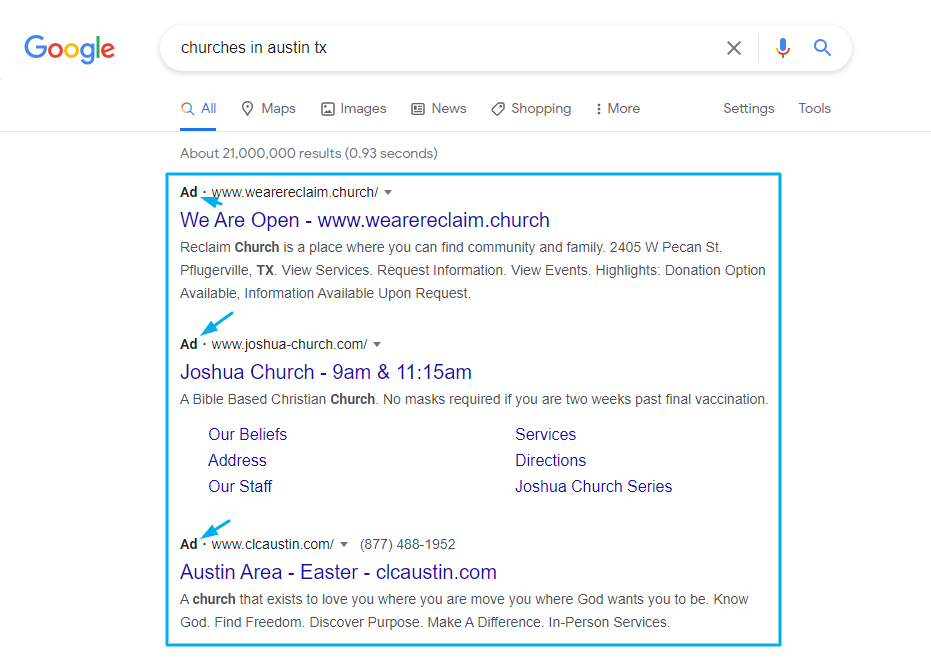
Speaker 2 00:06:26 Yes. First thing usually that they will see is an ad for something. And this could be, you know, if someone searches churches in Austin, Texas, an ad can pop up for that. It might be best Mexican food in Austin, Texas, you know, and this is not just for, it's good to kind of use some other examples, not just church specific, because I think a lot of people, they do Google searches daily, right. From their phones. And they're one of my favorite searches is lunch near me and I'm just needing ideas. And so the same to be said. So when someone does a search, he, and a lot of, and there's a lot of different kinds of searches. The first thing that they'll see usually pop up, it's usually towards the top. Sometimes it's towards the bottom is an ad. So in this could be an ad for your church. So Google ad words. And now I think just Google ads as it's called, these have been around for a while. It's something that many churches pay for and have a monthly budget for. It's obviously something that businesses pay a ton of money for, especially the big ones and very profitable ones, but church specific ads are available Google ads. And so that's, that's usually the first thing that pops
Speaker 0 00:07:46 Up. Yep. That's right. Yeah. So it used to be that the ads would on a computer at least they'd show up on the right hand side. They don't really do that anywhere. I remember they used to be ads over there, but now they're all in one line typically. And usually you'll see a handful at the top. And then you'll see a couple at the bottom of the search. Yeah. So, um, you know, we, we did some testing here today just to kind of see what's normal right now. I did a test. I got four ads. I think you had one on the one that you did there. And so this does happen. You will see these ads and these are paid ads. So these are places that people, it makes sense that they're at the top because they're paying good money to be there. And it's a whole different game.
Speaker 0 00:08:28 It's a pay to play kind of a thing. Um, people have asked me before, how much do these ads cost on Google? So the base rate, the way Google ads work is they're paid by click. So it's not every time you show the ad. It's every time someone clicks on your ad. So for someone to click on it, it costs as little as 5 cents. That's kind of the floor, uh, for a click, uh, to literally hundreds of dollars, hundreds of dollars per click. So, um, I have, I I've seen ads that cost upwards of $300 for very specific keywords. But as far as categories, some even categories of ads costs on average, like an average cost of an ad is close to $60. One of the highest ones, this is interesting is bail bonds, bail bonds is one of the things, because if you think about it, if you're typing bail bonds into a computer or into a phone, you probably need to make a purchasing decision on that pretty soon.
Speaker 0 00:09:24 Right. It's kind of an urgent thing that's happening there, right? So you're a, I don't know where you are exactly when you're doing it, or if it's a family member, but you're ready to buy in the next few minutes probably to do something like that. Yes. So average keyword price for bail bonds is $58 a click. So just for the click, even if you just get on there and you have no interest in buying bail bonds, you click on bail bonds. They paid Google $58 for that click there. So wow. Churches in general. Um, I'd say their keywords that we usually target and rank for. They cost on average between a dollar 50 and five or $6 for some of those key words. Uh, and, uh, that is, can be a very good investment for churches. But, uh, as we talk about all the time on this, this channel on this podcast, we have an even better option. I'll let you go ahead and talk about what that is. So we don't have to talk for it. We
Speaker 2 00:10:19 Have talked about it before, but it's an amazing opportunity that, uh, many churches still do not know about. And that is the Google grant. So, and because of after everything you just said, some of our listeners might be, well, we don't have a huge budget. Well, here's the good news. You know, the Google grant is something available. If you are a 5 0 1 C3, which most churches are, you qualify for it. Google gives you up to $10,000 a month and literally that much $10,000 a month of these Google ads that can be, make your church more visible when people are doing searches. And as we've talked about it before we help there's, there's a work that goes into that. And we've, we've, we help churches with that. But the grant is absolutely free to get and for churches to take advantage of, and this is something that every church we believe every church should be aware of and try to use.
Speaker 2 00:11:11 Cause it's, it's pretty much a no brainer and it to be clear, Google, you know, I hear often this is too good to be true. It's really not. And it's a big part of Google's brand. Google is of course become extremely successful in more than one way over over the years. And this is their way of giving back and they're doing it to other organizations that give back churches most certainly, hopefully are giving back to their communities and serving their communities. So as well as other nonprofits. So it's a great thing that's been around for years, looks like it's going to remain. And, and so yeah, we highly recommend that.
Speaker 0 00:11:47 Yeah. I think every church should, uh, get out there and claim it. Uh, that being said, um, I think that the Google ads platform by itself is not something that you can just walk in there and use, uh, and get great results. And on top of that, when you use their ad grant program, they put a bunch of additional kind of restrictions and things on the kinds of ads you can run. And some of the scores that they need to have. So I don't want to get too deep into the weeds with this and kind of the technical stuff. But one of the big, what used to happen is churches would, or any nonprofit, they realize, oh, I get $10,000 a month. So let's just advertise to everything to everybody. It's free money. Let's just take it and Google wised up to that pretty quickly.
Speaker 0 00:12:32 And so they put this limit on there. Uh, and what they say is that your ads need to have a 5% click through ratio. So that means that the ads that you're giving to people, they will, if you, you need to maintain that every time an ad is shown that one out of 20 times, people will click on it and go to your ad. So if you are, um, if someone is searching for, um, uh, restaurants in Austin, Texas, and you're a church and you say, well, Hey, we offer communion some Sundays. So we have some food at our place. So let's put our ad out there. Google will start to realize, Hey, nobody seems to be clicking on this communion ad that we have here. Cause they're actually looking for restaurants. So exactly. So it's one of those things that, uh, you, you need to have relevant ads that actually people will click through.
Speaker 0 00:13:23 And so there are a lot of technical requirements. It's not something that if you've never done any online advertising, that you'd be able to walk in and immediately get $10,000 of results on there. Uh, so there are services out there. We provide a service that does this. And, uh, we kind of are our industry leader with this area here. So we have a link. If you're watching this post online, there'll be a link over to where you can learn more about our service to help with that. But regardless, I think it's something that every church should be taking advantage of. Even if you can't spend most of it, get on there, claim it, use it. And there's a lot of opportunity here. Anything else to add on that one? Again,
Speaker 2 00:13:59 One thing about these ads is that you can, even though you, you want to, like you said, Google wised up and you want to be specific in how you're targeting people and you want this to be these, to be ads that are of interest in church related somewhat. It could be a little unrelated and still makes sense. So yeah. So one thing to point out is that it could be someone just looking for prayer and might be spiritual answers. And that is church related. It might be things to do in Minneapolis. We keep saying, Austin, let's use another example over the weekend. And you might have, you know, your Easter egg hunt, you know, that you're putting on for the community. That's still relevant. So you can be a bit broad, but you're still targeting people with these. So I would say that this part of the anatomy of becoming more visible, it, it has a lot of flexibility. So it has, it has, it it's broad, but still targeting the people. It's not, you know, you don't want to target people looking for PlayStation fives. And then all of a sudden they end up on your home homepage of your church website. So it's still gonna be related, but it can be a bit unrelated to is maybe I would just add that. Yeah. I think that's
Speaker 0 00:15:08 Really, that's important an important distinction there, because this is usually targeting people that may not be looking to find a church service to go to today, but all kinds of felt needs like that. You mentioned things to do that at the last church I pastored that was our big bread and butter with the ads. Is that and prayer, that was really a big one for us too. But people looking for those kinds of items, uh, there'll be typing in things to do in Madison, Wisconsin, and our church services would come up or events we had would come up that kind of stuff. So, yeah, that is a, that is a huge part of it. It is more, uh, people that aren't quite at that showing up on a Sunday morning point yet. Uh, because the next one we're going to talk about, that's more targeting those kinds of people. So why don't you, uh, hit the second part? So at the very top we have ads and then right below that, what usually shows up next to you. Yeah.
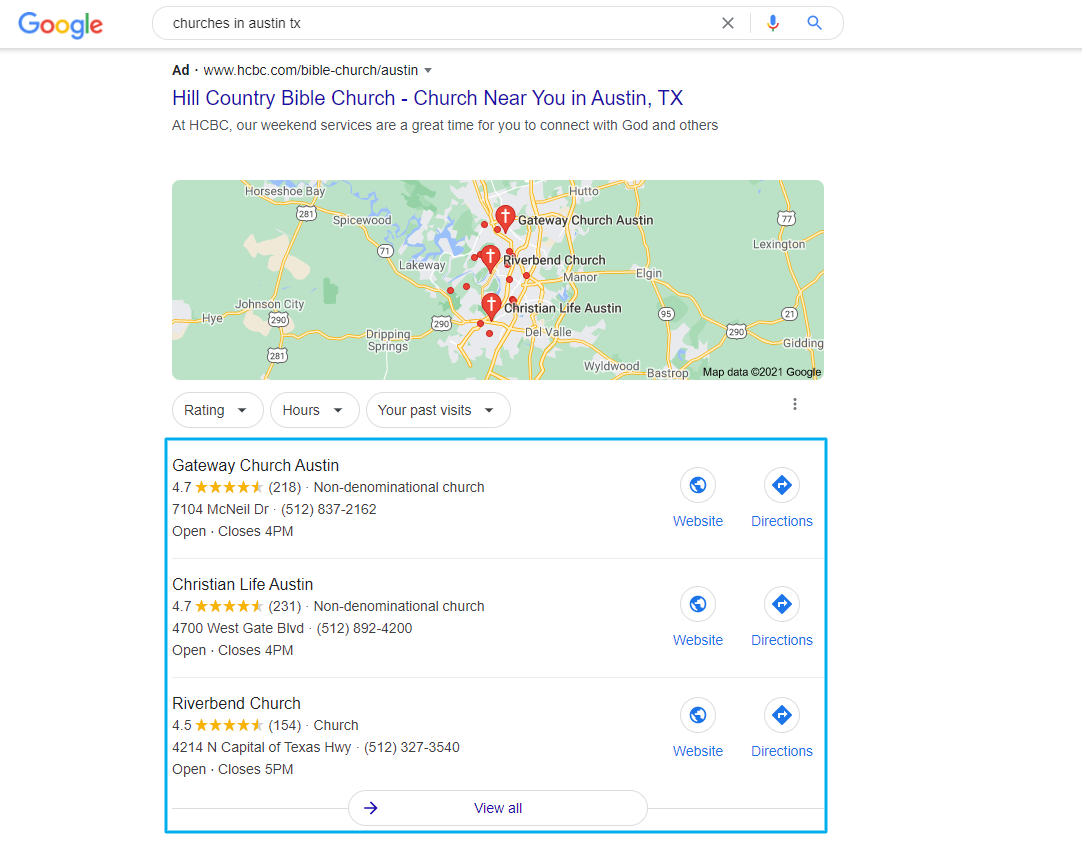
Speaker 2 00:16:00 And the next one is the map pack. And the reason I just kind of gave that example about how the ads, the Google ads are a little more abroad. This is a specific local search. So the map pack is what people see when they do Google something. It's, it's that top three to make maybe five. Sometimes it's usually three of churches that come up when someone does a search like churches near me, uh, you know, churches near me, churches in Austin. It's the list that you come up in that little box and square. And that's really huge because that's just going to put you right at the front. And it's someone that's doing a search in your area, specifically someone right there locally. And so that's the difference with this kind of a search is that it is specific to someone searching locally for, for a church.
Speaker 0 00:16:56 Yep. Yeah. So if you, if you just targeted people searching for churches in the ads, you would, there's not enough volume there, right? So there's not enough people doing that to be able to make a huge debt, but in this map pack area. Uh, so this is usually a map and it'll have usually like the list of the three most what Google deems to be the three most important organizations that meet that requirement to that search that's who they're usually going to put out there. So if you search for Mexican restaurants in Austin, Texas, Google, and its algorithm will do some calculations and say based on where this person is located right now in the city and what time of day it is. And who's open, this is probably these three Mexican restaurants are probably the ones that are most appropriate to show to them.
Speaker 0 00:17:42 And so the goal in, uh, and trying to reach people in this local search area is people that are typing churches, uh, or maybe they're typing in things like youth groups or children's ministries or that kind of stuff. So, but it is pretty specific and they have some kind of a location intent is what we call it. So they either type in mere me or in Austin, uh, or sometimes Google is smart enough to know if you just put in churches that you might be looking for churches in Austin, because you happen to be in Austin or in Honolulu or wherever you would wind up being. So, um, so these are, um, these are a very different kind of search. This is the newest of the searches. We're going to talk about the newest type, uh, is this map pack search. And, uh, the way you actually reach people on here is very different from how you reach people or how you show up on the ads. And it's very different from how you show up in other kinds of searches. Uh, there's some really specific things you have to do. So maybe you can talk a little bit to us about those and about the ways that people can help their ranking when it comes to the, the local or the map pack sector. Yeah.
Speaker 2 00:18:48 Yeah. So that's, that's basically, uh, what is called referred to as the acronym is in AP, um, which stands for name, address, phone number. This is, this is one of the ways, right? So that means that your name and address and phone number at your church is consistent across a lot of different websites. So I guess, 70 something to be precise. So around 70 something, different websites, all have your name, address, phone number. That information needs to be very consistent. So this sounds kind of, this might sound strange and weird, but, but this is something that Google is looking for to give you a high ranking in some of these websites out of these 70 some odd websites, people will be aware of Facebook's one of them Yelp, but one of them that we were both chuckling about the other day when we were talking about is called eight coupons.
Speaker 2 00:19:44 And so, you know what pastor out there is saying, my gosh, we need to make sure our contact information and our church info is really optimized in accurate on eight coupons. So it is something that's kind of out there. And, um, but it's very important. Uh, and, and this is something that, and you can dig in a little bit more on it too, that, that it's not just a one-time fix where you recruit a volunteer at your church and say, go to these 70, go to eight coupons and also make sure with Twitter, all of our info is exactly the same and then hoof, okay, we're done. And we're ranking
Speaker 0 00:20:20 Visibly. It takes a little more. Yeah. So I guess, um, to take a step back, even from the nap, the nap, I think that's exactly right. That that is a really important metric in, uh, and how your church will rank on those local searches. But, uh, to even take a step further back, what it, what it's showing on there is the results of your Google, my business page. So Google has their own basically think of it as like a, another, almost they have your own profile in Google, kind of like how you have a profile on Facebook. You have a profile on Twitter, you have a profile on Instagram. You also have a profile on Google and Google tried many versions of this. They tried like, uh, there was the, um, Google plus was their social network. They tried for a while and it kind of morphed into this, this Google, my business is what it's called Bao.
Speaker 0 00:21:12 Uh, and these are the profiles that show up on that map pack. When someone does a search for churches or Mexican restaurants or whatever they're searching for. So your Google, my business is what comes up. So step one is usually really optimizing that. And this is where you put in things like your service times and office hours and photos of your, of your church. And you'll put in, uh, usually, uh, if you can, if you have a welcome video, a welcome video goes a long way in these areas. And then your nap, your name, address, and phone number has to be consistently put on there and then consistently matching every other site on there. And so, um, so that is really a big thing. Another really big part of showing up on here is reviews. Uh, and this is something that seems so strange to churches because, you know, I, I, you know, I think a review is something that is strange to give to a church like, oh, I cared for the worship, but the sermon wasn't great.
Speaker 0 00:22:05 And here's what I liked about it. We're just friendly. It's always a little bit weird, but really think of it more as like the Google's way of saying testimonies. And the nice thing about Google my business is they encourage you to request reviews. Like, so other sites like Yelp, and there they'll say you're not allowed to ask for reviews. And they try and restrict people from giving reviews, Google my business. They took a different approach and said, we can't really monitor what's real. And what's fake and trying to figure that out. So just ask people for reviews and let's get them out there. And they want those. That's what we would call a social signal. And when people, when Google says, okay, well, here's a church. They have like 4.7 stars and their reviews, and they have like 70 reviews. Well, they're going to start to see that as a more prevalent organization. And they'll say, you know, we probably ought to show this one more often when someone is searching for churches near me and they happen to be close enough to drive to this church. So that's the thought behind that there. So
Speaker 2 00:23:05 Be a friendly church and do a good job of, uh, of church. And, but I think one thing I'll add to that, it's also very important that windows reviews do happen that, that a church out also responds to some of those,
Speaker 0 00:23:17 Correct? Yeah. Say all of them, like, there's really a theme of, if someone just writes in a review, Hey, great church loved it. Or something like that, write back and say, Hey, Joe, it was so nice of you to say that we hope to see you again sometime soon. You know, that's, that's a, that's a good response. And that just every response actually adds more traction and feeds the algorithm and helps you show it. And
Speaker 2 00:23:38 If it was a bad response, then it probably very good to just say, sorry, Hey, we'd love another shot. Um, we're
Speaker 0 00:23:45 Like, so we had, I think we might've shared this before, but we had one review on our church where someone wrote in one star and they said, hands down, the worst mosque I've ever been to. And so I don't know what to do with that. Uh, so, you know, we, we, we tried to still, you can't delete these reviews, right? You don't have configure user generated. So ideally if I could, I would say, you know, by, by, I don't want that there anymore, but instead we had to respond and say, Hey, I'm sorry, we didn't meet the standards. Uh, we're not a mosque, you know, we're insured. So if you were looking for a mosque, I imagined it would be a pretty bad experience. And so, you know, you try to, you try to have those kinds of comments on there, but it's, I think responding to all of them is good.
Speaker 0 00:24:24 And let me add to what you were saying too about, um, I think when churches hear what you were talking about with, yeah, I understand I can get on there and make a Facebook profile. I could make a Yelp profile, but 77 different places. That's, there's probably more than that out there, but we've targeted basically like 77 that we think are, are probably good ones that churches should be listed on. And they would actually add some value to your local traffic. Here's the challenge is that like, when we tell that to pass, it was like, well, what am I going to do? 77 different places to go create accounts that are information. And then on top of that information tends to change over time. Like we look at this for churches and on any given month, 5, 6, 7 of them are going to change your info or have a new comment to respond to.
Speaker 0 00:25:11 Uh, it's just, it's a, it's a, this is the, this is the hard work of all this is getting in there and doing that. So that is something else that we help churches with. Obviously that's not the point of this conversation here today, but if you are looking for some help in that we have some links over to that. That'll be down below in the description here where you can learn more about our local SEO programs and some of those kinds of things. So yeah, 77 is a lot of people to submit to, we have some solutions to help get you submitted and maintain those kinds of things. They're too lot to keep track of those ongoing too. So, yeah, absolutely. So, all right. So moving on from the map pack, um, the, the third and I guess final part or final set of results. So usually it's ads at the top, the map pack with the top three churches listed there, and then below what's down below that Ian,
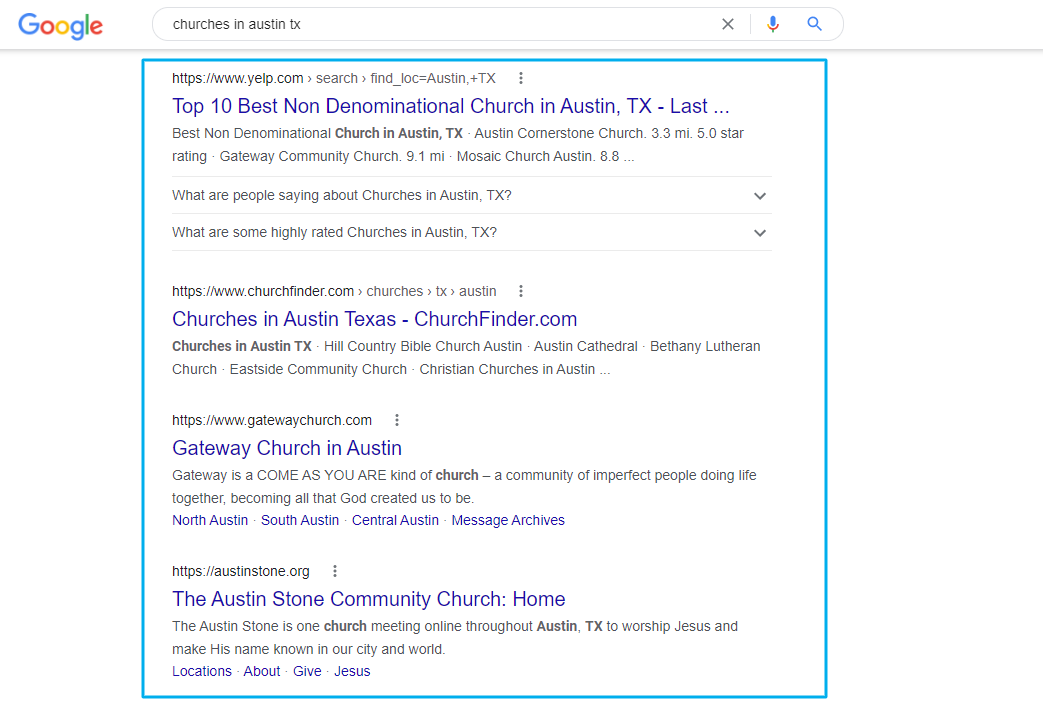
Speaker 2 00:25:59 It's basically your organic results. So how you rank organically. So, um, that word has been around. So think of it as kind of the more natural way to be visible. Um, and there's, there's actually a lot of encouragement and things that churches can do on their own to be able to do a good job here. This is where it's really important to have good content and key words on your website, making sure it's up to date. Uh, there's a lot we can talk about. We've talked a lot about the importance of blogging while that takes some work. We've talked about, you know, sermon content, uh, and, and the good news is, is that, you know, churches are doing a lot of these things already that can easily be tweaked, but this organic parts also, it's extremely important because even though we just talked about a lot of things you can do with ads and local SEO and visibility, and there's work to be done there, this is kind of the behind the scenes work. If you will. That, that I would say is almost kinda like the foundation of making sure this is almost kind of in place first, because if you're not doing a good job of how you rank organically, well, then the other marketing aspect of it and the directing of traffic will that you're going to kind of put the cart before the horse.
Speaker 0 00:27:21 Yeah. I think that the organic results, like, so what, like, basically you think of this way is the organic results is how your church website itself, how it does in search results. Whereas the map pack that was more the local search, that's more about how your Google, my business profile ranks, uh, and then the ads, that's something kind of altogether different, but your website plays an important part in all of these, especially on the organic results, but your website plays a part in whether or not you show up on ads. We'll try as we might, we can't create ads for people that will help their church rank. If they have a terrible website, it's just, we still can't get them results on that because Google's algorithm is smart enough and they're not going to let you show ads to things. You have no content around, and there's all kinds of challenges there.
Speaker 0 00:28:07 And then same thing goes for the local stuff. If you have a terrible website, it makes it harder to rank on these areas to rank in local searches. And you have to prove that you actually are a church, uh, so that Google knows that with your keywords, that those things, but, uh, the organic results, those were the original. So when Google started, it was just organic results. And then they added the ads at the top and then they got results. And now the map had kind of moved the organic results down to the bottom. And for churches, I would say it's less than, I think the organic results are really important for national organizations like, so reach, right. That's more important to us, the organic results. Then the map pack is right, because we have an office that nobody works at. We just have a mailbox, basically, that's where our address is.
Speaker 0 00:28:54 And you can Google my business, but there's no place to actually go with us all being spread out all over the country. And so we don't really target that too much. What's important is that people find us in the organic results. We're not looking for people searching for church website providers near me, because that gets searched for like four times a year. Probably we're looking for, or digital marketing for churches near me. We're looking for people that are looking for digital marketing for churches all over the country and all over the world, really. And then the organic results help us there. So in this new age that we're living in, I think organic results remain really important because you are now online. Probably you're probably doing church services online. And so you can reach people that are across the country, across the world and still have an impact on them.
Speaker 0 00:29:41 I think it's still something churches should take really seriously. Uh, but it maybe is not quite as important as the other two areas nowadays, I think, but you were saying is right here, is that the way you rank for these things is by taking your website and its content on there really seriously creating new content all the time, making sure your content is optimized on the site. And that's really, um, the, the thing about search engine optimization and really getting that right, is that it's just, it's, it's a lot of work like creating content is not something that just kind of happened. I wish I could sit here and tell you. And probably 10 years ago, I could have told you, Hey, you can do a few tricks to kind of cheat the system and get results on here. But those things, those, those loopholes are, if they're not gone, you will be so severely penalized for it that it's not worth even trying.
Speaker 0 00:30:31 So if Google starts to figure out that you're just writing churches in Austin, churches in Georgetown churches, in round rock churches in all these cities around me or churches near Austin and churches near George, and just doing this stuff and spamming keywords, they're going to say, yeah, that's a spammy site. Let's blacklist it. And you'll never show up in search engines, which is not a bad deal. Yeah, exactly. Right. So all that to say, it's, it takes hard work. It takes writing sermons and actually taking the sermons that you're writing and transcribing them and putting that content on your site. It takes blogging. And the time that's associated with that, not to say, this is something that takes a lot of skill necessarily. You don't need to be a SEO expert to get some juice here, but really creating content just takes time. Like if you're going to write a good blog post that's a thousand words, it might take you an hour or two or three to do something that's, that's worth reading to do something like that. So it takes time. Yeah. Commitment.
Speaker 2 00:31:27 Because as we've mentioned before, if you start a blog, you can't just throw one good blog up there and call it
Speaker 0 00:31:33 A day. Yeah. I mean, we got, we have tons of traffic on our blog now, but it's because we've been doing it. We haven't missed a week in like four years. We've been doing it a weekend and week out 2000 word posts over and over and over again. And because of that consistency and having content like that, we start to really rank well on some search terms that we want to rank for and churches can get the same kind of results. I mean, we w we have seen this kind of stuff happen for churches, but it's not going to happen just by writing one blog post. You're exactly right. It's something you have to consistently do that kind of stuff. Anything else to add to that Ian or how churches can get results there?
Speaker 2 00:32:08 Oh, no, not much. I think the good news is, is there's a lot of people passionate about this. These days, there's people that are actually bloggers. That's what they do. You, you may have someone in your church, you may not even think about it, but you might have someone in your church. That's already doing this just in the same thing to be said for updating your social media. There's probably someone that's passionate about that. The good news is for, we've mentioned this before, getting sermon content up there. That's, that's something that's being done weekly by most pastors already have their, their message written out and points and keep scriptures. And yeah, there's this transcription work with that. But, um, it isn't something like you said, it is a commitment and it does take some work, but, um, we don't want to communicate that. It's just something that's impossible.
Speaker 0 00:32:57 So it's, it's worth going for, I think that's the main point. And that's, that's the whole point of this today is that I hope this has been helpful to everybody that understanding what these three parts are, the ads, the map pack, the organic results. Each one of those I think will be valuable. And if you invest in each one of these areas, whether time or finances to have someone else help you do it, uh, it will lead to people visiting on Sundays. It will lead to people connecting with your church. Uh, it will lead to new discipleship. It'll lead. In my experience, we literally saw hundreds of people give their lives to Jesus that found us online before they walked in the door. So I can say that, you know, our call to the great commission, it remains strong. That's what we believe in here.
Speaker 0 00:33:39 Uh, as followers of Jesus, that's what it matters most to us, but this is how people find churches. This is how people hear the gospel nowadays. And I think each one of these is a worthy goal to be working towards is ranking on there. So I hope it's been an encouragement to our audience to get out there and either invest in having someone help you with it or learn and set aside the time to do it on your own. We're good. Either way. We just hope that it's something that, uh, you got that our audience and retried family that we really take this seriously. So anything to close with besides that, Ian,
Speaker 2 00:34:12 I think that's a perfect thing to close with that. We began talking about that and we'll end with that, that this is about helping you reach more people.
Speaker 0 00:34:20 So that's what it is exactly. Right. So, well, good guys. If this has been helpful to you, uh, it would mean a lot to us. If you would rate, review, subscribe, comment, like do all those things on there. That's how we get the word out there about this podcast. Thank you for having done that 50 episodes in a row. Now we've just really appreciate that. Thank you for being a part of our retried family and we'll catch you guys next week. So, yep.
Speaker 1 00:34:46 Thanks for listening to the reach right podcast. We hope this episode will help you reach people the right way, looking for more resources for your church. Check us out online at reach, right studios.com. If this episode has been helpful to you, it would mean the world to us. If you would rate, review and subscribe on iTunes or wherever you get your podcasts. Thanks again for listening. And we'll see you next week. <inaudible>.