Episode Transcript
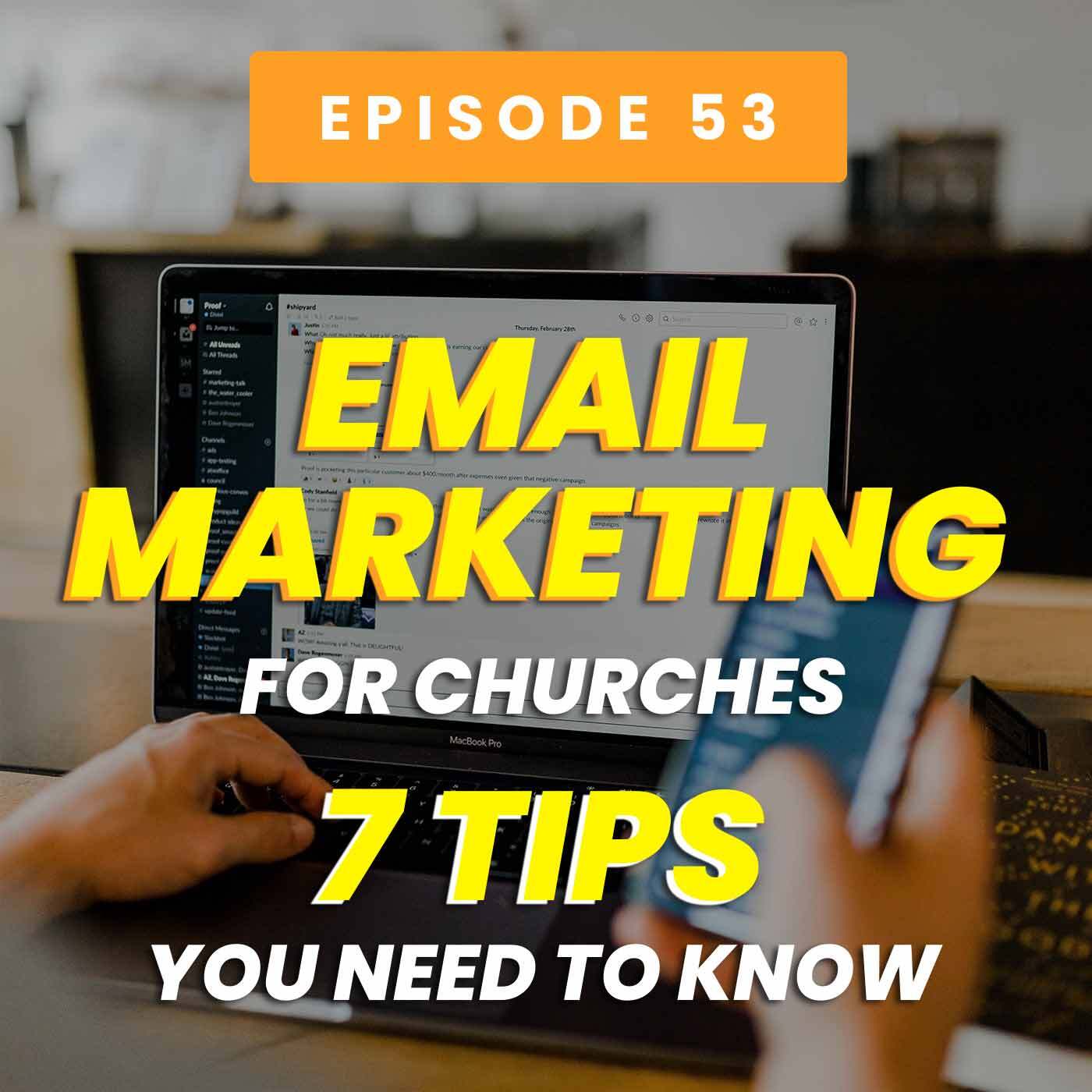
Speaker 0 00:00:00 In today's episode, we unpack seven tips for better email marketing for churches. Email is one of the most important ways for you to communicate with the people in your church, family and getting it right, will pay huge dividends going forward. We hope this conversation helps your church reach more people and grow. This is the retrial podcast.
Speaker 1 00:00:30 You're listening to the right podcast. The show dedicated to helping pastors and church leaders reach people the right way, hosted by me, Thomas Costello, and with me as always is my cohost Ian Hyatt. We're here to help you your church. See more visitors and grow.
Speaker 0 00:00:57 Hey guys, welcome to the retrial podcast. Episode number 53. I am your host Thomas Costello. And with me as always is my cohost Ian Hyatt. Hey, what's up Thomas? Hey, not much man. Excited for our conversation today. We're gonna be talking about email marketing for churches. Uh, we're gonna have, we have seven tips. We want to share with people here today. Uh, when I mentioned that this was the topic and we started dialoguing about it, your immediate reaction was, oh, no, not again, email marketing. And I think that's probably the reaction, a lot of our audience that that's the kind of content we try to put out here is stuff that everybody says, oh, I have to listen to this.
Speaker 2 00:01:36 That's not to say it's not important. Just my funnest topic, I guess. But yeah, I
Speaker 0 00:01:42 Think that this is the thing is that I think it's, we only do things that, um, I think we would only do it. Like there's only one reason to do things that we think our audience might roll their eyes about and not want to listen to us because we think it's really, really important. And I think that this is something that is, uh, it is often overlooked. Uh, and I think if you're anything like the church culture that I've come from is that the church newsletter and email marketing is just something that is like an afterthought. And we, we kind of hand that over to the church secretary and, uh, she just kind of gets it done and, and puts it whatever it is. And, uh, I want to say, first of all, that's not one of our tips, but that's the wrong way to do email marketing, I think for churches.
Speaker 0 00:02:28 And I will say that I think email marketing is one of the most important things that churches can be paying attention to when it comes to communication, actually marketing. And I think that's the thing is that we don't think of email as a marketing tool. We think of it more as a kind of followup and communication, right? And I, I talked to so many church leaders that it's just something they've always been doing and they feel like this burden to have to keep doing it. But here's the thing. The reason why it's so important is because this is still one of the few means of communication that most people still pay a lot of attention to. I think that if something comes up in our, in my Facebook feed, it doesn't demand a response for me. Uh, if something comes up in Instagram or on Twitter, or even in other places, like even if someone just leaves me a, a generic text message, that doesn't like a normal text message, I'll respond to it.
Speaker 0 00:03:27 But if it's a church wide text message, it doesn't demand a response. But people, when they think about their email, there are still things. This is where important documents get sent and people still do look at it and pay attention to every single email that winds up in their actual inbox. And so we have some tips and strategies we're going to share today, but I just want to quell the myth, I guess, that this is no longer important or that email is dead because I think it's more alive than ever, uh, email marketing. It's harder than it used to be. Uh, because email algorithms are smarter and you're, it's easier to wind up in spam and you have to do more to make sure people appear there. But I think it's something that's really important. So I don't know. What do you have to add to that?
Speaker 2 00:04:12 Yeah, not much. I think you hit it on the head there. I think that, you know, a lot of people, I like how you said, you know, texts, don't demand a response, social media posts. Don't always demand a response, but email is something that it doesn't always demand a response, but it's something you'd be more inclined to respond to. And I agree. I think a lot of people at first notion they could be like, well, yeah, in the day and age of social media and texting and mobile and everything emails, you know, not as important as it used to be. So I could see there'd be a temptation to have that mindset. I almost thought that email was going in that direction when texting and all of this stuff started surfacing several years ago, but then I started to realize, well, my email did become more important, especially emails that I wanted to receive, because I think that's the thing is that, yes, there's more spam out there, but you know, Gmail has ways to categorize and filter certain emails. And so I see stuff the way I have my email set up, I see stuff that's important to me or something of, of, you know, relative interests. So I do look at that that email is even more important than I do when I'm on Facebook or whatever, and whenever I'm seeing there. So I'm glad
Speaker 0 00:05:26 You hit that. I think it is a really important, uh, place to market. Now, as we talk about things today, I want to share this, that g-mail has really taken over the email industry. And so they kind of set the standard when we talk about some of these tips or a lot of them are based on how a Gmail mail account works. And so let me give a quick idea on this is that we all know that they're spam filters, right? So then there is a whole spam folder where stuff tends to go to, and mine is totally full of all the junk of things that I don't ever remember subscribing to or things that people stole my email address from. And they're sending me things that that's one thing in Gmail. There's a couple of other default categories and you've probably seen this too.
Speaker 0 00:06:10 And on your, uh, do you use Gmail for your personal email address? I do. Yeah, you do. Okay. So, um, so with personal, like it has like a personal have like a promotions folder and then there's also like a social shoulder, uh, and you can add other folders for like forums and those kinds of things. And so, yeah. Right, exactly. So one of the goals we try to do with email marketing is to get right into the main primary inbox and skip that social folder or especially the promotions folder. So if right email starts to determine that most of your emails are promotional in nature, uh, you know, the way that you, that, that thing you went onto their website and subscribe for a discount five years ago for a, for a t-shirt store or something like that. If you wind up in that same place, you, you will be missed much more often, so you won't be seen that way. So it really is one of our goals to get out of the spam filter, but then, uh, also avoid all of those other folders that Gmail can put people into. So as we talk about this, these are some tips to make sure we stay out of there and really engage with people that way. So, yeah, it's important. I think it's something that we really need to pay attention to. So I'll let you go ahead and kick us off with the first tip for people today. Yeah. First
Speaker 2 00:07:23 One's a good one here and actually exciting to me, not totally boring to me. So this one is right. Enticing subject lines. And it's kind of funny when, when I was initially looking at this one, I thought back to your days, my days, your days, and are ours together. When we started at a, the first website company that we used to work for back in that time, and this was over 10 years ago, you can get away with just putting like your company name in the subject line and say like following up or something. So you put the name of the company and following up, and people would still open the emails. And I re, I remember that, you know, I, you know, most people would open my emails or respond to my emails, even if they weren't going to become a client or whatever.
Speaker 2 00:08:13 And during that time and sales, but you can't do that anymore. So you need something that's going to be. And I think a lot of this is because of the spam you mentioned, and because of how inundated we are with, with different promotional stuff, you need to be a little crafty and clever and write enticing subject lines. I actually saw one the other day. I was joking with you about that. Got my attention and caused me to actually read further, even though I wasn't necessarily interested in what this company was offering. They said in the subject line, Ian, I made a horrible mistake. And so that actually, I was like, okay, what's this about? You know, so that got my intention. I actually opened it and read further. So that, uh, that came to mind with that. So,
Speaker 0 00:08:57 Yeah, and that's, that's the web. So th the first kind of wind condition on any email marketing strategy is getting people to open your email. So, uh, by and large, uh, you have to realize that most people will not open and emails that you said the majority of most emails do knock it opened. Uh, so I think a good open rate is usually kind of in the thirties, or maybe a third of the emails you send, they actually get opened. Uh, so the, really the only factor in that, uh, other if, if you're, if you're not winding up in people's spam folder is how engaging of a subject line have you written that's. The big question is how engaging is that subject line? If it's not engaging, it'll be low. If you can inspire someone to click on it, then it'll be low. If you can really get a lot of traction, like the one you just mentioned there, then a lot more will, will open that email.
Speaker 0 00:09:50 So, but your message will actually never be read if they don't open your email. And so to do that, you need to have an enticing subject line. So, um, we've gleaned a couple of things I've found that questions are really good. Uh, so asking provocative questions that would be in line with what people are expecting from your organization. So for a church, maybe it's some kind of a personal question or a theological question or something like that, that you're going to try to answer in the body of the email. Um, you, if you add, if you, um, use words that are really engaging and enticing, so, um, there's, there's all kinds of tools out there to, to help you with subject lines, we'll get put some in the, in the description of this episode here, we'll have some links to some of the, uh, email, subject line generators, where you put on a topic, it'll tell you a great subject line to go with it, but finding excitement, action kind of words.
Speaker 0 00:10:45 So if you, if you, uh, if you are going to write like seven email marketing mistakes, it might get more clicks. If you call it seven excruciating email marketing mistakes that you want to avoid. So you'll when you use action words like that, it gets great results. And then I've shared this oldest trick of the book for us now. And it's so contrary to my personality, but use emojis, emojis get clicks. I can't explain it. I don't know if it's true for me and my own habits or not, but we have AB tested these over and over again. We'll talk more about that in a bit. We've tested this kind of stuff and subject lines with emojis, get better results. So for, for what it's worth, that's something that's really important. But, uh, in writing these kinds of subject lines will get you better results. It'll get your emails open more. So that's really tip number one.
Speaker 2 00:11:37 Good. That's good. And why don't you tackle the next one?
Speaker 0 00:11:40 Yep. Number two, uh, email marketing tip is to build a visitor sequence, uh, build a visitor sequence. So this is a sequence of emails that get sent all by itself. When first get someone's email address after they've visited, or they told you they were going to visit your church, maybe you got it online and they put it into a form. I know one of the forums we see on websites, and we put on a lot of website rights websites right now, as a plan, your visit form, people will put in their email address and you can start this before they visited, but you need to build a sequence of probably between four and seven emails that go out all by themselves after someone's come for the first time or told you they were to come for the first time, that's helps someone kind of take that next step and become more engaged with your church.
Speaker 0 00:12:30 Uh, so, um, it's going to be a thank you email that goes out. It's going to be a, Hey, here's something for you to check out kind of an email. Here's an upcoming event, kind of an email. Here's our next, uh, our next membership class email. And the key is that these are going to go out over a predefined period of time. Uh, and they are going to help basically nurture somebody, helping them, helping them, nurture them to become a fully committed part of your church. So they introduce them to kind of your assimilation process and it helps them make that step there. So usually these are going to be something like if we do five, let's say for instance, you're going to have one that goes out the same day that they showed up. You're going to have one that goes out the next day after they showed up, you're going to have one that goes out later in that week. So maybe like Thursday, uh, you're going to have one that goes out on Saturday that says, Hey, I hope you can come back tomorrow. You're going to have one that goes out the following week and it's going to be a sequence that just moves in that direction there. So these are really effective and it's something to help build the intimacy and the connection that you have with someone that's come to your church for the first time. So, uh, what, uh, what say you about those? Well, I like that
Speaker 2 00:13:40 You said the intimacy and connection. Cause I think some pastors, maybe that at first notion they would say, well, I don't want to be pushy and just send someone a ton of emails and scare them off after they visited for the first time. But we've seen this over the last several years. There's plenty of studies that show that, you know, I mean, yes, don't be pushy with your emails and the content in there, but it,
Speaker 0 00:14:02 This weekend, right. We really want you to be there. Right. That's not what it is. Yeah, yeah.
Speaker 2 00:14:07 You need God. Right? You realize that. So, but no, I think that the thing is, is that people appreciate them. And actually it's, it's, it's a lot better. I would prefer these. I don't know about you over someone showing up at my door, maybe one or two days after I visited with a basket of cookies, that'd be kind of not to say that there's still not a place for showing up at someone's house right after they came to your church. But I think overall the email puts someone in control. They get to respond their own way. We don't see, you know, as far as the data we've seen in studies on it for these to come off as pushy, matter of fact, they're the opposite. They show that you care and you actually want this person to show back up. And like, you, you touched on several different ideas for these emails. They're all focused on helping that person plug into your church, which is why they showed up to begin with. So
Speaker 0 00:14:59 Yeah. Yeah. Don't be ashamed of this. They gave you their email address. They're expecting you to email them like right. Nobody. I mean, it's, that's why they gave it to you. They may not have wanted to, you know, they may be something that you required or asked them to do, and they may have been hesitant about it, but you know what, it's easy to unsubscribe and it's easy to get off a list and it should be, at least we'll talk about that more a little bit later. Uh, so, uh, I think that it's something that it, it doesn't have to be off putting to people. People expect it, and it really is a huge opportunity for you to help people assimilate. And that's really our assignment, right. Is to disciple people and to lead them closer to Jesus. And this is a great tool to do it.
Speaker 2 00:15:36 Yeah. And that's a good transition to our next one is these types of when we were saying that these emails are, you know, these are of interest, they gave you the email and they also visited. So we're split, we're sending specific emails based on, you know, that that person visited for the first time. So this, that leads to this next one is you need to segment your contacts, your email contacts. You need to another way of putting that as organize them because not everyone is a first time visitor, right? So someone, if you're members should be getting different emails than someone who was a first time, visitor, someone who's actually joined a small or visited a small group or something, they should be getting different emails, or maybe it's an event based thing. There's just different. We all have people in different places in the life of church life. If we put it that way, that should be getting different kinds of emails.
Speaker 0 00:16:34 Yeah, that's right. So this is a little bit more of an advanced thing. And I don't know that I recommend this for every church. If you have, uh, you know, 45 people in your church and your email list is maybe 60 people, including everybody that showed up over the last two years or something like that, you know, it's a lot of work for, uh, to write two different emails. But if you have a list of any size, then it really starts to make sense to segment that out to people in different places in their life, their relationship to your church. So it doesn't make sense that you're going to send someone that's been serving at your church for 24 years and is there on Wednesdays and Sundays and as part of a small group and leads a ministry, they don't need the exact same email that someone that came one time two years ago, God, because it's something that they're in just different places.
Speaker 0 00:17:22 So you want to really focus your emails on where people are. And if you segment your list, you make it smart enough that you have some people that are, I think for most churches it'll be two or three different spots. Um, in that case, uh, you'll have some people that will be the brand visitors that have come a couple of times or never got assimilated. And then you have maybe a second segment as people that have come and have become assimilated, or maybe the, those that are, that have a place of serving, or maybe those that give regularly, those are the different kinds of segments that you would have. And so if you organize your list in those two ways there, I think just those two categories of people that aren't a part yet, and people that are members of our church, having slightly different emails or different kinds of messaging to those two people, you'll just get better results with it. So a little bit more work, a little bit advanced, but I think it's valuable.
Speaker 2 00:18:13 Yeah. You don't want to send the, thank you for your, for your giving and your, your generosity to someone who's never given it your church before. So I think they're just, they're just doing fine. So that's good.
Speaker 0 00:18:28 Yeah. Number four, here, it's a scrub your list, scrub your list. This means clean out your list every probably about six months or so. Uh, take a look at your list, uh, and you need to scrub it of people that aren't opening your emails. Uh, and there's a few reasons for this. And I, this is really hard for me. I just did a, uh, a scrub of our reach right email list. Uh, and we had to delete like 2000, uh, 2000 people from our email list. And that hurts, you know, it's like, I kind of stinks. It's 2000 people that gave us their information and I had to scrub them off our list. I do that every six months, like I said, and it stings, but it's something that you have to do. Uh, and what we do is we basically, we run a search of all of our emails and we say, Hey, show us anybody that hasn't opened our email in six months.
Speaker 0 00:19:16 So we've sent them, we send a weekly email at least. So that means we've set them at a minimum of 26 emails over the last six months. So they've opened zero of them. So that means our chances of them ever opening an email are pretty slim. They're probably not going to be opening our content. And it's just something, I don't know, maybe they changed their email address. Maybe we've wound up in their spam folder and they're not seeing it. I don't know the reason why, but it's probably not valuable to them. And I have to just kind of be okay with that. We try to make valuable content. We have thousands and thousands of other people that are on our list that do open our emails regularly and they like it. And so I don't take it personally, but here's why you do this is that Gmail specifically and all the email providers out there.
Speaker 0 00:20:01 Now, they have become very sophisticated in how they filter, what goes into spam, what goes into promotions, what goes into these different categories and what goes straight into the inbox. And one of the key metrics that they use is they look at which emails are getting opened by most people. So for instance, if we're sending out a list to let's say 15,000 people, right? And so we have a big fat your church, Leslie's a smaller, let's say you're a church that has a thousand member or a thousand people on your mailing list. And that's pretty normal. Usually a mailing list, I'd say on average is about three times your normal attendance. That's kind of what I've heard to be a good number to work with. So let's say you have a church of 300, you're sending out a thousand emails every week or something like that.
Speaker 0 00:20:44 Half of your emails are probably going to Gmail. And so Gmail is able to look at this and say, Hey, I've seen that 500 every week come to our accounts. And most of them are just not getting opened. So they're probably more than likely spam. So let's try to put these into the spam folder in a nutshell, that's how the algorithm works. So the fewer emails that don't get open, that you can send out, the more likely future emails will wind up going into people's direct inbox and skipping their promotion and their spam. So if I'm sending out 2000 emails in our case that are not getting open to buy anybody 26 times in a row, if I can get those, get rid of those that really ups my open percentage and then Gmail and all the other providers start to say, well, these guys are sending better and better emails lately.
Speaker 0 00:21:35 Let's start to put them more right into the inbox and make sure people see this kind of content. So it's an important habit to build. If someone never opens your email, you need to scrub your list. Now I'll tell you most churches don't do this. I talked to very few that are intentional about getting rid of people from their list, but it is a really good habit to be in. And it will long-term, although it doesn't feel good with your, your vanity metrics and feel like, oh yeah, we have 4,000 people on our church mailing list. This makes me feel so good. Well, the real question is how many people are opening and reading and clicking on your emails, the number of you're sending it out to that's just a total vanity thing. So what do you have to add to that again?
Speaker 2 00:22:13 Not much. I think you covered a lot of that and that was all really good stuff. I think that especially Gmail's process with that and the metrics and everything that they, they look at there. But I think that also think about it this way, too. Another good way to justify doing this is you don't want to, if someone's not interested in what your content is and what you're offering, well, you don't want to bother them with it. Anyway. It's kind of like that person that shows up on your door and you're not interested in what they have to sell. Right. So, so I think that that's a good way to kind of justify doing it too. But yeah, so that's good.
Speaker 0 00:22:47 The more you show your content to people that don't care about it, the less people that do care about it will actually be able to see it. So that's a good one way to look at it. So perfect.
Speaker 2 00:22:56 I'll go after the next one here, which we always love to talk about this one, every episode, including one call to action. But however, in this episode, we're focusing on the word one, one called action. We've talked about. There is you never want to have too many calls to action with anything that you do, but there are some times where you can have more than one. When it comes to email marketing. One is the key. You and I were talking about how many studies have been done on this. And it makes sense, actually, with email, to me, to Thomas, when I'm reading something, if I have more than one option, what more than one call to action to take whatever next step it is, I'm less likely to do it again. People are. I always, I always talk about this with calls to action. People are always no matter what, even if they're sitting in front of their computer and they're not on the go with their phone, even if they're in their office and they're spending more time on a desktop or a laptop, they're still impatient and they're still, you know, you better have something of interest in a quick manner and then call them to action quickly.
Speaker 2 00:24:02 So I think when it comes to email and someone's reading your content, that hopefully is of interest to them, give them one option and one thing to do rather than,
Speaker 0 00:24:11 Yeah, I think that's really important. I think that, uh, there's, there's two things that I see churches do. They either have no call to action or sometimes they have too many calls to action. So I'll, I'll tackle both of them. Uh, so having none, uh, if you don't have something you want someone to do as a result of getting that email, you probably don't have an email worth sending, right? You don't need to send it as an email. Uh, just sometimes churches do this with like their, their bulletins. They basically do an email version or like their weekly newsletter. And it's in their mind, it's just to communicate, to tell people the information they need to know. But if you don't have something that you want someone to do as a result of having that information, it probably doesn't even affect their lives. Anyway. So if you're doing emails like that, um, that are event based, or are you talking about what's coming up in our calendar or what our current sermon series is, whatever that content is, give them a place to respond, sign up for an event to get involved with serving addicts, find a place to, to be on the team, those kinds of things.
Speaker 0 00:25:10 So give a call to action. The other idea is if you send out that newsletter and you have seven events you want to talk about and you have seven different calls to action, that's not a good way to do it. You need to probably think through your email strategy a little bit more and have one primary reason for sending the email, not seven events that you're sending it about, but have one primary reason which would have one called action. Don't, there's all kinds of research on this. If you give people lots of ways to respond, instead of just one way to respond, you'll get less results. If they have lots of different ways. Sometimes we think of the opposite, like, well, I want something for someone. If someone's comfortable with the phone number, I want them to call. And if they're comfortable with it, email address, then they'll want that email.
Speaker 0 00:25:53 And if they want to fill out a form that I want them to do that or texts or whatever it is, just give them one, just choose one. Say the way that you get started on this is by sending us a text at this number or responding to this email with the word, whatever it would be or clicking here. I would say that every email you send should have a link, because that is something that, again, the algorithms measure, how many times a link is clicked on to assess how valuable email is. So every single email plan on having at least one link, the one exception I say to this one called action rule is we like to use and we've seen results with a postscript. So we we've used a strategy where we use really simple, like a hundred word email that just is a, uh, some copy with really enticing texts.
Speaker 0 00:26:37 And it links them to the one article or post or thing that we want them to click on. And then at the end, we'll have a signature. And then another PS that says some other posts or some other call to action that they can go on, like at a postscript there. So we've seen that to work, but in general, one call to action. That's what we're going for. Yep. That's good stuff. Awesome. Number six, use a, B tests use AB tests. So, uh, for those that aren't aware at AB test is something where you send out, uh, one piece of content, uh, and it has two different versions of it. So you can compare which one gets better results. So as your list grows, it's probably, isn't very helpful if you have 75 people on your list because the numbers won't, you know, but it's a good habit to get into, but if you're sending to a thousand people, uh, and it's really a good idea in that case to start using some AB tests or you do two versions of the email that would have two different slight variations a lot of times, and see which one gets better results.
Speaker 0 00:27:41 So if it were me, I would start with my subject lines on a subject line, try two different versions of it and see which one gets you better results. So here, for instance, next time you send out an email with a subject line, try half of them with an emoji or a couple of emojis and half of them with no emojis and do your own little test. And so if you send out a thousand emails and 500 have emojis and 500 don'ts and you find that, uh, that 50% of the emoji ones get clicked on, but only 25% of the ones without emojis get clicked on. Then you're going to learn a lesson when you do that. And you're going to start to know that, well, we get more opens when we use emojis. So going forward, let's use emojis more often and then try it with something else.
Speaker 0 00:28:23 Try it with a question on the subject line versus a how to a statement on there and see which one gets better results. And every single time, the idea behind this is every time you send an email, you want to learn something. You want to learn something about your audience, about how you can get better results. And that's how you can go from 20% open rates to 50% open rates. Uh it's by making these little micro changes that play a big part over time. And here's why that matters. If you're sending out to a thousand person list, let's say an average 300 member church has a thousand person list. If you get twice as many opens on an email, that means you'll probably get twice as many clicks on that email, which means twice as many responses and twice as many people taking steps. So if you could double the number of people that are getting assimilated to your church, what kind of impact would that make that that's, that's huge, right? So, yeah, huge opportunity. Well, and I think
Speaker 2 00:29:20 It's a worthwhile effort because I think, and you were just touching on this. I mean, imagine if you, you know, ever every pastor wants to, they want not only more members and visitors, they want, at the end of the day, they want to lead them to Christ and they want to see someone's life changed. And so imagine if, if this is a worthwhile effort, if you see that you get 20 more in your first quarter by testing this out, I mean, how huge is that and what, what kind of, when would that be for your church? A huge window for any church? Yeah. So it's a worthwhile effort and this can lead to things. We're all trying to grow our churches and coming out of this pandemic that focus on growing is, is heightened right now, too, or getting back to where we were and getting even better than where we were. And so these are worthwhile efforts to definitely to test and see what works to, to get better results.
Speaker 0 00:30:12 Yeah. Let me, let me just add one more thing just here. I, I, I totally get that. That sounds bizarre. Like audit surface that like, you mean to tell me that like the way to double the number of people we're winning for Jesus is by testing with, and without emojis emails, but like, it's, it sounds totally weird. I get it. But it's not just that one thing. It's a culture of you learning from these things and, and making incremental improvements. I emojis, aren't going to double your open rates, but if you do this for a year and you learn 52 different lessons, you can double your open rate on these kinds of things. If you take these things into heart. And I think if this is one of the primary ways that you introduce your discipleship process to people, which it is that will lead to more people getting into your discipleship process, more people following Jesus. And that's just really what it's all about for us here. So I know, I know Jesus, didn't talk about AB testing and scripture. I know that's not in there, but I do think that this is something that I talk about it because I believe Jesus would approve of it. I don't, I don't speak fully on his behalf, but I think it's, it works
Speaker 2 00:31:22 Jesus and his disciples did plenty of attention getting things in their ministry or strategy that got people's attention, whether or not it was a miracle or something that was said, same kind of thing is if an emoji is going to get someone's attention, we, we put a at my church, one quick example on this, we built a really big cross we're up on a hill. We're at a very visible place off the highway. You know, a lot of churches have crosses, right? So nothing special. We build a big visible cross. And I can't tell you how many people we've had come that just say we saw the cross from the street we were driving to on the way to the grocery store. And we thought, oh, there's a church over there. We need to go. We've been looking for a church. They came because they saw the cross.
Speaker 2 00:32:07 They can come because they saw the emoji in that specific email. So again, it's attention getting right. And it's whatever, any little supplemental things that cause someone to take a step is worthwhile, right? When it comes to all this good. Exactly. Right. Well, I'll tackle the last one here. And that's, don't sweat the unsubscribes. This is a good one to finish on. Like you said, when you scrubbed our email list, you were a little sad that 2000 people were going away. Same thing. You can get sad when someone unsubscribes, they're no longer interested in my church, what our ministry has to offer. Yeah. That's a bummer. And if they're not interested in anymore, but again, kind of the other example that I was just talking about, you really don't want, if they're not interested, they're not interested. Uh, and so, you know, if they unsubscribe, don't worry, let's find a way to get more people to subscribe, but you really don't want them there if they're not interested. And there's a lot of other reasons, I'm sure you'll unpack too for that. Yeah.
Speaker 0 00:33:02 I mean, it's, it's hard to say this, but unsubscribes are good. You know, you want people to unsubscribe from your, your email list. If they're not, if they actually don't want the content, because in the end having people that don't want your content, don't open your content though. Click on your content, makes fewer people that want your content, see your content. The algorithm will start to think it's less valuable. And so I have been there. I have pastored churches and it's almost like, it's like an informal way of someone telling you they're leaving the church. It's like that, that conversation. When you get that, Hey, I wanted to know pastor, if we could take you out to coffee, that's never the conversation you want to have when you're in ministry, because I wanted to talk about something or something like that. That's what an unsubscribe feels like when someone has been a part of your church says, I don't want your emails anymore.
Speaker 0 00:33:51 It hurts. It hurts your heart. It makes you feel like you're, you're, uh, it's kind of a vote that they're telling you, but you have to get over that. They are good. You want people, you want to invite people. And so to that end, I think it's important that you make unsubscribing obvious and easy on the bottom of everyone that we send. We have some very clear texts that says, click here to unsubscribe and you just click it. And then it automatically unsubscribes. Doesn't make you log in or putting your email address again or something like that. And frankly, those are really bad systems. If it's something where you have to click on subscribe, and then it makes you log in to unsubscribe or to enter your email address, I'll tell you what I do is I don't have time to figure out what my login information was on that site. Try to reset my password so that I could unsubscribe for your email list. So what I do is I flag it as spam because if I can easily unsubscribe, I just get rid of it that way. So you want to make it obvious and easy and just know that if someone's clicking on that button, it's just not meant to be. It's something that it wasn't, they're just not that into you. That's what it comes down to. And that's okay. So yeah, I think it's, it's a good thing in the end. Good deal.
Speaker 2 00:35:05 Good stuff. Nothing much to add there. So
Speaker 0 00:35:08 Yeah, email marketing guys. It's something that every church really needs to be serious about in 2021. It is one of the most valuable communication tools. Make it more than just something that's an afterthought that the secretary does every week, because we've been doing it that way for 15 years, make it something that is actually part of your culture and a primary way of communicating, because it is one of the main ways that people will still receive content from you. So we hope this conversation been helpful for you if it has been, or even if it hasn't, uh, give us a review, tell us a five-star review. It means a lot to us. Tell us what you like about the show, but rate, review, subscribe, do all those things. It does mean the world to us. Thank you so much or unsubscribe. If you don't want to, it's true marketing. The algorithm works the same way broadcast. So if you hate this and you don't ever want to watch it or listen to it, please do unsubscribe from this. Thank you for being part of our retried family though. Guys, that means a lot to us and we hope to catch you next week. Blessed.
Speaker 1 00:36:15 Thanks for listening to the reach right podcast. We hope this episode will help you reach people the right way, looking for more resources for your church. Check us out online at <inaudible> studios.com. If this episode has been helpful to you, it would mean the world to us. If you would rate, review and subscribe on iTunes or wherever you get your podcasts. Thanks again for listening. And we'll see you next week. <inaudible>.