Episode Transcript
[00:00:00] Speaker A: Well, more and more churches are moving away from formal church membership in this day and age. But is that really a good idea? Well, we take the time to discuss that question. Let's do this.
You're listening to the Reach Right podcast, the show dedicated to helping your church reach more people and grow.
Well, hey guys, I'm Thomas.
[00:00:22] Speaker B: And I'm ian.
[00:00:23] Speaker A: And today we are talking about church membership. And the question is, does it still matter here? And we're recording this at the end of 2023 and I know from experience that a lot of churches have moved away in part or completely from the idea of membership within their church. And we want to discuss a little bit about why that may or may not be a good idea. So should be a good conversation.
[00:00:50] Speaker B: I think so, yeah. I think because we have seen some there's a lot of statistics that we're going to dig into a few here right off the bat. But yeah, it's been a little bit on the decline.
[00:01:02] Speaker A: Yeah, I think that there's a few different ways that we've seen the decline. Like it's something that in some churches it's just kind of a renaming of membership. I know in the church I pastored most recently, we didn't have membership because it was nice to be able to say, oh, we don't really put a lot of emphasis on membership. We had something called partnership that was the exact same thing as membership. So we just called it partnership and it was more palatable to people we found. So that's one way that it's kind of changed a little bit. I think that there's been some churches that have just done away with it. They have nothing to do with membership anymore. And then I think there's others that just have deemphasized it where it's not something that as prevalent as it used to be, where there would be just a push for everybody that's come a few times to take the membership class, become a member, sign on. And now it's something that people would have to maybe seek out on their own if they want to become members. And that's something that I think is another way that it's been just kind of reduced in its significance, I would say. Does your church have a formal membership and is it something that you guys emphasize?
[00:02:05] Speaker B: That's actually something that we strongly push and I'm glad we do and yeah, so we have a growth track is what we call it. And it's basically three, four steps really. It's something that is going on since it's four different parts or three to four different parts. It's something that we have going on actually during each because we have numerous services. So when you're in the 09:00 service, there's one going on if you plan to attend the eleven or whatever and vice versa. And we make it to where it is pretty fluid, meaning that if someone jumps in on number two, that's okay. And they missed the first one and they go back. But it's a big deal for our assimilation process. And we believe strongly in membership. And actually, as we've mentioned on this podcast before, being part of a larger, what's technically a megasized church, I think the stigma often is that all we care about is just butts and seats, so to speak, or just visitors, new visitors showing up. And that's not the case for us.
[00:03:11] Speaker A: Do you guys use the term membership like it's become a member?
[00:03:14] Speaker B: That's the same term, yeah, or partners.
[00:03:17] Speaker A: We may have switched to partners recently.
[00:03:22] Speaker B: I think both of those are used, but we do. Yeah, we've kept that awesome.
[00:03:26] Speaker A: That's cool. Well, we saw some stats recently, and I'll let you kind of share some of these that kind of were eye opening. It was from the Gallup Poll, right? So it talked a lot. They did a lot of surveying on religious affiliation. And Gallup is not a Christian organization, but they had some eye opening insights on membership in religious organizations, which in the United States is primarily churches. So what are they?
[00:03:51] Speaker B: These are we saw a good chunk of stats.
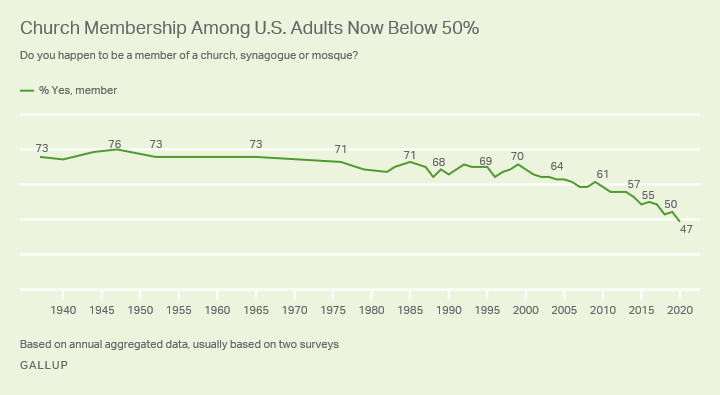
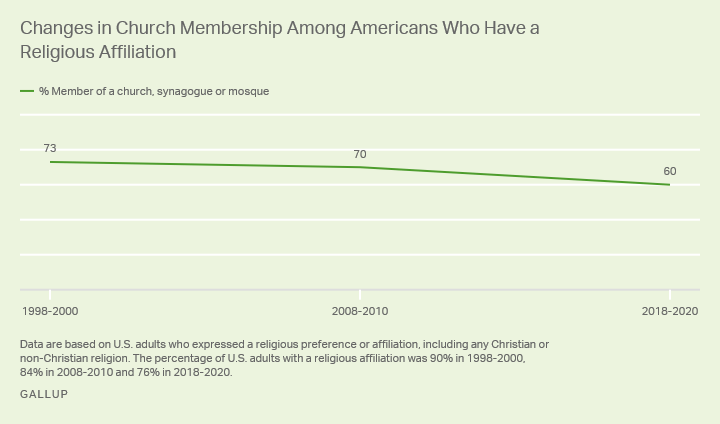
These two are the ones that stuck out to us. But as of 2020, less than half of Americans, so 47% said they belong to a church or a synagogue or a mosque. This is a significant drop from 70% membership rate in 1999. So in that 20 year span, quite a big from 70 down to 47, I think is pretty crazy.
[00:04:19] Speaker A: Huge difference. Yeah, that's like a 50% reduction, basically, in the number of people that are there. So that's enormous. And it's eye opening. And I think that kind of reflects the realities that it's, in part, that the culture has changed and then it's also, in part, that in churches, I believe it is deemphasized. So yeah, that's good.
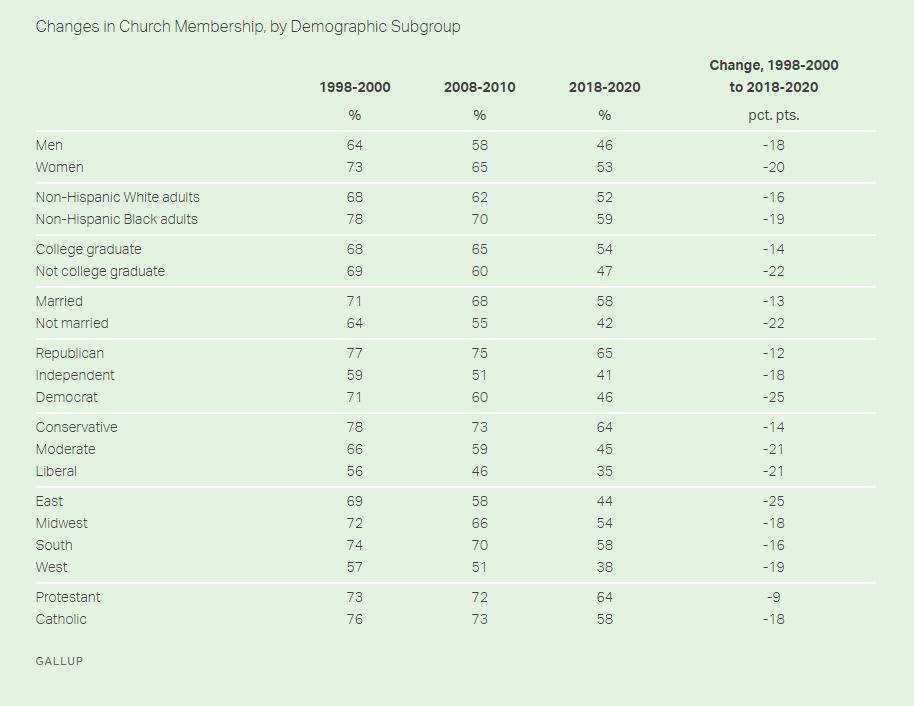
[00:04:42] Speaker B: And this next one is it's also generational. So this part of this slump, if you will, and drastic decline, is there's generational differences. So it's most pronounced among younger generations. So 36% of Millennials reported being members of a church, compared to 58% of Boomers and then 50% of Gen X. So it is definitely a generational thing. It seems like that it's trending down.
[00:05:10] Speaker A: Unfortunately, which makes sense, I guess, with the timeline. And it's kind of what I would expect. Right? I expect that Boomers would be more likely to be members than Gen Z or Millennials. So I guess I'm not surprised by that. But I think it all tells the tale of just this changing trend away from membership and towards kind of more of a casual affiliation, if any at all. And I guess we probably ought to pause for a second and talk a little bit about some of the reasons that we hear as to why maybe why churches and then why people that are part of churches are less likely to become members or what are some of the objections to a membership process? And there's a bunch of them. I think that there's like the exclusivity feeling of membership. It feels kind of like we don't want to feel like an in group and an out group. I get some of that. And I think that there's some question marks and we haven't quite figured out what does membership look like in a digital age.
Basically, to a lot of people, their closest thing they have to membership is subscribing or following an organization.
By the way, great chance for you to do that right now. If you're watching us on YouTube, hit that subscribe member of Reachwright. Yeah, that's it. Be a member of the family here, but hit that subscribe button, it would mean a lot to us. So that is what membership looks like to people. Like, I'm a member of the MrBeast community because I follow him or whatever channel you tend to follow on YouTube or whoever you follow on social media. And so what does that look like for churches? And then I think for churches, there's the administrative burden of like, why do we need these two separate categories? Or three? We have, like, attenders, we have visitors, we have members, we have leaders. So there's another category that doesn't really matter for us, I think, for a lot of people. But in the end, I think the biggest one is that there's this tension around commitment that we don't deal well with anymore. Like, it used to be something that was just obvious and you commit to people that you're around and you're doing ministry with and you're living life with and life with. That's something that we're just much more afraid of that than we used to be. On both sides, I think people in our community are much more reluctant to be willing to sign on and become members of a church. And I think as someone who has pastored and has led staffs of people that have asked for membership, it's something that pastors get afraid about, like having to ask someone. It's like asking someone on a date, right? You have to go up to them and what if they say no? And if they're not ready yet? It's like your fear of rejection is there. And so we get nervous. It might scare people away if we ask them to become members. And so that's some of the things that I hear. I don't know. Do you hear one of those more than others, Ian, or what do you.
[00:08:00] Speaker B: Not? I think altogether, I really can't think of one that I hear more than others.
Speaking with as many pastors and working with as many pastors as I do. So I think it's a mix of all of that. And I think you hit the nail on the head. I think commitment is always a big thing, right? That's why men don't get the wife is waiting for the or the I'm sorry, the girlfriend's waiting for the proposal.
But as time has gone on and cultural changes and like you said, in our digital age and membership being often just who we're following online, I think it's a mix of all of those. But the commitment is the biggest part of it, especially with a church. I think when it's a different kind of commitment than, like you said, a subscription online, it's a personal thing, it's a spiritual decision and I think that that often can make it a little bit more challenging.
[00:08:57] Speaker A: Yeah, agreed. Well, let's do this. So you and I, we came up with seven reasons why membership still matters here in 2023 or if you're watching this in the future, I think these will apply all the way till we'll give this till 2030. If you're watching this in the future, who knows if it'll still matter then? But I feel safe to say that for the next six years at least, it's going to be mattering for churches. So why don't you kick us off with the first reason we came up with why it still matters today?
[00:09:23] Speaker B: Yeah, I think number one, and this is a good one to be number one, we believe it's biblical. It's a biblical foundation for belonging all throughout Old and New Testament. You can see especially in the New Testament with the body of Christ being established, just that it's something to where it's a community of people that are bought in to not only the biblical teachings but their unified body. They are breaking bread together, they're serving together, they're giving and sacrificing together, they're congregating together. That's communicated all throughout scripture for sure. So we believe it's biblical.
God calls people to an extra step of devotion and he says follow me. Not just say you believe in me, but follow me. Same thing. This is that extra step of commitment for someone to belong to a local church body.
[00:10:13] Speaker A: Yeah, I've been reading First Corinthians in my devotional time this last couple of weeks here. Just kind of poring over it slowly and you cannot read First Corinthians and not walk away with. There is a deep level of commitment that Paul expected for this church that was totally jacked up, but he was trying to remedy that. And one of the big prescriptions he has is just it's almost like it's assumed know, you guys are one body. And it talks a lot about these passages about how each part of the body needs each other. And this is just so true at a local church level. I think it was very clear in this Corinthian church 2000 years ago. I think it matters still for today. So yeah, obviously I think there's a biblical command to it now that gives us freedom on titles we use for it. Whether we call it membership or partnership or being part of our church body or whatever we would say I think that there's at least a very strong call to commitment towards the people we're part of a church with that we would commit to one another in that. So that's in the Bible. And that's something that I think is a hill we need to die on, is it fosters accountability and spiritual growth. So when there's no membership, I think that you'll usually find that that correlates with a church that doesn't have a high level of accountability at a minimum. And with accountability comes spiritual growth. Because if someone hasn't formally decided that I am a part of this and I'm submitting myself to this organization and to the pastors here, then you don't have the license to hold people accountable. If someone's just kind of attending and showing up as a pastor, you want to be sensitive to that and you want to say they're still trying to figure these things out. I don't really know where we stand with them. I don't know if they're willing to kind of hear what I have to say or have me hold them accountable to things. And when there's a certain level of membership, I think that that kind of opens up those boundaries, and it lets people it's them saying that, yes, I am part of this. And I'm open to you speaking into my life and calling me when I'm not around or when you see me doing things I'm not supposed to, that you reach out to me and talk about it. So that's the kind of thing that I think it opens up when we have membership.
[00:12:32] Speaker B: Yeah, totally agree and not much to add to that. I think it's a good segue. It's the next one that it also strengthens community bonds.
So when someone's a formal member, they're going to feel like they belong more and they're going to have a deeper connection. And that comes from that accountability you mentioned and that growth.
And that is something that I would say as an encouragement, even though we talked about those negative statistics. We have seen studies for millennials particularly, that they do want to feel like they belong and that they're a part of something bigger than themselves. So we've seen plenty of those studies and statistics too. So I don't think we write off the generations to come as just going to be, yes, there's a challenge there, but people want to belong to something. And if we go about this the right way in church leadership, I think there's some real opportunity there.
[00:13:26] Speaker A: Yeah, I think that membership is a good part of those community bonds. That if someone has decided for themselves they want to be a part of our community, it gives people this freedom and I think more courage to go and try to build bonds and build new relationships because people are always. Really? If I know that someone's here for a little while and then they'll be gone in a few months, I'm less likely to invest my time and pursue them and build relationship. And so I think a formal membership process does a good job of that. It helps to foster some of that next. It supports organizational stability. So this is kind of an obvious one, is that if you invite people to be members of your church, I think with that, usually there's some kind of a membership commitment. And it usually says like four things in total that I'm going to come on Sundays or be part of a worship service. I'm going to be a part of some kind of a small group where I have discipleship and accountability. I'm going to find a place to serve and I'm going to give. Those are most churches I've heard those are the four things that you agree to in a membership covenant. Well, a few of those things just kind of build the stability of your organization. If you have people that are members that say as long as I'm around, I'm going to try to be there on Sundays and I'm going to give well, how much stability does that add? That if you have people that are going to be tithing, you know that they're going to be around more. It just kind of makes things more consistent as a church, which is more stable and it's beneficial to us as church leaders when we see that kind of stuff. So yeah, that's a big deal.
[00:14:54] Speaker B: Yeah, that one is obvious and it makes sense. So the next one is encourages active participation. So someone's going to be more involved in church activity serving if they're a part of it, if they're a member, if they're going to take ownership of it.
When you're a part of a church's vision and mission, you're going to feel more obligated and compelled to want to take those extra steps. So this one totally makes sense.
[00:15:21] Speaker A: I think what it does is it kind of forces clarity those commitments. I was talking about a lot of times if we're not asking people to become members, that a lot of times we won't really communicate this well. That our expectation is that you would be a part of a small group and you'd be in a place of serving. And so when we have formal membership, you cannot miss that. Right. Like you have to know, okay, this is what I'm signing on for. I'm willing to do this. And so when you've done that, people are much more likely to actively participate, like you said.
[00:15:49] Speaker B: Yeah, no that's good.
[00:15:51] Speaker A: Next one is it facilitates no, I think we got we're not two more I jumped ahead. You're right, I got one. And it facilitates pastoral care and support. This is big because it helps us as church leaders to know who we feel like a pastoral responsibility towards. Everybody's going to need these kind of pastoral services at some point in their life, whether it's losing a loved one or new babies are born or you spend some time in the hospital, these kinds of things, pastoral care and then just other things like marriages are struggling and problems raising kids. When people are members, I think pastors, they understand that they have now have the ability to speak into and that the member expects them to speak into and be there in those seasons of their lives. So I think that that formal membership really makes that relationship clear there. Whereas if it's just someone who's attending, well, you still want to be able to feel out for that and offer those kinds of things. But people sometimes slip through the cracks because you don't know what's happening, you're unaware of their lives. And without membership, it just makes that much harder. Yeah.
[00:16:58] Speaker B: And you mentioned earlier the point you made about if you know someone's not going to be there possibly in a few months, it's hard to invest into them. Not that a pastor doesn't want to. Of course you should invest into a newer person, newer visitor, but they're just not already a part of things. They're not already walking through things in life with you. So much easier to pastor a member, for sure. So now we've come to the last one. So promotes a sense of commitment and ownership. So I think that's good. We used that word earlier. You want people to own it. You want people to own the vision. Of course God owns it at every church. But you want them to feel committed to the mission and vision that they are a part of it, that they want to walk and live that out. And I think that if someone doesn't feel like they have some ownership and they're not committed to anything, you're not going to see as much fruit out of them. So I think this one is a good one to close on, for sure.
[00:17:55] Speaker A: I think that at my last church we had a saying where we said the members are the ministers. And a lot of churches, we kind of get into this rut of where the pastors are the ones that do the ministry and the members are the observers or the audience basically watching ministry be done. And I think membership, when done right, it flips that on its head where the pastors become not the ministers but the administers. Their job is to be able to administer for people and members of the church to do the actual work of the ministry. And so that's what real ownership looks like. When we do membership, people can kind of take ownership of that and they can sign on to, like you were saying, the mission and vision of the church and be the ones that actually carry that out. And that's really when churches start to see growth, I think, is when they get through over that little hurdle of pastors being the ones that do the ministry and not members doing the ministry. So those are some ideas that we have. So with all of that said, I just want to say and go on the record saying does membership still matter? Absolutely it does. I think membership is still something that is vital for churches if you're a pastor out there that I imagine for a lot of us it's tricky because I know I've had challenges myself and I know leading a staff again where my staff got nervous around these questions of asking people to commit to things, it is nervous. It's nerve wracking to do because there is that rejection part that you feel in there. But I have to say that all of the reasons we see from first and foremost that it's biblical and everything else on top of that, it still matters. It's worth the risk to go and ask someone, even if they say no, and just get it in your head, like some people are going to say no, that's going to happen. When you ask people to sign on and become members that you will get rejected occasionally, they'll say, no, I'm not ready, or I don't want to, or this is not for me. And you just have to be able to live with that and be okay. Because the benefits of membership, they far outweigh that momentary discomfort of word conversation. So pastors, have courage, people to sign on. You can do it. Absolutely.
We hope this has helped you with some of those reasons and why it still matters. If it has been helpful to you, it would mean a lot to us if you'd hit that subscribe button again, become a member of the reach right family.
[00:20:16] Speaker B: That's right.
[00:20:16] Speaker A: Thanks guys for doing that and we hope to catch you next time. See ya.