10 Church Content Creation Secrets for Viral Social Media Posts

June 06, 2024 00:24:13
10 Church Content Creation Secrets for Viral Social Media Posts
REACHRIGHT Podcast
10 Church Content Creation Secrets for Viral Social Media Posts

Jun 06 2024 | 00:24:13

/

Show Notes

In today’s digital age, churches are finding new ways to reach and engage their church community through social media. Creating content for social media platforms can help share the church’s message, events, and activities with a broader audience.

But what exactly is that content? What should churches be posting, and can they do everything they can to make sure it reaches the right audience and gains the traction they want? In today’s podcast, we’ll be covering everything content creation for social media. Our focus will be on our list of the top 10 church content creation secrets for viral social media posts.

With thoughtful planning and a focus on positivity, church content creation can become a powerful tool for spreading faith and fostering a sense of community online. Ready to learn more?

Let’s jump in.

Estimated reading time: 11 minutes

Connecting with the Community

Connecting with the Community

This podcast is all about creating content for social media. Before we jump into our top 10 secrets, let’s explore more about social media and why your church should use it. In the modern day, communication and connection is not like it used to be. Even churches need social media in order to reach the people they want to reach.

But it’s not that easy. For some of us, social media is a confusing mess we don’t understand. For others of us, just technology in general is a confusing mess we don’t understand. Let’s break it down into some simpler parts to we can learn more about how to use social media for our churches.

Church Social Media

Social media accounts are a great way for a local church to connect with its community. By creating profiles on platforms like Facebook, Instagram, and Twitter, churches can share their message and activities with a wider audience.

These accounts allow churches to post updates about upcoming church events, share Christian content, and keep members informed. For instance, a local church can post about Sunday services, Bible study groups, and community outreach programs.

This helps church members stay updated and feel more involved. Additionally, social media makes it easier to reach people who might not attend church regularly but are interested in learning more about its activities and beliefs.

Essentially, social media is how you communicate and reach new people these days. People consume most of their new information and find new friends and communities by scrolling on social media apps. If a church has an effective social media page on multiple platforms, it is much more likely to meet new people.

According to Statistia, it takes Twitter only three-quarters of a year to reach 50 million people. By the same stats, it takes Facebook only one year, but other forms of communication like TV thirteen years or radio forty years!
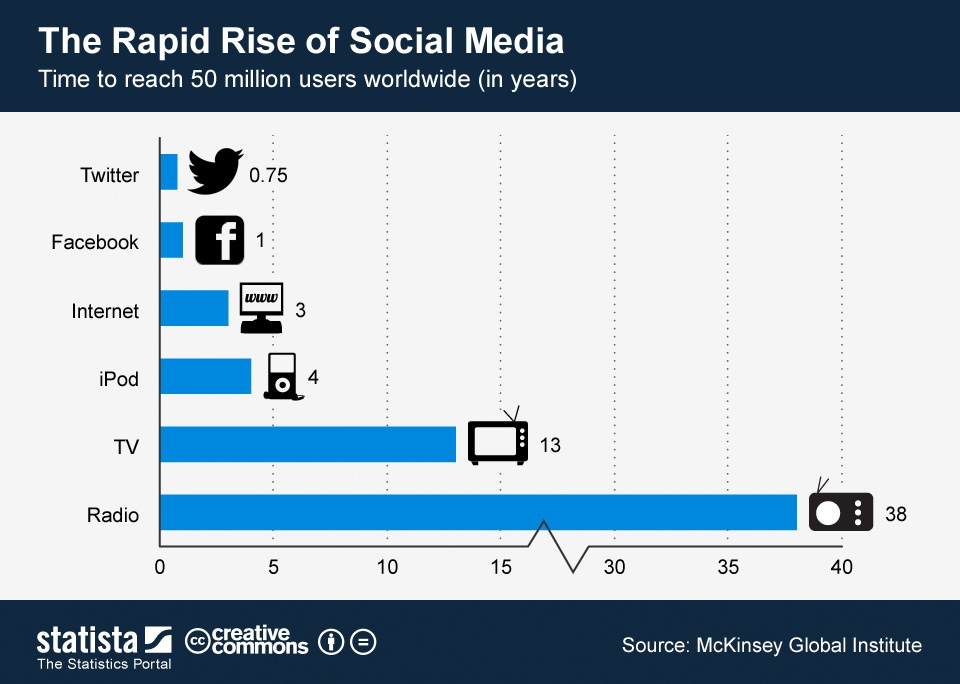
Statistia

The truth is obvious: social media reaches people like never before. So why not use it for your church’s outreach?

Sharing Christian Content

One of the main purposes of church social media is to share Christian content that inspires and uplifts. This can include Bible verses, inspirational quotes, prayers, and teachings. By sharing this type of content, churches can provide spiritual nourishment to their followers throughout the week, not just on Sundays.

Social media posts can also include short videos of sermons, worship songs, and testimonies. These posts can reach a broad audience and provide comfort and encouragement to those who might be going through tough times. It’s also an excellent way for a local church to demonstrate its values and beliefs, helping people to connect with its mission and message.

We’ll explore content creation more in our next section.

Promoting Church Events and Activities

Promoting church events and activities is another important purpose of church social media. By posting about upcoming services, holiday celebrations, and special programs, churches can increase attendance and participation. Social media accounts can also be used to share photos and videos from past events, showing the vibrancy and community spirit of the church.

This not only keeps current members engaged but also attracts new visitors who are curious about the church. For example, a church might post about a community service project, inviting members and non-members alike to join in.

This helps to build a stronger community both online and offline. Moreover, promoting events on social media ensures that important information reaches people quickly and efficiently, making it easier to organize and execute church activities.

Social media accounts play a crucial role in modern church life. They help local churches connect with their community, share Christian content, and promote church events and activities. By utilizing social media, churches can extend their reach beyond the walls of the church building, creating a church online that is accessible to everyone.

This builds a sense of belonging and keeps people engaged with their faith throughout the week. As churches continue to embrace these digital tools, they can spread their message more effectively and build a stronger, more connected community.

10 Content Creation Secrets

10 Content Creation Secrets

Now that we’ve covered social media and why its so important, let’s dive into what you should post on social media. Church content creation isn’t easy. Thankfully, we’ve compiled our list of the top 10 best church content creation secrets to help you out.

Let’s jump in.

1. Know Your Audience

Knowing your audience is crucial for effective church content creation. Understand who they are and what they care about. Are they families, young adults, or seniors? By knowing audience preferences, you can create posts that resonate with them.

For example, young adults might enjoy modern worship music and event updates, while seniors might prefer traditional hymns and community news. Tailoring your content to meet these preferences ensures your posts are relevant and engaging.

When you connect with your audience’s interests and needs, your social media efforts will be more impactful and meaningful.

2. Inspire Your Followers

Sharing inspirational content is a great way to uplift your audience on social media. Post Bible verses, uplifting quotes, and inspiring stories that resonate with your community. These types of posts can provide comfort and encouragement, especially during challenging times.

Sharing short videos of sermons or testimonies can also be very impactful. When people see and hear messages of hope and faith, it can strengthen their connection to the church. Inspirational content not only engages your followers but also spreads positivity and reinforces the church’s mission to support and inspire its members.

3. Highlight Church Events

Highlighting church events on social media is essential for keeping an engaged community. Regularly post about upcoming services, special programs, and community outreach activities. Use clear details and eye-catching graphics to attract attention.

Sharing photos and videos from past events can also show the vibrancy and unity of your church. When people see these highlights, they feel more connected and are more likely to participate. An engaged community stays informed and involved, strengthening the bonds within the church. Promoting events on social media ensures everyone knows what’s happening and can join in the church’s activities.

4. Showcase Sermons/Teachings

Showcase Sermons/Teachings

Showcasing sermons and teachings on social media provides valuable content for your audience. It helps keep the church’s message alive throughout the week. Share highlights and key points from recent sermons to engage your followers. This valuable content can inspire and educate your community.

By showcasing these teachings, you provide spiritual nourishment and encourage deeper reflection. This keeps your audience connected to the church’s mission and message every day.

5. Utilize Visual Content

Utilizing visual content on social media is key to capturing attention and engaging your audience. High-quality photos and videos make posts more appealing and shareable. Include images from church services, events, and community activities.

Visual content is memorable and can convey emotions and messages more effectively than text alone. Encourage user-generated content by asking church members to share their photos and experiences. This not only adds variety to your posts but also builds your community.

When you use engaging visuals, you can create a more vibrant and interactive online presence for your church.

6. Feature Community Stories

Featuring community stories on social media brings your church closer together. Share personal testimonies and experiences from church members. These stories can inspire and encourage others. A blog post highlighting a member’s journey of faith or a video testimonial can be very impactful.

Personal stories make your content relatable and show the real-life impact of your church’s work. By sharing these testimonies, you build a stronger sense of community and demonstrate the church’s positive influence.

Regularly featuring community stories keeps your social media content engaging and heartfelt, fostering a deeper connection among your followers.

7. Create a Posting Schedule

Creating a posting schedule is essential for maintaining an active and engaging social media presence. Plan your posts in advance to ensure regular updates that keep community members informed and connected. Consistency helps your audience know when to expect new content, making them more likely to stay engaged.

Schedule a mix of posts, including event updates, inspirational messages, and community stories. Use tools like calendars or scheduling apps to organize your content. By having a posting schedule, you can ensure that your social media remains vibrant and that community members always feel connected to the church’s activities and messages.

8. Live Stream

Live Stream

Live streaming your worship service brings your church to a global audience. Broadcasting your services online allows people from all over the world to participate in real-time, no matter where they are. It’s a powerful way to connect with those who can’t attend in person due to distance or other reasons.

Live streaming creates an inclusive environment where everyone can join in worship and community, regardless of physical location. By embracing live streaming, your church can extend its reach beyond its walls and share its message with a wider audience, fostering a stronger sense of unity and belonging.

9. Share Behind-the-Scenes Content

Sharing behind-the-scenes (BTS) content on social media gives your audience a glimpse into the inner workings of your church. This type of content adds authenticity and builds stronger connections with your community. Here’s how to effectively share BTS content:

When you share BTS content, you invite your audience to be a part of the behind-the-scenes action, making them feel more engaged and involved in the life of the church.

10. Use Hashtags Strategically

Using hashtags strategically on social media can increase the visibility and reach of your posts. Choose hashtags that are relevant to your content and audience. Incorporate popular hashtags related to your church, such as #SundayService or #Faith.

Additionally, use trending hashtags to join larger conversations and attract new followers. Avoid using too many hashtags, as this can make your posts appear cluttered. By using hashtags strategically, you can expand your reach, attract more followers, and make your church’s social media presence more discoverable to those seeking faith-related content.

Church Content Creation

Church Content Creation

In conclusion, creating engaging content for church social media accounts is all about connecting with your community, sharing uplifting messages, and inviting participation. By knowing your audience and tailoring your posts to their preferences, you can foster a stronger sense of belonging and keep your followers engaged.

Highlighting church events, showcasing sermons, and featuring community stories are effective ways to keep your social media content fresh and meaningful. Creating a posting schedule and using visual content can further enhance your online presence and keep your community members informed. Live streaming services and sharing behind-the-scenes content can help reach a wider audience and make your church more accessible.

Finally, using hashtags strategically can increase the visibility of your posts and attract new followers. With these strategies in place, your church can create a vibrant and impactful presence on social media, spreading its message of faith and community to all who seek it.

We pray over your church community. God bless!
More Resources on Social Media

View Full Transcript

Episode Transcript

[00:00:00] Speaker A: Well, if you've been doing social media for your church for any length of time, at some point you've probably come into creator's block, where you run into challenges of coming up with new ideas for how to post on social media. Well, in this conversation, we're going to unpack ten secrets to help take your content creation to the next level. Let's do this. You're listening to the reach, right? Podcast, the show dedicated to helping your church reach more people and grow. Well, hey, guys, I'm Thomas. [00:00:32] Speaker B: And I'm Ian. [00:00:34] Speaker A: And today we are talking about viral social media posts and how your church can do some things new this year to go viral more regularly. So it should be a good conversation. Everybody wants to go viral. Probably a good thing to start off to talk a little bit about what we mean by viral, because in this era of social media, chances are, I mean, viral means different things to different people, right? So for, um, for some people, I think very few churches are going to go, like, truly those viral moments. And usually if we do, it's for bad reasons. Uh, like we said something we shouldn't have or something slipped up out there. That's what really goes viral. Uh, but when we talk about viral, we mean just a post that does a lot better than your normal posts. Uh, so this is what tends to happen. In fact, just this week, we had a post that was totally random. It was a meme that we put out there. Typically with an Instagram post, we get a few thousand views and a few, maybe a few dozen likes on our Instagram posts here at Reachwrite. And then we had this one meme that was just kind of a joke about introverts and their discomfort with greeters at churches, and it had, like, 3.4 million views on it. And so that's the kind of stuff that we're talking about. Once in a while, you'll just get these ones that just, for whatever reason, they blow up. The crazy thing about social media, though, is that you could keep plugging along and doing the same thing all the time, and then you stumble upon just one post that does, like, the same thing that your last 200 posts did. And, you know, our follower count, like, quadrupled from just this one kind of viral meme that we put out there. So these kinds of things happen. I'm watching it happen for churches all the time. Are you seeing it too, Ian, that these churches have this chance to go viral? [00:02:28] Speaker B: Yeah, yeah, absolutely. And like you said, it could just be. I think the main thing to consider is you know, when you're consistent, you're creative. We're gonna be talking about, of course, different things to do to be viral, but that's what puts you in a position to have that one that just blows up or goes, truly goes viral or whatever. And I think that that's kind of what we've seen our reward be here by our consistency at putting posts out and everything on social media that, that all of a sudden you get rewarded. But, yeah, so I think that's exactly right. [00:03:03] Speaker A: I think that if you get anything from this, it's not going to be the ten ideas that we give you. It's consistency. Like that is the key to a viral post, because no matter what you do, you can. We don't even know, like, we had no idea when we put out that post about that meme, about introverts, like, we had no idea that that was going to be that well. And in fact, it did well on Instagram. It did terribly on Facebook reels, on TikTok, on YouTube shorts. It's just one of those things. So consistency truly is the secret sauce to getting results when it comes to social media for churches. I could say that beyond a shadow of doubt, but why don't you kick us off, Ian? We have a total of ten, I believe, right. Ten different ideas. So why don't you get the first one? You do the odds, I'll do the evens, and we'll go through. [00:03:46] Speaker B: Sounds good. Ten content creation secrets. The first one is know your audience. I mean, I think it starts with that. You know, we, we know that everyone's welcome at a church. Everyone should be welcome, no matter age, background, all of that socioeconomic status. But who is your church best position to target? Maybe in your community, you know, just based on your current church's demographics. Is it young families? Is it. Is it seniors? We worked with a church a little while back. And the villages of Florida, the largest retirement community in the world, I think statistically, definitely, definitely in the country, in the US, obviously, they weren't able to target as many younger families there. So anyway, one funny example out there, but I think that's. But when you start a social media strategy and one of consistency, you really want to know who you're targeting because that's going to help you know what kind of content to put out there, for sure. [00:04:48] Speaker A: Yeah, absolutely. Good stuff. Yeah. I think just knowing your audience is the foundation for any good social media platform at any, like. So for us, you know, that, that content we make, content that church leaders would find interesting or amusing. And so that one that went viral for us, I mentioned about introverts, you know, I think everybody kind of relates with that tension there of, you know, going to church and, you know, having to run in with the greeters. I think sometimes as pastors, we forget it, but a lot of people live in that. But, yeah, knowing your audience, so important to do that. So next one is to inspire your followers. So we got to remember that that is the central thing that we're able to do. Like, it's. It's not just competing for attention on social media. If all we do is just grab attention, grab attention and do those things, then we really miss the big opportunity that social media is. We don't just put out memes here at retry. We create content like this. We'll convert this podcast into several reels and shorts. Later on, we'll turn them into little bite sized snippets. So that's the content we use to hopefully inspire church leaders and encourage them in the same way. Your job is to take your audience. Some of your stuff might not be, it might not all be inspirational content and certainly don't feel like all of it has to be, but something you have to remember is the core thing you're doing is encouraging people in their walks with Jesus. And so inspirational content is super important. And some of the things that we're seeing work well for that right now is doing carousels. Those are something that we're experimenting a lot with right now of doing carousels, where you can scroll through or slide through different images on Instagram, Facebook, and then we're also. This is a newer feature to TikTok. They actually have a carousel function that happens in TikTok where you can scroll through still images. That's a great place for inspirational content. So maybe you have, like, you know, some content, like, hey, three verses to remember when you're in a time of mourning and you have someone be able to scroll through three different verses, it'll encourage them or turn that kind of content into a reel that works really well, too. So a reel where it's just maybe even an interesting background, and then it says three verses to remember when you're struggling in times of mourning. And it kind of has the three verses that would come up there. You can do the content in a few different ways, but don't be afraid of inspirational content. The main thing to know, though, is that the era of just posting scripture graphics by themselves, that's done. Like, we can't do that anymore. That doesn't work. But if you format it in the right way, there is still a place for this kind of content. [00:07:29] Speaker B: It's funny you mentioned the scripture graphics because that leads me the next one. That has been something that is time tested, tried and true. It's still relevant to this day, which is highlighting church events. And the reason I'm chuckling about what you said with scripture references is it used to be when Facebook was new on the scene. Thomas, you and I saw there were two things the churches did. A scripture graphic, then their event. Scripture graphic, then event. So we've obviously, churches have gotten much more creative these days. Most churches have, which is great, but this is one that's still going to be relevant. It's one that's been around. A church is always going to have events ongoing, so it most certainly is something that you're still going to want to carry out and make those regular posts on upcoming events that you want people to know about. These could be community outreaches, whatever. Have good graphics for them, maybe even videos. Obviously, a lot of churches do video promos for events or previews for events, make them as engaging as possible, but this is still a good one. [00:08:36] Speaker A: Yeah, and I would say the shift here has been like before. We used to do scripture graphics and then promotion for church events. I think it's probably more effective now to do highlights from church events. Again, social media, you think about the way that you and I use it. It's to highlight the cool things that are happening in our lives. When we're traveling, we post more on big birthdays. When we're having parties and celebrations, that's when we take pictures. We put that on social media. You should do the same thing for your church, actually, I would say you shouldn't use it to promote upcoming events. I mean, there's nothing, it probably won't hurt you. Very few people will see that kind of content. But making reels and again, making carousels around church events and highlights from them, they are super powerful. We had a baccalaureate service at our church just this weekend where we highlighted graduates and got to pray for them and those things. And it was just so great. And everybody was dressed up and it was really a great opportunity for photos. We put out reels for it and that's the kind of content that we see is really working right now. [00:09:43] Speaker B: That's great. [00:09:44] Speaker A: Awesome. Next one is showcasing sermons and teachings. This one is a. This is the, I think, the foundation of a good social media strategy right now. So we are unique in the church in that we're part, pumping out sermons each and every week. Most of us are videoing those sermons, so turning those into bite sized chunks that are useful for reels and shorts and tiktoks, turning your sermons into short form video, I think that's something that every church should be doing. I know it's a pretty big undertaking if you haven't done a lot of social media, but I would just set a goal. Maybe just even if one time a week, you would just have a Monday post on these platforms where you're having sermon content turned into a less than 62nd clip of your services. That is a great foundation for every church's social media platform. So I'd really encourage you to do that. [00:10:38] Speaker B: Yeah. And like you said, this is content that churches are creating at least once a week because there's a sermon once a week, so it's there already to be used. So next one is utilizing visual content. Obviously, you still want to be very visual, attention getting people are mostly visual. They're bombarded on social media. No longer are we just limited to a couple of different platforms. Some people are on three different social media or more platforms a day. You want to be engaging, have high quality photos, videos, the stuff when we were talking about videos of past events, make sure it's of quality, that it's engaging and it's just. It's more memorable and just evokes emotion. So how much more powerful is it having a video testimonial compared to just something written? [00:11:29] Speaker A: Right. [00:11:29] Speaker B: So picture speaks a thousand words. That still is a valid saying to this day. So good visual content is definitely something you want to be doing. [00:11:39] Speaker A: Yeah, there's really only a couple of platforms where you can even, like, consider doing non visual content. So just to get it out there, I'm ruling out, obviously, YouTube, you can't do non visual content there. You can't do it on TikTok, Instagram, you can't do it there either. Facebook, you can do non visual content, like you could write text, but I don't really see any point in doing that. I can't remember the last time I. Even if you're gonna do a long form post on Facebook, which can be powerful, usually having an image or something with it to kind of reinforce the story, it will help you. So beyond that, I mean, there is some place on Twitter or X now. Yeah, if you're using Instagram threads, that's a place you can do it. And then if your church happens to use LinkedIn, you could do non visual content. But, yeah, really you should be thinking every post where possible, video photography with an emphasis on video is really good. So good point, Ian. [00:12:40] Speaker B: Yep. [00:12:40] Speaker A: Next one is featuring community stories. So this is just, again, using the stories function that we have on Instagram. There's similar things in Facebook, like my day and that kind of stuff, but pulling in from when things are happening at your church, maybe people are tagging themselves at church on Sunday, at an event at your church, pulling that into your church's stories. We're seeing a lot of traction happening with that. So it's a good way and kind of a secret that we see to get a lot more reach on a post that may not have been going anywhere to help both that account that you're promoting as well as your church's stories account. So good stuff there. [00:13:18] Speaker B: That is good. Nothing much to add there. And this next one we talk about with a lot of different things, but specifically with social media, this is a good idea to create a posting schedule. This is something that's going to keep you on track, keep content out there consistently. Like we said, if there was one takeaway to this is be consistent. Obviously, creating a posting schedule is going to help you do that. So, and of course, a mixture of different posts, you know, on a consistent basis. We've, we've named several apps for this. I know you're a fan of several different apps. I know we use. Well, Thomas, I know you probably got it fresh on your mind what we use for some of those things, but any apps we would recommend for that. [00:13:58] Speaker A: Yeah. So we've used buffer, we've used Hootsuite, we've. We currently use Vista Social. We just find it's the most friendly. With TikTok specifically. I have mixed feelings about these. Like, I have seen that we have a hard time performing as well when we don't post natively with the apps themselves. Like, so if we don't actually get on to TikTok, one of the things with, especially with the algorithms now, especially on short form video, one of the challenges is that they have a local bent towards them. Right. So if you are in Austin, Texas, like you are Ian, in your area, you are more likely to see Austin specific content. And I see lots of hawaiian content here because I'm in Hawaii. But with some of the posting tools, they're not really great at the geolocation side of things. So it has a hard time getting that localized content for you. So if you want to reach a really broad audience, I don't even know. I think some of them might be placed in overseas areas. And so we've done some testing with these where we see a lot of our content. Like when we post with apps, it'll do really well in Malaysia and, you know, this kind of stuff, which is not, I mean, we love the people of Malaysia. That's great. We want to bless them as well. And I'm sure the gospel is just as important that it's there as it is in your community. But you are probably uniquely assigned not to reach Malaysians primarily, but to reach people in your area. So I don't know that the posting tools are the best choice for every church, but definitely those are a few you can dabble with. I just think having a schedule in general and having. Having a schedule, it kind of just keeps you on task, and it helps you to commit to one thing, to you're going to do something at your church for social. It helps you commit to it and actually stick with it when you have a schedule that's good. So that's the value for me, I think. [00:16:02] Speaker B: Yeah, well put. [00:16:03] Speaker A: Next one up is live streaming. I say this one with caution. Our general recommendation is that most churches should not be live streaming. I don't think it adds a lot of value. And by that, I mean they shouldn't be live streaming, live streaming their church services. The fact is that it's just, they're really hard to execute well. And I think that for most small to medium sized churches, especially, it's just you probably don't have the equipment, and you almost certainly don't have the expertise and skill set and manpower. And even if you did, it's usually better used in other places if you have this kind of expertise and. Yeah, and volunteers to do this kind of stuff. So I want to encourage you away from live streaming your services, but there is still a place, I think, for live streaming, and I think that that's just creating intentionally live content. Maybe it's a live prayer time that you do weekly. Yeah. I think one of the challenges that churches run into with live streaming services is that I rarely see. I've seen, like, once where the pastor, the person that's giving the sermon, or the worship team is aware of what's happening, like, on the chat that's happening. [00:17:15] Speaker B: Right, right. [00:17:16] Speaker A: Good reason. Right. It's just that that's a different function. But I think the way that these live stream tools are built on social platforms is they're made to be interactive, where it's not just someone manning the chat and saying, amen to your praise, you know, your hallelujahs but on top of that, like that, it actually affects the content that's being made. They type in a question and the live streamer can answer the question. Or in this example, if you're live streaming your prayer service, someone can type in a prayer request and you can live pray for them right on there. So I think that there is some room for experimenting with these things, and I think there's a chance to maybe not go viral with it, but I think really up your followers and get a lot of engagement by doing some live content. So something to look into. [00:18:02] Speaker B: I like that you said that. And that's a good segue to this next one here, that it's because when we think of live streaming in the church world, the first thing that comes to mind is the service, right? It is. But this next one, behind the scenes content, this could be a prayer gathering where you live stream that. And this is not always live streaming. As far as behind the scenes content, this could be something that's pre recorded as well. It could be taking someone behind the scenes of an event, an outreach could be Baptist. Like if you do a big baptism Sunday behind the scenes with some of the families leading up to that, or before the baptism happens, all sorts of different things. I know my church has done this, that we're very proud of our worship and everything. Sometimes they'll go behind the scenes on how the worship team is preparing and practicing and getting ready for each Sunday's worship service. And so. Yeah, so. But this, it's really cool. I think it lends itself to authenticity as well. [00:19:03] Speaker A: Yeah. [00:19:03] Speaker B: Meaning that you're giving people a glimpse into who you are. It's not just, here's the service. Right. It's not just come to the service, watch the service. It's, hey, we're doing all this stuff here. We want you to be a part of it. Behind the scenes. [00:19:15] Speaker A: Yeah. I think most people have no idea what happens during the week in a church office and the things that happen at churches. And I think that there's some interest in what that looks like. And so maybe even, like, day of the life content or helping people understand what life is like there. And then I've seen some success kind of in the behind the scenes vein with, like, blooper stuff. So if you're recording, you know, videos like these, like you were doing a podcast, and, boy, if someone wanted to dig into our 200 and some odd episodes and find bloopers, if we had the manpower to do that, there'd be gold in the bloopers. Side of things, of the ridiculous things we've said. I'm sure we probably wouldn't even have jobs. We'd be banned from YouTube if it all made it, I guess, at this point. But there you go. Yes, there's some room there. I've seen blooper posts do really well also. So. Yeah, that's funny. All right, last one, I want to. I'm going to say it, and I'm going to, like, have a huge caveat, but it's use hashtags strategically. And the caveat is, by strategically, I mean, almost never use them is the strategy you should use there. X. When Elon Musk took over at Twitter, they released their, their algorithm so you could kind of see how things work. And people were very surprised to see that there was a, basically a killing of any post that used hashtags, like, that was in the algorithm. It said, hey, it didn't completely kill it, like it show it to zero people. But there was a very negative modifier when people used any hashtags. And if they used more than one hashtag, it was almost invisible. Any post that you do, and you'll remember that Twitter invented hashtags like that. That all started on Twitter. There were no hashtags on any major social platform I knew about before, before Twitter, back in the day, it was a tool that we would use to find content around certain topics. And so it used to be that. But then the moment you give marketers this and they realize that I can get more eyeballs on my stuff, if I just do this little trick, then they would take advantage of it, and it just became a total wasteland of hashtags. So they kind of were the first one to publicly release that. Hashtags hurt you more than they help you. I suspect, even though we don't have access to their algorithms, that most of the other platforms are that way, I still think it makes sense. And we do it sparingly, very sparingly. On YouTube. We've just seen that it's something that doesn't seem to hurt. I don't really even have a lot of evidence that it helps, but it's just something that maybe I'm in the routine of that we do two or three hashtags on each one of our YouTube videos, but, yeah. So, for me, the strategy is basically, don't use them. If you want to use them, use them on YouTube. I think it might make sense, though. We still do it, but it may just be kind of habit, and I wouldn't be surprised if when we do this podcast next year that I say don't use them on anything. And that's a yeah, we're not doing it. You shouldn't do it either. So. [00:22:22] Speaker B: So this was nine do's, one don't today. [00:22:24] Speaker A: Yeah. [00:22:25] Speaker B: Out of the ten. [00:22:25] Speaker A: That's it. So. Well, good. I hope it's been helpful for you guys. These are things that we are practicing here. Our social media media team does it. I think it's if you just take a couple of these and incorporate it at your church, I think you will start to see things again. We started by saying this. I want to finish with it. Consistency is the key. You, you will do a hundred posts and one or two will get you more followers and more attention and make a bigger impact than the other 99 or 98 of them. That's just the way social media works. So the way that we have to handle that is make sure that all of our posts are done with excellence because they're hard to change after the fact. I can't tell you how many YouTube videos we've done where I kick myself after the fact that, oh, we didn't put in that invitation for someone to follow us or we didn't invite them to request more information on our website. And now it's going viral and I can't do anything to add that content later. So make sure you're consistent. Do it right and you'll get results. So to that end, I would hate to not tell you that this is a great chance for you to subscribe to the Reach Rite podcast. If you're looking for some information on how your church can reach more people and grow, we offer a 100%, totally free church marketing review. You can hop onto our site, we'll put a link down in the description where you can find that sign up for it. No obligation whatsoever. We'll do a deep dive into how your church is performing online, your entire digital marketing landscape, and give you an actual score out of 100 so you can see how your site and how your church is performing and how visible you are. So please do take advantage of that. Thanks for being a part of the Reach right family and we'll see you next time. [00:24:11] Speaker B: See ya.

Other Episodes

Episode 0

March 22, 2022 00:25:01
Episode Cover

Tips to Build Your Church Online Assimilation Process

An online assimilation process is crucial for taking people from passive content consumers to members of your church family. Churches today are finding new...

Listen

Episode 0

October 01, 2021 00:23:35
Episode Cover

What Kind of YouTube Content Should Your Church Create?

Your church has a YouTube channel.  That’s great. But how can we actually engage people on YouTube? The key to connecting with people on...

Listen

Episode

March 06, 2025 00:24:10
Episode Cover

Ranking the Top Social Media Platforms for Churches

Social media is a powerful tool for churches to connect with their communities, share messages of faith, and reach new people. With so many...

Listen