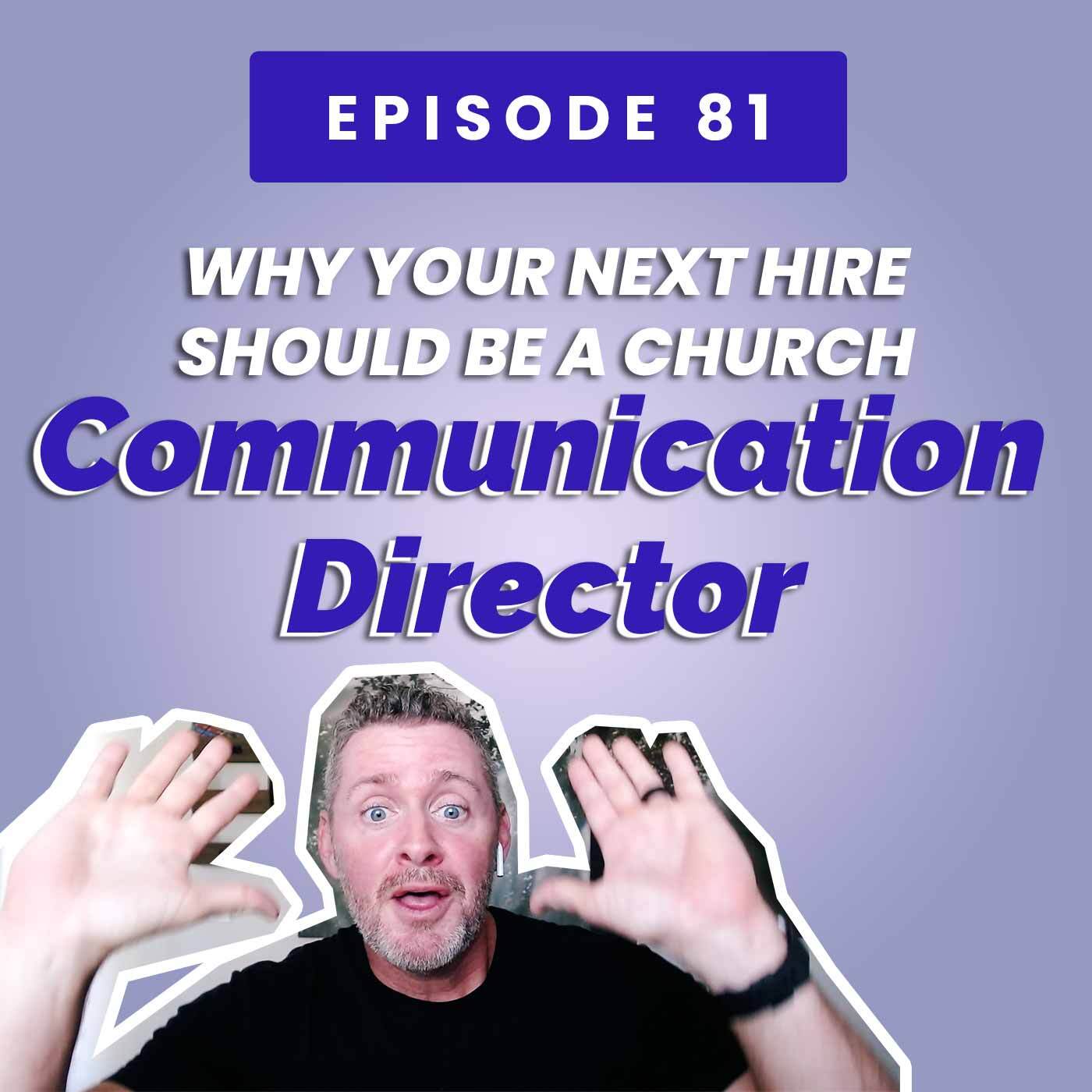
Speaker 0 00:00:00 A little over a year ago, I put out a tweet where I said the communications director is now the second most important job in a church. And I got a lot of pushback from that tweet, but I still stand by it. And in this episode today, we're going to talk about eight reasons why your next hire at your church should be a communications director. We hope this conversation helps your church to reach more people and grow. This is the reach right podcast. You're listening to the retried podcast. The show dedicated to helping pastors and church leaders reach people the right way, hosted by me, Thomas Costello. And with me as always is my cohost Ian Hyatt. We're here to help your church see more visitors and grow,
Speaker 2 00:00:58 Ready to get.
Speaker 0 00:01:03 Hey guys, welcome to the right podcast episode number 81. I am your host Thomas Costello. And with me as always is my cohost, the
Speaker 3 00:01:12 Hyatt. Hey Thomas.
Speaker 0 00:01:14 Hey man. How's it going?
Speaker 3 00:01:16 Going good. Going good little warm, little warm for a winter's day here in Austin, Texas, but I know that's a par for the course for you in Honolulu. So there you go.
Speaker 0 00:01:26 It, it definitely is. It definitely is nice warm, uh, beach weather, I would say. So we do get some change here. I will say like it does change from time to time. It, the, uh, the temperature on average is about a 10 degree shift between July and January. Uh, so, you know, cry, cry me a river,
Speaker 3 00:01:46 Uh, all of our listeners up north. They're very jealous of you right now. So
Speaker 0 00:01:50 Yes. Yeah, that's, that's exactly it so well, we have a good conversation today. Uh, it's going to be the title of the episode is why your next hire should be a church communications director. Um, I think this is a, an important conversation. I put out a tweet, uh, probably in like may of 2020, uh, where I said that, uh, because of the pandemic and in this new season, the church communications director became the second most important job in every single church. Uh, and I was met with all kinds of pushback and some people said, that's ridiculous, don't be absurd. And I don't know what their thinking on their ranking was or where you should rank people. But I stand by that. I still think that that is the case. I think that a, um, you know, maybe you'll, I'm sure for most of our audience that having a full-time church communications director as a standalone position, that's not something they can pull off, but I think really thinking through the elements of communication and making sure that those roles are assigned to somebody, uh, that is one of the most important things that you can do.
Speaker 0 00:02:57 And so, uh, as we've dug in and we've had some conversations, I think you agree with me on this, that just, this is a, this is a, a super vital role, uh, for churches all over, because everything is communication nowadays. I mean, that's like, everything is about how you communicate. There's so much ministry that, that happens outside of sanctioned the times at church and all the other communication and information that's passed along there. Uh, it is just, uh, it's, it's so vital. It's taking advantage of all that other time in the week there. So agreed. Yeah.
Speaker 3 00:03:31 Oh, totally agree. And I've, I connect with so many communications directors, uh, and, and I will say this, uh, I connect with more of them over the past several years, and I think this was something that was actually already, uh, becoming the case even before the pandemic. I would say, I think, you know, the pandemic accelerated, uh, the necessity for good communication and, and someone to handle that role. Uh, but, uh, because of the internet, because of just our modern world and the way that churches operate now, um, I think that, that I would argue that was the case even before the pandemic.
Speaker 0 00:04:07 Yeah, absolutely. No, I think you're probably right. It's just, we didn't realize it until after the pandemic. And we said, oh, no. Now we can't even communicate on Sunday mornings for a few weeks, at least, or in my case for 18 months, we couldn't communicate on Sunday mornings. And so, uh, you know, here we have, uh, this ability to communicate outside of that. So yeah, I think that's really it. So today what we're going to go through is, I guess you could take it as almost like a job description or some of the things that it communications director, what they can do, what they should be doing, some of those things for your church there. Uh, I think it'll be a helpful conversation, I think as we kind of brainstorm this and, uh, came up with those ideas, I think it's, um, I think it's for a lot of churches, it, you could see this as a full-time job.
Speaker 0 00:04:50 If you put all, if you did all of these things and you're consistently keeping all of these plates spinning in the air, uh, it is a big job for people to undertake there. So, uh, I'll go ahead and kick us off today. Uh, the first, I guess, reason why your next hire should be a church communications director, uh, is you probably need help creating church statements, screening your church statements. And by that, I mean, your mission statement, your vision statement, your core values. Uh, so we talk to churches all the time. Uh, and how often do we hear one of two things? It's like, we, we don't quite have our mission, vision core values worked out yet, or we have our mission, vision, core values worked out, but it was the guy before me that did that. And we're kind of thinking about changing them, right?
Speaker 0 00:05:37 That's like the two most common answers, very rarely do we hear someone say we have our vision mission and core values all worked out. We love them. We're proud of them. We use them all the time and they're working great for us. Uh, so I think that a, a communications director could really help you in crafting those and helping you think through that really important along with other people on your team, it's not going to be just a one-person job to do that, right? So that takes a lot of input from other team members, but even more important, they can help you make those be part of the vernacular at your church. It's something that people use all the time that it's used in all your communications, because we know that a mission or vision statements, they have zero value. If nobody knows what they are, right. There's no real use to those, if you don't ever say them. And they're just something, that's not a document someplace that nobody ever sees, it really needs to be something that's communicated. So I think that helping you to create and keep those, those statements alive, that is a really important role for a communications director.
Speaker 3 00:06:41 Yeah, I agree. And one of the, one other thing you made me think of as was taglines, which are big now for marketing and web, what you do on the web and how often do we, uh, come across a church? That's not quite settled on what they have, uh, or it's very linked. It's very lengthy. And they, they lean on us in our consultation to try to help them with that. And, and sometimes we can, but it it's, it's better suited, uh, for some communication director or someone, uh, communication wise would probably be better suited to think through that. Um, yeah, that's a totally agree. And that's probably a good segue into the, the next one. Uh, two is, is keeping your communication concise is something that a communication director would do. So, uh, we have had this problem and I say, we, your yours truly as well when I pastored and just in ministry life and, and every church struggles with probably staying on message and keeping things concise and consistent.
Speaker 3 00:07:42 Uh, we're very wordy also within, uh, churches are good. We have a lot to say, there's a lot that God has to say in the Bible. And there's a lot that, you know, all of that. So, uh, I know that that's something too, is that a valuable trait that someone who's helping with your communication should have is helping you stay on message. And, and, uh, and, and repeating that often, I know that that's, you know, it's probably something that we can get tired of of saying the same things over and over again, but it's, it's really important to keep a church on messaging and going. Yeah.
Speaker 0 00:08:14 Yeah. I think it's Andy Stanley, who has said that, like, if you, if you're starting to get sick of you, you saying your, your vision statement or your mission statement over and over again, that's probably a good sign that you're just starting to say it enough, because you gotta remember the more you say things like we know this site for this podcast, right? It feels like sometimes how many different ways can we talk or include calls to action? You know, are talking about call. Like, that's our thing for every episode is, although I don't think we have that one in this one, but call to action, call to action. That's when we always talk about, and we feel like, oh my goodness, we're talking about it again. It should be so obvious at this point, but we have to remember that people that even our most dedicated followers of podcast, you know, that they're, they may not be waiting or watching every single week.
Speaker 0 00:09:00 They might miss a week here and not have heard it for a few weeks. So if they hear once a month, that's talking about call to action. That might be okay. So same thing goes for your church. If you are saying your, your mission statement, um, uh, you know, over and over again, sometimes you think, man, people must be getting tired of hearing this in reality. They're not hearing it anywhere near as much as your saying it, it just feels like you're saying it a lot. So, and to your point about being concise and being, you know, really laser focused and we can tend to be wordy. Lord knows that, uh, I, I definitely tend to go that way. Um, I think that is such an important skill for a communications director or just people in general. I tell my kids that the most invaluable skill they're going to learn in, uh, in middle school, high school, it's going to be like the writing skills that they pick up there.
Speaker 0 00:09:49 Uh, and really, I find that in, in my job, I know I'm sure in your job, all the written communication that we do now, uh, that is so important. And if we are wordy and unclear in those things, it really can totally change the message and change people's experiences. So, um, if we're really serious about discipling people and reaching them for Jesus, the more clear we can be with our communication, with our processes, all those things, the better off we'll wind up being. So yeah, they help you stay concise. That's important. Yeah. Cool. Next one is they help you post on social channels consistently? Uh, this probably would be the biggest thing that a communications director can bring to your team as far as the actual time spent in doing this. Because I can't tell you, like it's a, it is a giant, um, a giant worm hole when you go into the social media channels and it can take so much effort and time and management and all of those things that go into managing a social profile to be able to really get those things dialed in.
Speaker 0 00:10:57 That's why, you know, churches will come to us sometimes and say, Hey, you know, which social channels should I be doing V the right answer to that is only the one or two that you can manage to do that you can keep up with. Right. And so if you're going to actively use these, I think for, we've talked about this before on the podcast about, um, Facebook, uh, you brought up be posting at least once a day. If you're going to be on Instagram, probably 3, 4, 5 times a week, if you're going to be on Twitter, you probably ought to be posting three to five different tweets. Every single day is how much it takes to kind of keep up with these channels and be using it adequately. And so, yeah, you can post less than that, but if you want to get the most out of it, you need to be consistently doing that. And that's a huge brand building challenge. I think for pastors who are pulled in a million directions already trying to remember to do that. And that's just the posting, right on top of that, you have all the interaction that actually makes social media social thinking
Speaker 3 00:11:53 Through what you're going to say. Yeah. I mean,
Speaker 0 00:11:56 Uh, a good, a good, let's say you do a, we talked about doing scripture graphics. That would be something that a lot of churches maybe you'll do that once a week. You have a, a plan where you do certain posts on certain days of the week. We had a whole episode dedicated to helping you think through that. But if you're doing a scripture graphic once a week, you have to think about what the scripture is that you want to share. You have to get into canvas or any other, uh, editor you're going to do and make the graphic. You have to get the post ready. You have to add your other sub post to it. And then on top of that, you have all of the, all of the comments and interaction that people are going to say. So every time someone says, Hey, I love that scripture. That means a lot to me. You want to write back and have a comment on that. Every time someone comments on Twitter, you want to retweet, and you want to do those things. And that is we're talking to do just those three channels, which are probably the most important for churches. You're talking about dozens of hours a week, I would say, of actual work. And so that's where a lot of this time might be going as to managing these kinds of these kinds of, uh, profiles and keeping your social media active there. So,
Speaker 3 00:13:02 And that's, that's why it's worth it. If you can, if it's within your church's budget to hire a communications director, or if it's not in your budget and your smaller church or whatever, to at least find someone on staff or someone heavily involved in the judge to do that consistently, because how many times have we heard that? And again, if you have a volunteer, that's doing amazing job of that and keeping up with it then. Great. But how often do we hear, that's not the case, you know, if someone was, maybe someone was maybe doing it for a couple of months and then it fell off and you haven't posted or anything,
Speaker 0 00:13:37 That's a good point. I, I would try to get that person cause it's such a big job. You're exactly right. Like, unless you have someone that is, that doesn't need other work. Um, I think that this is something you probably want to pay someone to do. Um, if you don't want to take it on as part of your own job as a pastor or leader of a church there, but I think this needs to be in someone's job description and know that 10 hours a week or something like that at least is going to be handle is going to be spent managing these profiles. That's really important.
Speaker 3 00:14:06 Yeah. Good. I'll get the next one. And this is a biggie too. It's a, you need this person, this communications director to help build your assimilation communication process. And I like how we specifically put that in the point that it's build your assimilation communication process, because you may not lean on a communication director. You may, but to build the whole assimilation process, but the communication process of it, the order of it, what you're saying and all of that, I mean, how many churches do you and I both consult and come across that as soon as we ask about what a church is doing for assimilation it's most of the time, I would say a work in progress, but something that is so vital to do for sure. So yeah,
Speaker 0 00:14:51 Yeah. The communication around it. I mean, so what we're talking about here is crafting, um, that sequence of emails that a first time visitor gets, or, uh, helping you think through the text messages that they're, that you're sending out to them and making sure that you really clearly communicate, uh, in each one of those pieces of communication, what you want somebody to do next, how they can take their next step into life with the church, all of those kinds of things I even would put into there, some of the language that you cover, uh, in whatever your starting point to growth track membership classes are. I find that most churches, they either just took whatever Rick Warren did with his class system and then modified it or took whatever arc churches offer and modified it and made it throws you. You probably want to have someone spend a little bit of time and making sure that those are really tailored for your church. And I imagine a lot of our audience are saying, yeah, you know, I've been meaning to get to that, but I just haven't had the time. Cause it's a big undertaking. I see this copywriting and just content creation is such an easy thing to back-burner for people. But it is so important. I think we all know innately that we have to get to it, but it is something that's kind of such a big undertaking that we're sometimes scared to kind of jump in on it with that. So, yeah, that's good. That's good.
Speaker 3 00:16:09 You're good. You reminded me that, uh, that, uh, our worship pastor at our church when the pandemic happened, uh, he, I was talking to him and he was just, he was like, you know, I was just doing worship before and now I've become a copywriter and a content creator and it's just not my thing. So again, better suited to probably a communication director. So that's good.
Speaker 0 00:16:30 Yeah, absolutely. I'm an agreement there. So, uh, next one is handle your weekly newsletter, your church newsletter. Uh, so many of our people we talked to, this is the king of the afterthoughts, right? The weekly church newsletter. It's just something that we have always done. We kind of have to do it. We don't like doing it. We don't really see any value in it. Uh, it's just something that we do to kind of make sure all the announcements we talked about on Sunday to make sure that they're an email form as well. Uh, and it has to be more valuable to you than that. If that's your only reason, find a reason to get rid of it. You don't need to do that anymore, but I would say that rather than just getting rid of it, you're better. Your best bet is to maybe change the purpose of your weekly newsletter there.
Speaker 0 00:17:16 Because I think that weekly newsletters can be very valuable. Uh, we've talked a lot about that on episodes of the podcast before, but really the purpose of this is to help people take that next step towards becoming a part of the church family or taking the next step to growing closer, to be more like Jesus, to move further in the discipleship process and growing in those ways there. So it is not just a way to talk about events. You need to be really thinking about this each week, weekend, and week out. And I think for most churches having someone that is the champion of your church, church newsletter and takes responsibility for it, that really is important. So, um, managing that, it's going to be a big part of their job.
Speaker 3 00:17:56 That's good. I don't have much dad. Their newsletters are still very relevant, uh, for sure. And, uh, and there's a lot to think through with that and communicate. So next one, uh, if I can tackle that, um, and this one might be one that a pastor says, huh, really? Uh, because it comes off as so technical, but that's have a communications director handle, uh, local SEO, uh, for you now SEO is a term means search engine optimization, but it's a term that a lot of pastors now are more aware of than ever before. You know, five years ago, I talked to a pastor like, no, what's that, uh, now most pastors are aware, have some sort of an idea of what it is, but being visible online when people are searching is extremely important. And there are some simple steps that someone doesn't have to be super technical for.
Speaker 3 00:18:45 Now, there's deeper steps that are technical and take some help. And, and possibly your communication director will want to outsource this work to, uh, someone or a company, uh, and be the point person to communicate with them because there is a lot of work with it in, in some technical pieces. But, uh, how vital is that now, uh, everyone is Googling everything from these, uh, and, uh, and, and you want to be visible there and rank well. So, uh, and it is time consuming much like the newsletter. We just talked about another thing. So having someone handle this as well, uh, is a good thing.
Speaker 0 00:19:22 Yeah. I think that what the communications director, what their role is in local SEO, it has more to do with what people are gonna read and see and hear about your church. So there's all the technical stuff of like, you know, getting your church listed on dozens and dozens of different directories out there and making sure you're using the right kind of key terms and those things. And so that might be something that makes sense to outsource, uh, to do that somewhere else. So what the key to local SEO though, just so our clients are, I guess our, our retried family here knows what this is about. Um, this is about, um, getting people when they search with a local intent. So they're searching for something like churches near me to getting your church to rank in the Google map pack. So the very top of most searches now is going to be the top three results that are right in their area there.
Speaker 0 00:20:16 And getting to rank on that. Now, the thing about that is that those people that when you rank on that, you are not typically going on to people aren't going on to your website from there, they see you ranking there and they'll see how to get to your church. They'll see the information you put in your Google profile. They'll see the pictures that you put on your Google profile. They'll see all of that information. So tailoring the way your Google business profile looks and the words you have on there. That really is a communications director's job to making sure that some of that same messaging, what you guys want to say about yourself is consistent. And it's put out on your Google business profile there. So that's the key thing. I would say, lots of others, things can be said about that. We in fact have a whole episode coming up next week. That's going to be all about the difference between local SEO and organic SEO, but just SEO in general for churches. I think it will be really helpful to everybody. That's listening to this one here. So, uh, that'll be good. Cool. Uh, next one. I'm sorry to something else there.
Speaker 3 00:21:14 No, no, I didn't. As a matter of fact, I was just going to say, I'm glad you pointed out other than the technical stuff that it is. It's communicating. It's, it's what people see and hear about your church.
Speaker 0 00:21:26 Yeah, that's it. So, all right. Next one, back to, um, you know, we're talking about Google business profile. This next one is that you actually need this person to manage your website content as well. Uh, the days where you had to have a technical master doing your church website, those are long gone. Now, uh, the, the average person that can edit a Facebook profile, uh, or they can get in there and put together tweets or edit word documents, they probably have the skillset, or at least with a little bit of help, they could figure out how to make normal content edits to a website. Now we're not talking about building a website, that's a different beast, and that might be a different skillset. But when it comes to the once a website is built, most of your work is going to be in continuing to keep content.
Speaker 0 00:22:14 Up-to-date always adding new content. That's all part of that. So the main ways this happens for churches is adding sermons, adding events, and making any other little changes that have to happen on your church website, but sermons and events. Those are the two big things. We really encourage her just to blog as well, too. I think if you have leaders blog, that is great, but here's the thing is you need your communications director to help you make sure that the content on your sermon posts your event posts is totally and perfectly dialed in the right way. So like sermons, we talk about this, that one of the biggest mistakes we make is just putting the video out there and a title and letting it speak for itself because you need to actually have more content than that. If you want people to be interested in clicking on it, to dig in deeper, to want to listen.
Speaker 0 00:23:03 So you really need to be thinking about what you want to say on each of these posts. Same thing goes for events, how we know from doing church announcements, that if you just say, Hey, vacation Bible schools this week, it starts on Monday at nine. If you just say that, no, one's going to come to VBS this year. Right. You know, talk about why it's important and the reason behind it and why we do it and how we need volunteers. And so all of that needs to be reflected the same way on your website when you're creating events, a communications director can help with that.
Speaker 3 00:23:31 Yeah. And there's been a saying in the web world for years now that still holds true. And this was the case, uh, what almost 15 years ago, when you and I first kind of got into this industry, that content is king, right. Uh, and I think now churches understanding the importance of your website and social media and everything that you do online contents become even more important because you know, it used to be that, okay, can we just get some people to get onto our website and, you know, just have some basic information there. It's more in depth. Now what you're saying to who you're trying to reach and communicate to is vital. So having someone think through that, so that's a more important now, that's it so good. I'll bring us home last. One's awesome. Not least last but not least is you need this person to help create video content.
Speaker 3 00:24:19 That is so vital now. And, and I think most people know that, uh, I still though just, I can't even tell you how many, not just church websites, but when I look on a church's social media presence as well, just the lack of video. Now, I say, I will say, churches have done a much better job of, uh, uh, boosting this and stepping up to the plate with this since the pandemic. Um, because uh, churches knew we had to get online and for people to watch our services and to connect with people. So we've seen an increase in video and even, uh, not just with sermons, but there's so many different, uh, creative things you can do with video, but people are visual. That's nothing has changed to especially, uh, you know, your millennials, gen Z ears and on, uh, even more visual than, than, than we are as a, I guess you're, you're barely a millennial. I'm barely a gen X-er, I'm, I'm almost a millennial by one year, but anyway, uh, so all that being said, even for us, it's important, but I think for this next generation, I mean as much video content, uh, out there this, so you need someone handling this. So it can't just be a sporadic video once a year. Yeah.
Speaker 0 00:25:31 I just thought this is kind of an aside, but I just noticed that you talked about, I think five years ago, we will all would have been like, I'm not a millennial. One of those millennials, those guys are like, they had all those. We just made fun of their butts of all jokes, where millennials. Right. And now our tune has changed
Speaker 3 00:25:47 Man buns and onesies and all that
Speaker 0 00:25:51 Tune has changed nowadays where it seems to me, like you're saying that, you know, I, I, I'm not a gen, a bear, almost millennial. I I'm, I'm kind of like a millennial at heart, not really a gen X-er so much. So
Speaker 3 00:26:03 Our said that until I turned 40. So
Speaker 0 00:26:08 There you go. Um, so for videos, I think a couple of ones, just so our audience knows what we're thinking about. Um, these are videos like a welcome videos. Those are great on your website. So like a 62nd video, I think a communications director can help you really hone in because really it's about being concise and clear if you have 60 seconds, because no, one's going to listen to a nine minute welcome video. You want like a one minute, maybe 90 seconds, something like that being super concise. And cause you really only have like five or six sentences you can get out in that time. So making sure that you really hone that in and say exactly what you want to say, that's big. Uh, we're seeing more and more churches doing kind of a explainer videos for some of their key ministries, youth ministry, children's ministry.
Speaker 0 00:26:55 Men's, women's those kinds of things. Uh, again, short videos, but helping you really craft that message, a communications person to do that. Now they're not going to necessarily have, maybe you'll get one and you'll have a unicorn that does all the video editing and all that stuff too. But in most cases you'll need someone else to do all of that. But really it is two different jobs. It's it's, it's like thinking the person filming in Hollywood, is it the same guy writing the script? And that's not the same guy doing the editing, right? So these are two wildly different skillsets, the editing and creation of videos and actually creating content and writing the scripts for these videos. Totally different skillsets, totally different sides of the brain. I wouldn't even say one's more of a creative, one's more of a technical skill set. So yeah, your current, your creative, I'm sorry.
Speaker 0 00:27:40 Your communications director is going to be the person who's going to be great for something like that. That's good. Good, cool. Well, good. Well guys, thank you so much for being a part of our retried family. I hope this has been a helpful conversation to you. I hope that you can, or you start to consider how you could maybe incorporate a communications director onto your team there if you don't have one already. I think even if it is, if you only have the budget for a volunteer person, getting someone to start to champion these areas, that is one of the most important things that you can do. So hopefully this conversation was helpful on what that job is going to look like. If it has been helpful, it would mean the world to us. If you would rate, review, subscribe, let us know in the comments, if it has been helpful to you, we want to thank you so much for being a part of our retried family. And we hope to catch you next week. Thanks for listening to the reach right podcast. We hope this episode will help you reach people the right way, looking for more resources for your church. Check us out
[email protected]. If this episode has been helpful to you, it would mean the world to us. If you would rate, review and subscribe on iTunes or wherever you get your podcasts. Thanks again for listening. And we'll see you next week.