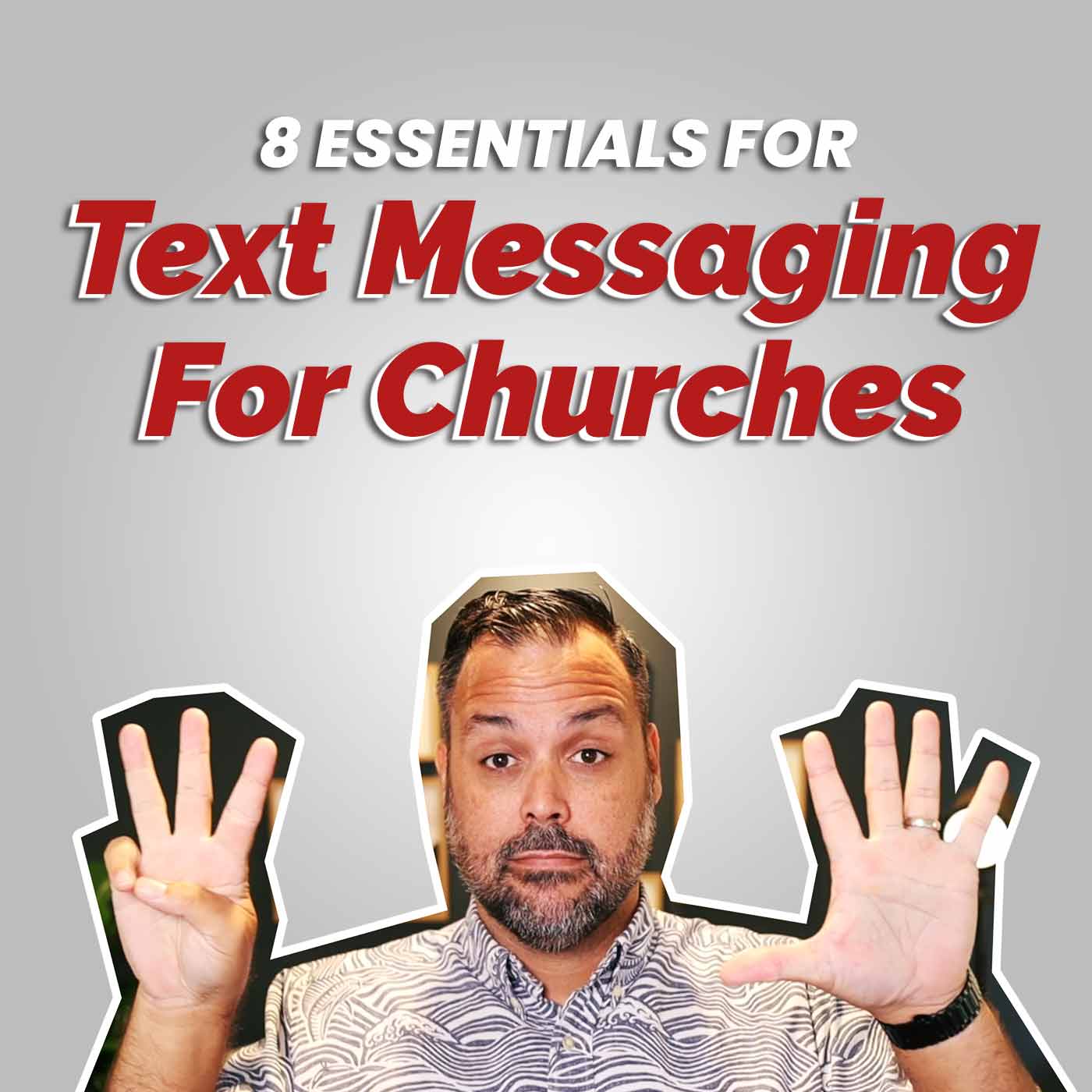
Speaker 0 00:00:00 Well, nowadays just about everybody uses text messaging, but the real question for us is should churches be using text messaging? Well, we think the answer is probably yes, but we have a few caveats. And in today's episode, we'll talk about eight essentials for text messaging for churches. We hope this conversation helps your church reach more people and grow. This is the reach right podcast. You're listening to the retried podcast. The show dedicated to helping pastors and church leaders reach people the right way, hosted by me, Thomas Costello. And with me as always is my cohost Ian Hyatt. We're here to help your church see more visitors and grow,
Speaker 2 00:00:54 Ready to get ready to get funky.
Speaker 0 00:01:02 Hey guys, welcome to the retried podcast episode number 91. I am your host Thomas Costello. And with me as always is my co-host
Speaker 4 00:01:10 Ian Hyatt. What's up Thomas.
Speaker 0 00:01:12 Hey, not much. He had man excited to talk today, uh, to talk to you in person, because today we're going to be doing the talking about the main way that people talk nowadays. It seems like now you and I are from a time where, when we were younger, we would have to call people on the phone. And today we're going to be talking about the new way that people primarily communicate. You're talking about text messaging for church's eight essentials for text messaging for churches as our topic. So, um, I don't know, like when text messaging started, I don't know if you're like me or not, but I was text message resistant when it first started. Right. I was like, why would I text someone? I'll just pick up the phone and call
Speaker 4 00:01:53 Them.
Speaker 0 00:01:54 And I have become a, I think like as of like 10 years ago, now I've become a full fledged convert. So the world of text messaging, or I would absolutely prefer to receive a text message than having to talk. And I'd much rather send a text message than top grade.
Speaker 4 00:02:09 Yeah, agreed. I'm the same. And I started out resistant to, uh, and, uh, but, but I, it quickly started making sense. So
Speaker 0 00:02:16 I'm that way with everything though, if I look at my life, I was probably, I was on my space and I was Facebook resistant and I was like, oh, I don't know if I want to make the leap. I'm already on a social network. So, and then I became Instagram resistant cause I'm already on Facebook. And I'm, I'm, I'm still in the very firmly in the camp of Tik TOK resistance on a personal level. Uh, so, uh, or Snapchat resistance. So maybe that's just part of getting older that we do that. But, uh, I have, and I imagine our audience has, and certainly the churches that they lead have all fully embraced text messaging. Uh, and I think churches probably took a little bit longer to adapt to tech, to text messaging. Then we did on a personal level. I imagine a lot of our audience doesn't really rely on text messaging right now. I know, uh, I last pastored a church about two and a half years ago now. And we did some text messaging, but it was very, very small, like the small, a very small amount of text messaging. I don't know that we had a lot of this in place. The stuff we're going to talk about today, the essentials for text messaging here. Um, I don't know. Tell me about your church. Do you got, is a lot of your communications done via text now? Or has it been
Speaker 4 00:03:29 Yes, it is. And I actually that's. That is it we'll dig more into the specifics of course, as we go, but that's the method of communication that I prefer to get updates and, uh, events and things that our church is doing. So yeah, our, our churches fully embrace that. It's been been something that I'd actually say in the last couple of years. We've vamped more, more up on that, um, on, on texting. Yeah. So
Speaker 0 00:03:53 I think the pandemic maybe, maybe move people forward with that a little bit. It was probably helpful to, uh, to, to people in that season for kind of quick communication. Um, but there are a lot of mistakes that we see churches make too. We'll get into some of that a little bit, uh, in just a second there. So, um, but what do you think, let, let's talk, I guess before we get into these essentials, what, um, w do you think that, is that what people want? Like it, would you say that that's, that's the preferred way for most of our audience to connect with their church now?
Speaker 4 00:04:24 Well, I think, I think it depends on what, what it is you're communicating, right? W what is the reason for a text over an email per se, or a phone call, but I would say in general for most things, I think so. Uh, it's it, and I think we'll dig into more of the reasons for that, but, uh, uh, but the first thing that comes to mind is quick and convenient. Um, yeah,
Speaker 0 00:04:50 I think you're right. I think that we, we saw some studies here that, um, that like, when it comes to business communication that this, this is interesting, this is from Statista, they did this study and they said that 25% of smartphone users, which is everybody basically now are at most adults, uh, 25% of them prefer getting business messages via text. So that it's kind of a sacred space still. Like, I, I feel like the reason why a lot of us like texts so much more than email, uh, is because our email, if it's anything like yours is like mine. It's like 90% of it is not on a personal nature. It's not someone directly that I know talking about something personal with me. It's usually more like, you know, it's, I probably get 50 different promotional messages every day, 10 messages that are automated from forums or social media, that kind of stuff. And then maybe a couple that are just on a personal level, like someone that typing out a message that was specific to me. And that's the thing about text messaging is if I scroll through my texts, you know, most of them are personal texts. Uh, you know, occasionally businesses will do something like I went to a restaurant the other day and they say, go wait for your table. And then they send me a text with my travels ready. It's a one-time thing. I'm not getting, you know, daily special texts from them about, Hey,
Speaker 4 00:06:11 We have a booth open right now. We have another table open.
Speaker 0 00:06:14 Yeah. And so I think that the statistics seem to stay that there is a little bit of hesitancy for people, um, when it comes to text messages from businesses. Now I know that churches are not businesses. And ideally people will think of messages from your church as something from a, a person. And it's something that they have an actual relationship, but we all hope that people want to receive our text messages when we send them. But we feel that same way about church emails, right? Like that we all hope and wish that everybody would open every single church email that we send. But the statistics show that, uh, if you get, I don't know if you get 10% of people clicking on a link in your email, that's a huge win. So I don't know. I think I'm a little bit, um, I think the statistics don't bear out that I think that there's just some best practices. That's why we have this whole episode today that if we embrace these things, we're going to talk about, you can do text messaging in your church, I'd say more successfully. Uh, I think that it's something that, uh, that I think we can, we can kind of overcome some of these objections that people have and make it something that's worthwhile.
Speaker 4 00:07:18 Yeah. That's I totally agree.
Speaker 0 00:07:20 Cool. All right. Well, why don't we kick it, then we'll go into the eight best practices. Why don't you kick us off with the first one?
Speaker 4 00:07:26 Yeah. First one's establish a texting policy. So I think that is good because as we're talking about there's, uh, when we were just differentiating between email, phone calls compared to texts, I think since it is relatively new and just like for anything that we decide to facilitate in a church as a practice with our members or new people, um, it's good to have a plan and have a policy. Okay. This is what we're going to make sure we text for. Um, you know, is it going to, you know, is it going to be mass texting if it's mass texting? Okay. How's that going to be used? What's the policy for that? Um, compared to like, if it's a ministry leader, individual ministry leader, texting someone like a men's like, for example, my men's pastor at our church he'll send me direct texts sometimes. And those are more,
Speaker 0 00:08:15 You know, that he typed that out on his phone himself. You're saying. Yeah.
Speaker 4 00:08:18 Yeah. So, and so, but it's not so much just the methods we're talking about, have a policy about each method, I guess, is what we're saying.
Speaker 0 00:08:26 Yeah. Yeah. I think it's so important to write something down before you start doing that. I think that personal text messaging is totally fair game. Right. So I think if a first time visitor comes and you have the time to type them a personal message as the pastor or a leader in the church. Yeah. Great. Go ahead and do that
Speaker 4 00:08:43 Have a policy to not hound them? Yes,
Speaker 0 00:08:45 Absolutely. We'll talk more about that in just a second, but I think that personal messages, those are almost always fair game, have a policy about it, but I think the policy really comes into place more with, uh, what are we going to text about, um, when, when will we do texting and we'll talk more about some of these things in these best practices here, but this is making sure you have some of this stuff written down, because what I've seen happen at churches is that especially at a large church where you have multiple ministries and someone might be involved in serving in youth ministry, they're in the women's ministry. They also do a missions on a missions team there they're on the worship team. And so they're getting messages that are general church messages and worship team messages and youth ministry messages. And after a while, they're getting four or five different text messages a day and they just kind of drown in them. So the less you text, the more impactful each message is going to be. I think that's really the, when it comes down to. So having a policy that helps you sort out when we're going to text, when we're not going to text, how often we can text those kinds of things are really important. I'd say
Speaker 4 00:09:47 That's good.
Speaker 0 00:09:49 Awesome. All right. So get a policy. Um, second thing, and this is one that I think a lot of churches skip, uh, is get permission. I think it's really important that when you start a, a text messaging, uh, campaign, this is more for the automated ones. I think you probably don't need to have permission to write a personal message from your phone to somebody else's phone. That's probably okay. But I think if you're going to put somebody on a distribution list where a text will go out to the entire children's ministry team or the entire church who's interested in advance, I think you want to be really careful with that, and it's not acceptable to have everybody that has ever given you their phone number beyond your text messaging list here, because there are visitors that came one time two years ago, and they don't really need to know about what's happening with kids ministry and the Halloween party that's happening. This paper,
Speaker 4 00:10:39 I'd be a little taken back. Uh, if you know, my son who's in fifth grade, you know, I got gotta, I got a text message. Hey, Luke's invited to this. I'm like, what, what, you know, without, without giving permission, I'm like, who's, who's inviting my son somewhere. Right.
Speaker 0 00:10:51 So, yeah, exactly. And it can
Speaker 4 00:10:54 Come off as spamming too when you don't give them rent because
Speaker 0 00:10:57 Absolutely. I think that's where big goals. Yeah, go ahead. I'm sorry.
Speaker 4 00:11:00 Oh, I was just going to say, we get plenty of, you know, there's plenty of spam emails, but now that is increased big time with texting too. Uh, my phone blocks, uh, you know, several spam texts each day. Yeah.
Speaker 0 00:11:10 Yeah. So here, I think about the way we do it here at reach, right. Um, so we don't have like a, we're not text messaging, everybody that ever, uh, gives us a request, some information we're not putting them on some kind of a, a long-term Texas. The only time we really, I know you personally write texts to people all the time where you're typing them out and that's fine. And then when people opt in for like text reminders for appointments and those kinds of things, we, we will automatically send those, but really having some kind of a system where people will opt in and get permission. I think that's really important. So the ways you can do that, um, wherever you're getting a phone number, you can have a simple checkbox that says, Hey, I'd like to, you know, send me texts, information, or email and text updates about what's happening there. You could have them check a box in that way. Yeah.
Speaker 4 00:11:57 I think sign up form like an online form from there too. Yeah,
Speaker 0 00:12:01 Definitely. But I think for some of our, for a church that maybe you're not doing a lot of texting right now, um, if you're going into this or you're going in for the first time starting to do some more mass texting or automated texts for churches, I think if you're under 150 or 200 people, you can probably take a look at people in your church and start your list with the people that you think will be okay. And I'm not here to give legal advice. You know, I don't, you know, I guess legally you should probably give everybody in your church a form that says, yes, please opt me into text messages and those kinds of things. But I think that for the most part, if it were me and my church, I would take a look at the people that are regularly a part of what we're doing at our church and get that. And then from that point on, I would invite new people to opt in, right. When they're filling out connection cards, when they're filling out online forms, those kinds of things. And I would go from there.
Speaker 4 00:12:50 Yeah, no, that's good. I think it's a good segue into the next one too, is that once you get that established, you know, um, you need a good message introduction. Um, so again, once you have the permission and everything, uh, it needs to, again, getting back to like, you know, spam and you don't want anything to be vague. You want to identify when you send that text, whether it's a mass text or whatever, a group text or whatever you would set up with this, there needs to be an introduction church's name, uh, obviously stating that, that, you know, this person has, uh, decided to opt in for, uh, text messages that there's help and stop and instructions and all of that thing. So that makes it official obviously and more valid. Yeah.
Speaker 0 00:13:32 Yeah. I think that that most churches in my experience, miss the how to opt out, and I think that's really in writing because if you're not doing that, you're getting numbers blocked. You start to get your text messages not delivered the same way. There are spam filters that work with text messages too. Otherwise we'd all be barrage. These are all done, not on our level, but on like the provider level. So I know that I use a Google five for my wireless plan. They filter out a lot of the worst messages that I'm getting. Yeah. Text message wise, because it would be just berated with that. But yeah, so, you know, we've all got them from big companies before where it'll say, Hey, text this to stop, text this for help, uh, text this, uh, or standard messaging rates may apply some of that kind of stuff there.
Speaker 0 00:14:21 All of that is to kind of cover you legally. But I think at a minimum, helping people know how to opt out, uh, if they've come one time and they're starting to get these things, they thought they wanted it, but you're texting them too much, giving them the answers on how to do that. That's important. And it's probably, it's actually a legal requirement that you do some of those things too. So again, not legal advice. We're not here to do that, but take a look into what the requirements are. I think you're right. An introduction is a good idea. Yeah.
Speaker 4 00:14:45 Good. Why don't you tackle the next one?
Speaker 0 00:14:47 Yeah. The next one is pretty simple, but something you need to think about is you need, make sure you're texting during standard business hours. Uh, I would recommend not texting. You could probably stretch it a little bit into the evening, but I probably wouldn't text before 9:00 AM. I probably wouldn't text after 7:00 PM. I think somewhere in that range is reasonable, uh, for, uh, for these kinds of messages here. Uh, I know that seems pretty self-explanatory but let me tell you this. Uh, if you have a, if you're a church that has a, a large online audience recognize that not everybody is there in your time zone, and I'm aware of this in Hawaii, uh, I can't tell you how often I will get messages from people, even though I have a Hawaii area code and it should be obvious, but I get calls or messages at 5:00 AM, 6:00 AM. They say, well, it's business hours and on the east coast here. And so let's give them a call, not thinking that we're six hours behind. So 9:00 AM, there is 3:00 AM here in Hawaii. So I know this is not for most churches because most of your audience is going to be their local, but more and more we're connecting with people and we have, if you're doing it right on your online services, you probably have a call to action where people can give you their information and maybe they'll opt in text there. Just make sure that you're aware of where they're located and think about that. Yeah. If someone is, uh, far away or in a different time zone from you.
Speaker 4 00:16:09 Yeah. That's good. Not nothing much to add there. I think that's just a, that's a good practice, right. With a lot of things is within normal business hours respecting people's time off at the end of the day. I know even sometimes I get personal text messages into the evening, I'm already kind of checked out for the day and, you know, want to take a little bit of break from responding and doing much or, you know, so it's obvious it's kind of common sense. I should say stuff, so,
Speaker 0 00:16:33 Yep, absolutely
Speaker 4 00:16:34 Good. Next one is use a standard greeting. So, um, yeah, so, um, something funny comes to mind when you and I were at a pass company, there was a, uh, there was a representative that was on our staff that would greet people over the phone without kind of a standard Sally greetings and salutations
Speaker 0 00:16:53 To use a standard human greeting,
Speaker 4 00:16:55 Right. Instead of just, uh, you know, name someone's name, right. So yell out, he'd yell out their name, you know, Blanca and, uh, and people wouldn't, uh, who, who is, this is gonna be the next comment he would get. And so, you know, same thing with texting etiquette, use standard, uh, greeting to avoid a confusion too. And, uh, so that people know it's valid. So
Speaker 0 00:17:19 Yeah, I think that, uh, you got to remember that when you're doing a text message, a lot of people don't have your church number, uh, whether you're doing a short number or a long number of different ways, you can do text depending on what service you're using. They, a lot of times won't have that saved in their phone. So if you're using it through a mass texting system or through your church management software, whether it's planning center or fellowship one, or any of those, what will happen is that it'll just be five digits and nobody has saved those five digits and they'll just get something. So if just a, if you go right into the message, uh, they'll not, they'll be like, who is this person or who is this? That's texting me right now. So always use, Hey, uh, this is, uh, Thomas here from first Baptist or whatever you would say, but make sure you have a, a personal greeting at the beginning of every single one of these messages, don't assume that after 40 of them, that they've saved you into their phone or that it's in there, they'll, they'll, you'll want to have a greeting there every single time.
Speaker 0 00:18:15 So yeah, I think you're, you are exactly right. I will say this with, so we, we have, and I'll give a little bit of something we've learned over the years. And I don't know if this really applies to churches, but we've talked about this when we are trying to engage with someone who were having a hard time connecting with, what did we find was the best way to start a text message to get someone to respond? Do you remember
Speaker 4 00:18:39 Put their name with a, with a question mark
Speaker 0 00:18:42 With a question mark. Yeah, exactly. So it's, that's something that I, I'm not, I don't think churches would be using that unless you're, um, maybe if, if you've sent for six or seven text messages to someone and haven't gotten a response from them on a personal level, like if you sent them, you thought you had the right number, you know, writing, Hey Joe, question mark, and then see if they respond. But yeah, I think that in general, using your whole church, your church name greeting is going to be important every time.
Speaker 4 00:19:10 Yeah, that's good. That's good. I think you got the next one.
Speaker 0 00:19:12 Yep. Next one is keep messages short and sweet, uh, text messages. Aren't a good place for long prayer request detailing the life support situation of someone that's in your church or trying to organize meal plans and giving a long list of who's on Wednesday and
Speaker 4 00:19:29 Emails. Thursday.
Speaker 0 00:19:31 This is not what text is for Texas for short sweet. Think of it like a tweet. Basically you should never be sending text messages that go into multiple texts. Yeah. So, um, as a general rule, you're looking at, uh, you know, maybe 140 characters. So something short, um, a quick announcement, a quick thing you need to know, those are the kinds of things that we're looking for in here.
Speaker 4 00:19:53 Yeah, that's good. I'm excited about the next one here, which is use emojis sparingly. Um, we've talked a lot about how emojis are, uh, I know you're you were saying how you were <inaudible> uh, and a lot of ways I'm, I'm not anti Moji, but I, I, I'm not like numerous emojis and texts or anything like that. I'll throw in one or two same applies here is keep them sparingly here, especially with this type of a text message. I mean, maybe when it's a personal thing with your friend and you're laughing, you can find the, the laughing with the tears coming out into the other emojis that they, uh, that you have with that. But here you want to keep it pretty simple because you can clutter things up. And, uh, and also in that that's in the vein of what you just said, keeping it short and sweet.
Speaker 4 00:20:39 Um, but the reason I was kind of excited about this is I remember when my daughter who's, you know, teenager got her phone for the first time and she was texting with her friends. I would see like when we were seeing her messages and helping her with the phone and everything, uh, like 10 different emojis, like 10 different emojis. And, you know, it would be a heart, it would be a smiley face, but then it would be an upside down smiley face and a Palm tree. And I'm like, what does this all mean? What is someone communicating with 10 different things? So, you know, it made me think of that, keep them, they, they do add, um, you know, personality, uh, and they keep things lighthearted, you know, I use emojis and emails to our clients and those things and, and, uh, uh, but I, I guarantee you, I'm not going to do a lot of them, uh, and the same thing here. Um, so it's, uh, it's good to use them sparingly.
Speaker 0 00:21:29 Yeah. We've gone from like the days of the hieroglyphics of the Egyptians all the way back to the 2022 and your daughter making hieroglyphics on her, a text messages, using pictures to tell stories on there. So crazy world that we live in. Yeah. You know, that I'm, I'm not personally, I don't send a lot of emojis, but all of our research shows that emojis actually get results when it comes. If your goal is to engage people, which it should be in a church, you want to engage with people, emojis make you more personal. Uh, and I think that they'll give you a better spot. So I don't recommend having entire messages in emojis. Uh, but I think having an emoji, every few messages or a couple of emojis, every few messages that's probably appropriate. Uh, and we've done a lot of research. Like I said, with our email marketing, at least emojis in subject lines are killer. They're really great at like, you put an emoji in your subject line on an email, you're going to get a much higher open rate on those emails. So we they're proven to work. Uh, but I think that you can do, you can definitely overkill and do do too much there.
Speaker 4 00:22:35 It's funny, I'm thinking of our church here that the last mass text message I got was for a men's night, like a man, a man night is what we call it. And we do a lot of stuff geared towards men's ministry and a big event and all of that. And it was a very, especially with men, you know, do you even want to keep it more simple typically is what, uh, I would think. But, uh, I was just picturing if they would have done, uh, you know, it's man night put a picture of a man invite one of your buddies and they show another man with another man. And then they have like, um, you know, a calendar emoji and check mark that had been too much. So, but
Speaker 0 00:23:09 All those things I mentioned in my mind.
Speaker 4 00:23:10 Yeah. Yeah. So maybe have a man or a muscle or something like that, but yeah, not too much. So yeah,
Speaker 0 00:23:17 Something like that seems appropriate. So, yeah. All right. I'll bring us home here today. Uh, so the last one is, keep your messages relevant and timely. Uh, so you probably should not yet be sending Easter, uh, T emojis or Easter emojis, Easter texts now. Um, probably not Easter emojis either. It's a little bit early, even though it's only a few weeks away. Maybe if you're trying to get remind people a time to invite is now those kinds of things. Uh, but it's not, it's not something we should be using, uh, over and over again for multiple reminders. It has to be something that is timely and actionable. Like now, if it's just something we want someone to be thinking about, it's probably not the way text messages, isn't the way to do it. If there's an action to take today to come. So if you're going to be talking about your services, for instance, you're going to send a text message the time to do that is on Sunday morning or on Saturday night, like right before. So people can start to get ready or get on their way there. If it's a reminder to serve, it's going to be, uh, at a, at a very timely time. It's not here's one a week in advance. Here's one, three days in advance. Here's one an hour before. So you want to be timely and keep them really relevant and make sure everything kind of is staying in that vein.
Speaker 4 00:24:33 It's good. It's good
Speaker 0 00:24:34 Stuff. Awesome. Yeah. Anything else to add about text messaging as we close up?
Speaker 4 00:24:38 No, I think, you know, I think it, it just, I think for most churches, it makes sense. I think based on what we've shared, I mean, and it's not to say you can't be effective without doing texts, but we hear from more churches asking us about this. And, and uh, I think that, uh, to, to get, I specifically personally loved them for updates. There's more that you could do too, but it's this they're quick, they're short and they, they keep you top of mind. So
Speaker 0 00:25:02 Yeah, I think for updates, they're great. And I totally agree. I think that everybody loves the personal ones though. I think you'd like that, that's something that is always okay. And so if you're not, I know there was some hesitancy for people to send text messages on a personal level to people for awhile. I don't want to bother them with a text message. I think it's okay. I think people prefer that and they want that. So if you're on the fence about it, start using it personally, consider using it, uh, for mass things within your church, therefore updates those kinds of things. But yeah, I think it's a pretty big opportunity. A lot of churches can take advantage of, so we hope this has been helpful for you. If it has been helpful, please rate, review, subscribe, let us know in the comments. I want to remind you guys that a lot of our episodes are kind of listener and watcher generated. So if you have any questions or things you want us to cover, or maybe topics that we're not letting we're not discussing here at the retreat podcast, let us know in the comments below, we'd love to consider it and maybe add it in and we'll even give you credit. If it's something that you recommend that we wind up doing an episode about it. So thank you guys so much for being a part of our reach, right family, and we'll catch you next week.
Speaker 0 00:26:12 Thanks for listening to the reach right podcast. We hope this episode will help you reach people the right way, looking for more resources for your church. Check us out
[email protected]. If this episode has been helpful to you, it would mean the world to us. If you would rate, review and subscribe on iTunes or wherever you get your podcasts. Thanks again for listening. And we'll see you next week.
Speaker 2 00:26:38 I guess